
Second Peter 2:1 talks about false teachers denying the Lord who bought them. What does this mean?
First, note that Peter says these false teachers bring heresies,which, as we have seen previously, refers to divisions within the Body of Christ.
And what is it they teach which brings these divisions? According to Peter, their primary error is that they “deny the Lord who bought them.” Most translations render it in such a fashion, but I must say that such a translation is hopelessly weak.
Denying the Master who Redeemed Them
A better translation might be, “denying the Master who redeemed them.”
The word Peter uses for “Lord” or “Master” is not the typical kurios, but is rather despotēs. It is where we get our word “despot,” which has more negative connotations today than it did in Peter’s day. Back then, it referred to a Master who owned slaves.
The word “bought” is the Greek word agarazō, which in a Master-slave relationship refers to being redeemed (cf. Rev 5:9, 14:3-4). So what is Peter saying? He writes that these false prophets, these false teachers, these bringers of divisions, have been redeemed by Jesus their Master, and yet, as shocking as it sounds, they have the gall to deny Him!
Denying Christ
And what is the significance of their denial? Here is where the text gets even more interesting. The word that Peter uses for “deny” is arneomai, which is exactly the word used in the gospels when Peter denied Jesus (cf. John 13:38; 18:25, 27). Certainly when Peter wrote this sentence, he was thinking of his own earlier actions and behavior in denying his Master who redeemed him.
And if the words of Jesus in John 13:10-11 where He says that Peter is already “clean” means that Peter was justified and had eternal life, then what all of this means is that Peter recognizes that it is very possible for a redeemed and justified follower of Jesus Christ to be a false teacher and deny their Master, just as Peter himself had done.
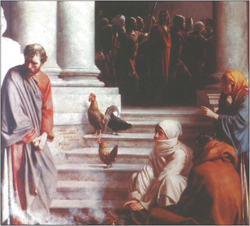 Though Peter seems to indicate his belief that the false teachers he has in mind are unregenerate (2 Pet 2:17), the denial of Jesus by Peter himself reveals that it is possible to be regenerate and still deny Jesus.
This is actually quite a relief, because when we sit back and honestly consider what false teaching is, we realize that every single person is a false teacher to some degree or another. How thankful we can be that God does not require 100% doctrinal accuracy from us in order to be given eternal life and live as citizens of the Kingdom of Heaven.
False Teaching
So what then is the message of 2 Peter 2:1? This verse reveals that there is such a thing as false teaching, and we do have a responsibility to warn them and others about their teachings.
However, we must remember that in some way, all of us are false teachers. The real tragedy of false teaching, wherever it is found, is that it divides the Body of Christ, and causes those who believe it to deny the Master who redeemed us.
But in regard to participation within the church and the centered set approach to ministry, these false teachers are still allowed to eat meals with the other believers (2 Peter 2:13), and possibly even teach when the believers gather (2:18-19).

Great stuff. I’ve always been concerned about people who throw the False Teacher around at others while never considering it may apply to them sometimes as well. It’s always humbling to know that I too am capable of teaching incorrect things about Jesus and dividing the church. Theology should always be accompanied by humility.
Seth,
Yes, it is humbling to remember that we are all wrong in some areas, which is why we need to listen to each other and be challenged by one another.
Yes, false teaching can cause division, but need not. I have observed that many things can cause division, but often the real cause for the division is not the stated cause. (I have a story about two groups that divided over the color of the carpet – the stated reason – but of course not the real reason.)
Usually the real reason appears to me to be closely related to who is in control, who is in charge. This is not to say that if part of the group “leaves” they are the ones being divisive. Perhaps they were forced to leave. Perhaps both groups chose to be divisive and they felt the only solution was a parting of the ways.
When someone disagrees with me, I usually say something like “Obviously we don’t agree on this. I don’t see that as a problem. I don’t need you to agree with me.” Some people accept that. However, there are those who are convinced that their point of view is “right” and that I and everyone else “must” agree with them. Those who are divisive in my experience always fall into that group.
Sam,
I think that is a good response when people disagree. It shows that disagreement need not threaten the relationship, but love and unity can still exist for the sake of the Kingdom of God and living like Jesus in the world. But you are right, some people simply cannot exist with this sort of relationship.
I agree with you all. There are many divisions in my Church caused mainly about control. This has caused a massive financial cricis as we have no one actually managing the money, everyone thinks their ministry is the most important and because there is no forward thinking, there are no warning signs to not just keep spending. The annual income in our Church has risento about £450,000. The treasurer has been with us for 30years and has never thought she needed to do some forward planning and does not like to be asked the question. Why have we a short fall every year. Our next council meeting may be an angry one and could end up in her resigning. Maybe that’s what’s needed.
We have been living in an unreal world where bully boys have been allowed to reign, pray that I will keep my cool and not be put off course. Clive
Yes, this happens all too often in churches of every size, shape, and creed, and it is difficult to overcome.
I hope that as the church decides what to do with the money, you can all maintain the peace and unity of Jesus Christ. It will be difficult to cut some budget items!
Thanks for that; refreshing to read about this topic without the article being bullish and arrogant. As soon as we add pride to our message we wrong even if we are right.
Go well 😉
Mark
Mark,
Thanks for the comment. Welcome to the blogging world! I just checked out your brand new blog! It looks like you will be writing about some good things, and commenting on other blogs is one of the best way to let people know about your blog.
Jeremy, You seem to have totally ignored the fact that these false teachers in II Peter 2:1 “bring upon themselves swift destruction”!
How then can they be believers????
I haven’t ignored it at all. I just recognize that in Scripture, the word “destruction” is not a synonym for “hell” or “damnation.” Instead, it means the same thing it means in the rest of our lives … their lives become filled with ruin, devastation, and the temporal, negative consequences of their teaching and lifestyle. Sometimes this destruction is even physical death. All of these things true believers can (and do) experience.
Jeremy, the word for “destruction” here (the Greek APOLIA) is also translated “perdition”. Can you show where APOLIA is used in scripture of a believer??? I noticed that you avoided including a word study of this word in your blog post! Is your response to this subject truly with a desire to free scripture and theology from the shackles of religion including the shackles of unscriptural Calvinism, or is your true allegiance to a theology of man’s making, i.e. Calvinism?
Some responses to your original post:
(1) Calvinists, yourself included, believe and teach that Christ only came to redeem the elect. This is an idea never taught in scripture! Rather Galatians 4:4,5 clearly teach that Christ came to redeem them that were under the law, that Christ is the propitiation for our sins (believers) but not for ours only but also for the sins of the whole world. (I Jn.2:2), that the Lord Jesus as the Lamb of God took away the sins of the world (John 1:29), that God was in Christ reconciling i.e. drawing near to the world (II Cor.5:19) that the Lord Jesus since he was lifted up draws all men to him (John 12:32) etc. You imply that AGORAZO is only6 used of the redemption/buying of believers! This simply is not true! It is a common NT term used of buying anything or anyone. The agora was the market. So the word simply means to buy something/someone in a market.
(2) While what you say, i.e. that even believers can deny the Lord, as Peter himself did, is true…..you are also right that Peter, the writer of this very passage indicates that those he has in mind are unregenerate! That is perfectly clear from the whole context of II Peter 2! Of believers/the godly/the just to whom he is writing, he uses the pronoun “you” (v.1,3,13) But of the ungodly/the wicked/those who are reserved by God for judgment/ the ungodly/ etc the writer always designates such by the pronouns “them”, “these”, “their” and “they” (v.1,2,3,4,5,6,8,10,11,12,13,14,17,18,19,2021,22) So your theory that the false teachers of verse 1 who bring upon themselves swift destruction/perdition are believers is entirely a fabrication divorced from the context!
(3) Finally your suggestion that II Peter 2:13,18 & 19 teach that such false teachers may be allowed to eat meals with the believers and even teach in the church is a horrible twisting of scripture! Rather such men are to be marked and avoided (Romans 16:17) rebuked the first and second time and then rejected (Titus 3:10,11)
Brother, why do you give more allegiance to a theology of men, never stated in words of scripture ,(i.e. The five points of Calvinism…TULIP) than you do to the plain teaching of the words of inspired scripture?
As you know, not everything can be included in every blog post. It is impossible to say everything all the time. That is why there was no word study included in this post. But have no fear, the word study was performed.
The basic answer is that in my view, nearly every time the word apolia is used in Scripture, it is in reference to believers (Matt 7:13; Rom 9:22; Php 1:28; 1 Tim 6:9; Heb 10:39). I know that you will likely disagree with my interpretation of those texts, but you should at least know that I have not ignored them, and have done my due diligence in studying the text. You are free to disagree, but don’t accuse me of not having done the study when you do not know what I have or have not done.
As for TULIP and Calvinism … I might encourage you to do some due diligence of your own before you start writing comments on this blog about what I believe. That is, spend some time figuring out what I believe about Calvinism and TULIP before you accuse me of believing and teaching it…. If you don’t want to do the research about what I believe, that is fine, I don’t care. But then at least don’t accuse me of believing something when you have no knowledge about whether or not I believe it.
Bruce, Please read Jeremy’s numerous other posts on this blog about Calvinism. Also read his responses to comments on those posts. When you are new to a blog it is easy to assume that everything the writer has to say on a topic is contained in one post, but often that is not the case and is not the case here. Having read most, if not all of the posts Jeremy has written that directly or as an aside discuss Calvinism, I am certain that most or all of what you are stating in the above comment is not what Jeremy is saying. Go to the search box at the bottom of the front page and enter terms such as Calvinism, elect, TULIP and so on and read everything you can find on those topics on this blog.
I have a question that has always puzzled me regarding the difference between modern hermeneutics and the way apostles quote and apply various passages of scripture. Simple example: Paul uses the passage from the law about muzzling oxen to support reasonable compensation of elders. As I see it, by modern standards, Paul’s example is an overreach of scripture. By human standards, the argument is a reasonable one, but buttressing it with an out of context is something no well-trained exegist would consider. This also stands true of many of the prophetic passages. Given the choice between the canon of scripture and modern principles of interpretation, I have no question where to camp, but I am, to a large degree, challenged by what looks like a major disconnect between modern scholarly discipline and the understanding of our ancestors in the faith. Of course, Paul and others may have drawn their extrapolations from divine revelation, but it does seem a poor recommendation for our perhaps overly structured (Westernized?) models. Thanks in advance for your thoughts.
In 30 years as a bible-student, believer and servant as music deacon, youth Pastor, and elder, I am still puzzled by this seeming disconnect.