
I hope I do not ruin your love for the Bible, but you need to know that the Bible was not written to you.
We Westerners have a very egocentric view of life, thinking it is all about us, and we sometimes approach the Bible as if God wrote it as a “love letter” just to me, to give me guidance and instruction for my needs and my questions, and to help me get through my day.
Such a way of viewing Scripture has led to most of the abuses and misuses of Scripture throughout the history of Western Christianity. For example, when a king (in England or France or Spain in the Middle Ages) thinks the Bible was written to him, to guide and instruct him, he takes some of the commands and instructions in the Bible that God gave to other kings as things that he and his nation should be doing.
We do the same thing today. We use God’s biblical instructions on how to the build the temple as both guidelines and justifications for building massive and expensive church buildings. We use prophetic condemnations of other people groups to justify our wars and our own hatred of others who are not like us.
We cannot just take what the Bible says and apply it directly to our life, because the Bible was not written to us. The various books of the Bible were written to the people to whom they were written. These people lived at different times, in different cultures, in different places, and spoke different languages, had different beliefs and values, and faced different issues and challenges. The books of the Bible were written to them; not to us.
Romans 15:4
But doesn’t Paul say in Romans 15:4 (cf. also 1 Cor 10:11) that everything which was written in the past was written to teach us?
Yes, he does say that, and I agree with it.
Notice that I am not saying that we cannot learn from the Bible. We can. But there is a big difference between learning from the truths and examples that are recorded in Scripture, and thinking that the Bible was written to us today, so that we must follow it exactly.
So What is the Bible For?
The Bible provides an example of how to live. It is a “guide” of sorts, showing us how people lived and thought, what they did, what God thought of such beliefs and behaviors, and also what the consequences were of these beliefs and behaviors.
Though we are living in a different time and culture, we can assume that many of the similar behaviors and beliefs will lead to similar consequences, but such is not always the case. So instead, we learn from the lives of those who went before us, and then, with our minds filled with Scripture, and with an understanding of our times and culture, and not neglecting the gentle leading of the Holy Spirit, we try to do our best to live our lives within the “stream” or “flow” or “trajectory” of Biblical revelation.
Maybe a little graph will help:
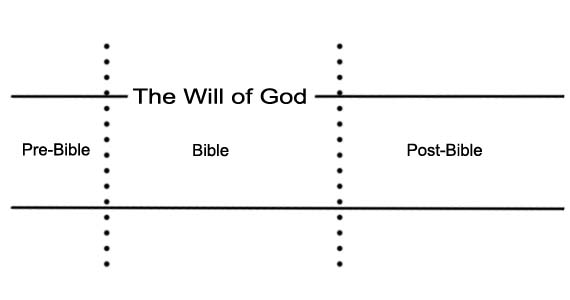 Everything within the solid lines is “The Will of God.” In between the dotted lines is the record of Scripture. People who lived before the first dotted line lived before the Bible was written. Sometimes people lived inside the will of God, and sometimes they lived outside. Then Scripture began to be written, and people got a better idea of what the will of God looked like.
Today, we live in that third section to the right. We have the entire Bible, and we can look back and see what the Will of God was for people who lived in the past. This does not necessarily mean it is the will of God for us today, because we are different people, living in difficult places, with different cultures, at different times.
So what is God’s Will?
We can assume that there will be many similarities between God’s will for us today, and God’s will for His people in the past. Many of the similarities will be exactly the same (such as maybe the 10 Commandments … or at least 9 of them … see how things change?) but most will not. But these examples from the past can guide us and inform us of what God’s will for us today may look like.

God has a different will for you and I in our time and culture than He had for a Jewish person living in the Babylonian captivity 2500 years ago. And that’s a good thing. I work with a lot of different religions, and I see all of them (Christians included) trying to follow commands and ideas that made a lot of sense 2000 years ago, or 1000 years ago, or even 100 years ago, but which today are pure insanity.
God gave us Scripture, and He gave us brains, and He has given us the Holy Spirit. He wants us to use all three to determine His will for our lives today.
But what about Jesus? Shouldn’t Jesus be our “perfect example?” Are we not supposed to follow and copy everything He said and did? We’ll look at these questions tomorrow.

Looking forward to tomorrow’s post…
Have you read “Christ in y’all”? It’s about how every NT letter was written using ὑμεῖς and not σύ.
No, I have not read this. Is it a book? Who is the author? It is an interesting insight.
It’s by Neil Carter..he makes his rounds at many of the organic church conferences.He basically says that the bible was written to community, nit the individualistic American Christianity. The Sermon on the Mount is not for each person to attain to, but “we, the body” must do it using each of our individual gifts.
Great post! But I was a little surprised to find you using this title only a few months after our fellow blogger David Ker, who blogs at Lingamish, published his own e-book with almost exactly the same title. Is this re-use of the title a coincidence?
Peter,
100% complete coincidence. I have never heard of the book until just now. But I will go check it out!
This blog is a godsend for me. It’s awesome to see that I’m not alone in my approach to the Bible and my God.
Today, many western Christians do take the Bible as a love letter to them personally, which, to me, seems egocentric and impractical. I believe this is quite often based on nebulous concepts and “knowledge” of God that has been passed down through years of tradition and orthodoxy.
One of these things, for example is the the concept that God is everywhere at all times and knows everything there is to know. This isn’t an attack on His sovereignty by any means, but rather an observation I’ve come to based on the behavior and statements regarding God. Nobody has been able to show me that in scripture. I see things that can be made into these attributes, but nothing concrete. Assumptions such as this, with no scriptural backup allow people to assign nebulous, movable attributes to Him. These attributes communicate directly into misuse and abuse of the Bible, and a loss of effective application.
For instance, just before the flood, we see that it grieved God that he had made man. If he had everything planned out, why would this grieve him?
My point is that perhaps in making these assumptions, or taking these points as fact when taught to us, we are really seeking comfort by sealing up the cracks in our dam against any uncertainty. We need our Creator to cover any base at any time no matter what. The problem is that these inaccurate directions point us to unwanted destinations.
Scripture provides us with enough certainty, a certainty that bears out in the life of one that seeks God earnestly, to give us as much comfort as we need. The rest is of no use.
Steve,
I am glad the blog is encouraging. Your comment is encouraging to me!
In your last line, are you saying that the rest of the Bible is of no use? If so I am not sure I agree. I don’t think it was written to me personally, but it still is an excellent help and guide as I try to learn from the lives of others so that I can live as God wants me to live today.
I disagree in some aspects Gods will doesn’t change he says I’m The Lord and I change not. That he is the same yesterday today and forever. You used examples about buildings and war what about the examples of how to love and how to show mercy and how to please him. The word of God was written to us that we may learn his ways and keep his decrees. If we arent reading the Bible to grow to learn of God and his ways and to recieve of it’s promises and new life then what are we reading it for? Maybe I’m misunderstanding the article. The word of God is alive and powerful meaning God uses it to speak to each individual. It’s written for us that we may learn. I can’t tell you how many times I’ve taken hold of a promise in the bible as if God wanted to believe it for myself and he brought it to pass. If it works then it must be written for me not just me but everyone.
I am not saying God cannot speak to us through Scripture. He can and He does. But this is different than saying the Bible was written to us. It wasn’t. Once we understand who it was written to, this allows us to better understand its message.
My question is, if the Bible is not written to us, then it was written to the people of the time. Therefore they are all dead and the book isn’t merely a “book” like any other inspirational book. That means that the god of the Bible is just another god amongst all the gods in history that are long gone, and we’re left to make him into our new and improved god to our liking? Pretty depressing as I always believed Jesus is alive and well and that there is no other god but our god. This just makes it sound like it’s all man made. How can I read about Jesus and the things that will happen if they aren’t written for us? That means all these things either already happened or never came to be and we’re just self prophesying. Can you correct me, I’m struggling to find myself and this is so depressing to come to terms with. Thanks
This was one post of a series, and I am putting them together into a book which explains more. The doctrine of the inspiration of Scripture helps show how the Bible is more than just another book. The Bible is unlike any other book in history! It contains the very breath of God!
I have recently started an online course on this very topic as well… https://redeeminggod.com/courses/study-the-bible/
“All Scripture is breathed out by God and profitable for teaching, for reproof, for correction, and for training in righteousness, that the man of God may be complete, equipped for every good work” (2 Timothy 3:16–17).
“Now these things took place as examples for us, that we might not desire evil as they did. . . . [T]hey were written down for our instruction, on whom the end of the ages has come” (1 Corinthians 10:6, 11).
“Whatever was written in former days was written for our instruction, that through endurance and through the encouragement of the Scriptures we might have hope” (Romans 15:4).
Figured I should back up my little two cents with some scriptural references.
Alisha, I don’t mean to be rude, but the scriptures you just listed support the exact message which the author was trying to convey.
Bobby Redding, no it does not. Exegete not eisegete. I know what the author tried to convey, unfortunately it wasn’t clear – the proof is in the pudding. A brother on this very thread of posts got confused to the point of exertion. We must be careful that we are not forcing scholarship concerning the Word and that we tell the truth from love. The Scripture has layers and must be carefully approached and explained to many who may not understand. I don’t agree with the message of this article, but some might. The Scripture in Mark 13:37 declares, What I say to one, i say to all. Ill be crystal clear – if you are walking on God’s choice real estate called Earth, then the Scripture was written uniquely for you. Did Paul write the letters of the New Testament addressed to your home address? No. However, God did write them addressed to your personal life predicament coming into this broken, fallen world. If God is Almighty and HE is, then as humans we should understand that the Book that He wrote will transcend times and cultures and our understanding. One of the beautiful things about the Bible and about Christendom is that its not restricted to culture or time. Truth never changes – and if it ever does change, then it wasn’t true. The Bible needs to be given more credit than whats written in this post and in many of these comments.
This is good discussion. And it is true! It sounds true and that is why it is so important to have God’s Spirit so we can know the truth when we hear it and discern it. It is so important to walk in love and seek the fruits of the Spirit in all things. And I believe sometimes we can use the Word of God the wrong way and make it harmful rather than helpful. God is a God of understanding and He is very versatile in His love because He has placed us in His plans. And we are peculiar in our ways… He is willing and able to operate in His truth in a million ways… But it is the same Truth. We just have to have a relationship with Him and be able to know what He wants us to do and when. Likewise, God still hates sin. And we still need to be striving to love one another and God to our greatest potential… Which is a lot if we are led by God. Also, because we are one in the body of Christ, Paul was talking to us in that he knew there would be generations to come and in speaking to a certain church, I believe he had the vision of the future, just as we do when we pray. So, when I read the Bible, I feel like they are my ppl and my ancestors. I really do think that if I could trace my ppl all the way back to that time, that my blood would trace back through the royal line of Israel. Don’t ask me how I know that. It’s not just from being egocentric.
MoLesa,
I don’t want to be rude or anything but when you read the bible and you feel like the people in the bible are your people, they aren’t. they never ever were and they never will be. as it stands MoLesa, nothing in the bible pertains to you or me. nothing. nada. zero. zilch. even if you take verses out of context and apply them to yourself or to other people around you, it still isn’t for you. it never was and it never ever will be. even if you take whole entire chapters and try to strictly apply that chapter to you, to your life or for your everyday life——– it still is not for you. the bible was never ever written to you, for you or about you. Paul, Matthew, Luke and John or Mark never knew you they never met you. they never ever knew you would exist in the future. they had no way of knowing that. nowhere in the bible nowhere does Jesus at anytime he never speaks commands or directs anyone to write any scripture at anytime just especially or personally for you. never.
no matter how much you love the bible and no matter how much wishing you do or will ever do and no matter how much you directly apply the bible to yourself and to your life——-the bible still isn’t about you. it never ever was and it never ever will be. the bible was never written to you, for you or about you. nada.zero.zilch.
Kevin, you didn’t want to be rude, but you totally were. Apparently you have no concept of being grafted in (Romans 11:17) by grace and faith in Jesus Christ and now a part of the family of God (Ephesians 2:19). Just as adoption causes you to become family with people that you were not biologically born to, we are adopted into God’s family (Ephesians 1:5, Romans 8:15). If Jesus is our Lord and Savior, then we are all brothers and sisters in Him. They are “our ppl”! Be careful that you don’t become a stumbling block and harm the faith of God’s children by your opinions. The fate of those is not good (Matthew 18:6).
Good article.
Very helpful.
Confirms my thoughts on the Scriptures.
Thank you very much for sharing this.
I think Jesus sums it up in Matthew 22:37-41. Love God with all your heart, soul and mind and love your neighbor as yourself. In other words put God first in your life, others second and yourself last. Additionally Jesus says all the law and the prophets hangs on this. The law and prophets were the first 5 books of the old testament and other books written by the prophets like Isahia.
I have concluded much the same as Jeremy but it has taken me over 60 years to do that. It wasn’t until I opened the Bible and began to read commentary on the different verses that I began to see how the different books were written.
The Bible can be summed up in on word “LOVE”. Jesus said it in Matthew 22: Love God, love your neighbor.
Just the fact that you work with other religions shows you do not believe Jesus is the only way to the Father. God is the same yesterday today and forever and his will has not changed towards humans and the fulfillment of bringing His glory and advancing his kingdom.
You don’t work with people from other religions in your day job? Are you a monk in a monastery? You are making incorrect assumptions here, Ryan.
Yes but he wrote Christians included meaning he is not a Christian suggesting he is standing from a viewpoint open to other ways other than Christianity
The Bible may have not been written TO each of us individually, but it was definitely written FOR each of us individually.
Excellent. Thank you for clearing up some much needed answers to questions.
I believe what you say,,, in my terms, the bible was written to encourage good from people.
As a life guidance, but based on people being superstitious. Believe in a life ever after have people purpose to do good.
My point, no one wrote the Bible but a bunch of people.