One of the most famous passages in Scripture about tithing is Genesis 14:18-20.
Genesis 14:18-20
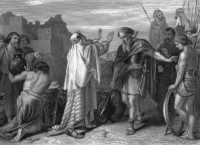
In this passage, Abraham’s nephew Lot has been taken captive by an invading army. Abraham gathers his trained men and pursues this army to rescue Lot. Abraham is successful, and returns from the battle with Lot, Lot’s family, all the people who had also been taken captive, and all the goods and possessions which had been carried away. On their return trip, Melchizedek, the King of Salem, comes out to meet them and he blesses Abraham and blesses God. In response, Abraham gave to Melchizedek a tenth (or a tithe) of everything. And that is everything that this text says about tithing. One little line.
Hebrews 7:1-10
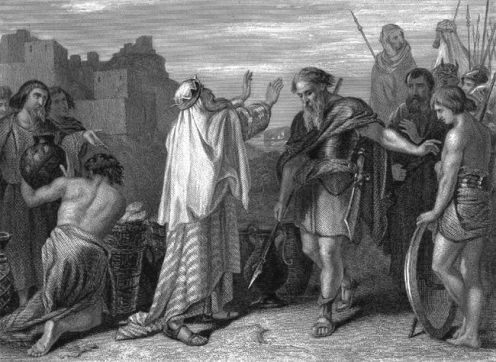
This passage would probably not be so prominent in the tithing debate if it were not for the comments on this passage by the author of the book of Hebrews. In Hebrews 7, the author of Hebrews makes the claim that Jesus is superior to the Levitical Priesthood. He begins this argument in 7:1-10 with a rather complex discussion about who has the right to receive tithes, and that Melchizedek is superior to the Levitical priests because through “the loins” of Abraham, the Levites paid a tithe to Melchizedek. Frankly, the whole argument sounds somewhat silly to modern ears, but was quite consistent with Hebraic ways of thinking about their ancestors and helps solve the dilemma about how Jesus could be our High Priest even though He was not of the Tribe of Levi.
Ultimately, Hebrews 7 is not at all about tithing, but is about Jesus being a superior High Priest. Nevertheless, this text is often brought up in connection with Genesis 14:18-20 to defend the practice of tithing in churches today. It is argued that Abraham gave a tenth of his income to Melchizedek, and that since Melchizidek is a “type” of Jesus, then Abraham, and all descendants of Abraham, whether physical descendants by blood or spiritual descendants by faith, must also tithe to Jesus. A pastor who teaches the passage this way will argue that we give our tithe to Jesus by giving it to the priestly representative, which in our day is the pastor or the church.
No Command on Tithing
But notice that this is not at all what these Scriptures are saying or teaching.
First, nowhere is there a command in either text for subsequent generations to follow the example of Abraham. In both Scriptures, Abraham’s tithe to Melchizedek is described, but not prescribed. We are told what Abraham did, but we are not told that all people must do the same thing. If we are going to read a law or command into this text, we must invent it.
But secondly, we have even missed what the text says about Abraham’s tithe. Genesis 14 implies what Hebrews 7 makes explicitly clear: Abraham gave a tenth of the spoils of war to Melchizedek. This was not a tenth of Abraham’s possessions, nor was it a tenth of Abraham’s annual income, nor was it even a regular offering which Abraham made to the local priest. This was a one-time gift from possessions which Abraham had just captured in war, the remainder of which, he returned to their original owners, the kings and people of Sodom and Gomorrah. Technically, Abraham gave 10% to the King of Salem, and 90% to the King of Sodom. He did allow his own soldiers to take a portion as well for payment, but we are not told how much that was (Gen 14:24). There is no instruction, command, or requirement here given to all people of all time about the necessity to give 10% of their income to God, to a minister, or to a church. Even for Abraham, this was only a one-time gift of possessions he had captured in war.
Numbers 31:25-30
By the way, there is one other example in Scripture of a portion of plunder being given to priests after a war. The event is in Numbers 31:25-30. The Israelites went and attacked the Midianites and captured all their possessions. Upon their return, God told Moses to tell the Israelites to divide the spoils into two parts: half should go to the soldiers who went out to battle, and the other half should go to everyone else. But after they divide the spoils for distribution, everybody was required to give a portion to God by giving it to the priests. And how much were they to give? The soldiers were to give 1/500th and everybody else was to give 1/50th. Together, the total “tithe” given to the priests in this case comes to 1.1%.
It is interesting that while the passage where one person gives 10% of the plunder to the Priest is a popular passage on tithing, this passage where all the people of Israel give only 1.1% of the plunder to the priests is not a popular passage on tithing. I doubt you will ever hear this second passage ever preached on as an example of how much of your money you should give to the church. And yet, when it comes to examples of people giving money to the priests, this second example from Numbers is arguably stronger, since all the people of Israel were involved, and not just Abraham.
No Command on Tithing
In both passages, however, there are no instructions or commands for God’s people, either then or now, to give a portion of their income to God by giving it to the priests. Both are simply examples of gifts that were given to priests from the plunder that was taken in war. In neither case is anyone consistently tithing of their income to support the work of God.

In the case of Abraham, I have read that he was following a cultural custom of the time to give 10% of the spoils of was (which is what the word tithe means) to the local high priest of your religion pf choice. Abraham chose Melchizedek. And yes, he is only recorded as doing this the one time….
I like where you’re going with this – you brave soul. 😀
I agree with you on this. Its a major, major stretch to try to make these passages support the modern concept of tithing. If Abraham had given Melchizadek a cartload of daffodil bouquets, do we really think churches would be trying to convince us to give bouquets of daffodils to them? This wasn’t even Abraham’s property. Nor was it his income.
If we stretched Scripture half this much on some other issues I’m thinking of, many of the folks who try to use these passages to support tithing would have an absolute fit. Just because this line of thinking has been around for awhile and just because it has been preached from hundreds of thousands of pulpits doesn’t mean it is accurate.
New International Version (©1984)
“Abraham is our father,” they answered. “If you were Abraham’s children,” said Jesus, “then you would do the things Abraham did.”. What is wrong with people practising what made Abraham rich. Tithing is an act of worship and just as you state that there is no command to tithe in the new testament so is there command forbidding tithing. It is a matter of faith and not of law
“Giving” is absolutely a NT practice and should certainly be a matter of faith – heart – and not of law. That is part of the point, I think.
However, by the logic you use, should men then lie to people and tell them their wives are actually sisters and allow them to be taken? Abraham did this twice. If a man’s wife tells him to sleep with her maid and get her pregnant, should he do that?
It is important to look at the context of Jesus’ statement in this account (John 8:31-47). He was talking about them accepting Him as sent from God. He told them they should do what Abraham did. What was it the he did that was counted as righteousness? He believed God. He listened to God. Nowhere in the Genesis account does it indicate that Abraham gave a tenth of the spoils of war because God told him to, nor does it indicate that he ever did it more than the one tome.
Ben, I reread my comment and realized it sounds a bit harsh. That was not my intent. I just wanted to pose some questions.
I actually have a few more thoughts to consider. Tithing is not what made Abraham rich. He only gave a tenth of the spoils he recovered for the King of Sodom. What made Abraham rich was God choosing to do so. The only thing that Abraham is did that was of value to God was believing Him.
Ben,
Are you saying that tithing made Abraham rich? If that is your reason for tithing, you are tithing for the wrong reasons, and tithing for this reason is just another form of mammon worship.
Regardless, you are right that there is no law forbidding tithing. Near the end of this series on tithing, I will suggest some good ways for people to give to others.
Hi Ben just wanted to clarify that Abraham did not tithe his way into prosperity. He was prosperous because God said he would bless him (Gen 12:1-3). Abraham did not have to pay God to get the blessings promised or to even enter into covenant with God. God told Abraham that he would ‘… be a blessing’. According to Gal 3:13-14 that same blessing is available for us now. Unfortunately the church has believed for too long that we have to somehow pay our way into getting God’s blessings by tithing or by sowing. We get God’s blessing in our lives by having faith in Jesus Christ (2 Cor. 8:9) and NOT by having faith in our ‘tithing’ or faith in our sowing. And the fact that Abraham tithed to Melchizedek was not something he was wanting to do to get blessed in return but what is unfortunately taught in churches today.
Elliot,
Thanks for weighing in here. You are absolutely right about the source and cause of Abraham’s wealth. It is all God, and is not promised or guaranteed to anyone else for a certain kind of action or type of faith. Thanks!
That’s a perfect answer! Couldn’t have been said better than that. “We get God’s blessing in our lives by having faith in Jesus Christ (2 Cor. 8:9) and NOT by having faith in our ‘tithing’ or faith in our sowing.”
Abraham was already rich by the time he gave this tithe from the spoils of war. I repeat from the spoils of war not his own personal property. Nowhere in the Bible does it suggest that Abraham became rich as a direct result of this one event.
Moisés pidio el 10 %, pero uno que Jesus dijo era el mayor: Juan el Bautista, pidio el 50% (1 camisa de 2), Jesus pidio el 100%. La pregunta es debemos dar a la iglesia nuestro dinero para que ella lo administre? O podemos separar una parte para los gastos ¿sueldos? de la iglesia?
With help from Google Translate:
Moses asked for 10%, but one that Jesus said was the greatest, John the Baptist, asked for 50% (1 shirt 2). Jesus asked 100%. The question is: Should we give our money to the church for her to manage? Or we can set aside a portion for expenses (salaries) of the church?
Great question, Luis. I will address some of these issues in later posts. I think we can pretty much do whatever we want with our money, but there is no command that we must give a portion to the church to manage for us or to pay for somebody else’s salary. Can we? Sure. If we think it is a good use of the money God has given to us.
I should tithe as much as I should call another person my sister to save my butt.
That is hilarious! Yes, Abraham did that as well.
I saw a sermon where the speaker (was a special guest speaker not the pastor) said that if you don’t tithe 10% you are actually stealing from God. What do you guys think about that? (The guy was also LIVING off of people’s donations!)
It’s a teaching taken from Malachi 3:10-11. And it is taken totally out of context. The statement was made to the priests who were not doing the Law. Doesn’t apply on so many different levels….I’ll be interested to see if Jeremy touches on that… And, in my opinion (based solely on my own experiences) it is a tactic to guilt/fear people into compliance with the doctrines of men….
okay, remember, you asked… 🙂
Yes, I will be dealing with Malachi 3 in the coming week!
Kirk,
He was using Malachi 3 to defend this idea. I will deal with this passage on Monday or Tuesday.
Hi Kirk I’m assuming he was referring to the Malachi passage; first it was directed to ancient Israel when they were under the Mosaic Law. God’s people were holding back their tithes and offerings. Consider what would happen if a large portion of Americans refused to pay their income taxes. American law views this as robbery. Those found guilty would be punished for stealing from the government.
In the same way, when Israel held back her taxes (tithes), she was stealing from God—the One who instituted the tithing system. The Lord then commanded His people to bring their tithes into the storehouse. The storehouse was located in the chambers of the temple. The chambers were set apart to hold the tithes (which was produce, not money) for the support of the Levites, the poor, the strangers, and the widows.
Notice the context of Malachi-3:8-10: In verse 5, the Lord says that He will judge those who oppress the widow, the fatherless, and the stranger. He says, “So I will come near to you for judgment. I will be quick to testes against sorcerers, adulterers and perjurers, against those who defraud laborers of their wages, who oppress the widows and the fatherless, and deprive aliens of justice, but do not fear me.”
The widows, fatherless, and strangers were the rightful recipients of the tithe. Because Israel was withholding her tithes, she was guilty of oppressing these three groups. Herein is the heart of God in Malachi 3:8-10: Oppression to the poor.
How many times have you heard preachers point this out when they harangued you with Malachi 3? Out of the scores of sermons I have heard on tithing, I never once heard a whisper about what the passage was actually talking about. That is, tithes were for the purpose of supporting the widows, the fatherless, the strangers, and the Levites (who owned nothing). This is what the Lord’s word in Malachi 3 has in view. http://anothergospel.blogspot.com/2011/06/is-tithing-biblical.html
Elliot,
Thanks for the great link! Yes, one of the main reasons for tithing was God’s concern for the poor and those in need.
This is a reminder we often need to hear!
Paul Anderson Walsh says that we are not robbing God but we are being robbed of God when we are taught that we can buy God’s good pleasure.
To be honest I get where you are coming from but I think the whole deviation of tithing and wheather its important for today can be summed up in Deut 8: 18 – “But you shall remember the LORD your God, for it is He who is giving you power to make wealth, that He may confirm His covenant which He swore to your fathers, as it is this day.
When you understand that money doesnt actually belong to us and that God wants us to use our money to help reach people then the burden of should I/Shouldnt I tithe, give a gife or offering becomes insignificant, why because we are told where money comes from and what its purpose it.
I am currently unemployed and onfortunitly have been for 3 yrs now but I still give monthly to charity and also to the kingdom (not just 10%).
An I love doing it why?
Because As Ive already said the money is Gods in the first place he wants to see can I manage it right. You can also pay your offerings direct to other people to help them.
God can get money and things to you but he wants to know can he get it through you.
The debate shouldnt be about tithing it should be about why God wants cheerful givers.
Im currently do ing a bible study on this myself…
Robert, you are right that everything we have belongs to God, and He wants us to give to things that help spread His love and mercy to others.
But remember, the 10% rule is not really in Scripture, not for us, not for Abraham, not for anyone. Check out some of the other posts about tithing: Pass on the Offering Plate
Hi Jeremy,
I get totally what your saying and yes Abraham gave 10% to Melchizedek. I belive that to have been a one off gift and Ive also heard somewhere that the 10% was in conjunction with a custom of giving in that culture.
I know that the tithe does not apply to us. Its not about us giving to receive from God has already supplied everything will ever need (as the word says “I shall supply ALL your Needs, according to my riches in Christ”). So when I give to God its with a heart to see His Kingdom advance not to get more.
That is the right attitude! Keep giving generously and joyfully!
Thanks bro keep this site going and thanks for your comments.
God Bless you
I don’t understand why everyone is so against the tithe.. for me i love to tithe cause its a way of me saying God I love you, youre number 1 in my life and heres just a portion of what i have, it aint much but its for you Lord… if you dont like where your tithe is going or being used for, then move church lol.. its that simple, you complain about pastors living off the tithe but u want pastors service, prayer, leadership 24/7… so what about his family? bible says a man who doesnt provide for his own family is worse than an unbeliever!.. so who will pay for the rent for the building? so who will pay for missionaries? who will pay for the cost building new churches in different regions?… the bible never says give when you feel like it, it says to give out of your heart, now if 10% is too much then give what u can, your best!! if thats 2% go for it.. if you like 10% then stick with that, and if you can do more than 10% then praise God, do that… see in america theres no law that says you have to pay tax, so how come the masses in america dont complain about it as you guys do? politicians are gathering up your money right? infact tax, legally is a volunteery in nature but why have the politicians twisted the law to say you go to jail if you dont pay it?.. how come ur not fighting that fight? why giving? to God for that matter.. bottom line is if you dont like the ground in which you are sowing then move!!! there are plenty of churches out there in which the money goes to the kingdom.. if pastors have part time jobs watch people complain about not having enough time with the pastor lol.. man confusion is in people i tell you
Joshua,
I am not against the tithe so much as I am opposed to pastors telling people they MUST tithe in order for God to be pleased with them. Yes, the tithe is a wonderful practice and a way to give honor and thanks to God for what He has given to us. It is a beautiful form of worship. But something so beautiful becomes perverted when it becomes a legalistic law that we must obey in order to keep ourselves in God’s good graces.
It is recorded that Abraham gave only once. How man paychecks have you gotten. How many times have you went to buy groceries. You do not give because you do not have faith. Without faith it is impossible to please God. Think about this and ask the Lord what that mean and not what your mind says, but what your heart says. You do know theres a difference between heart and mind?
Question: If the tithe is worship, how come it is not mentioned nowhere in the NT except in the letter to Hebrews? I mean, Jews should have known all about worshipping God in the first place! How come Paul hasn’t at least informed gentiles about it (Corinthians, Romans, Galatians, Colossians etc.)?? Answer: Tithing is NOT a form of worship.!!Worship has to do with the covenant of faith and righteousness by faith. Without such a covenant , it would be no reason today for us gentile christians to worship God, right? Well, according to Romans 4:11 a sign and a seal of “righteousness by faith” was circumcision given to Abraham! Circumcision! Yet, apostle Paul in the NT dismisses circumcision altogether. But unlike circumcision – tithe was never connected to the covenant/righteousness by faith. Never! So what basis do we have today to tie it to our worship? None.
Amen!
Thorougly enjoyed reading the article and the discussions. While I readily acknowledge that the Church is not commanded to tithe, I take the position that God’s promise to the tither transcends dispensation and was never revoked. I tithe in acknowledgement of the fact that everything I have comes from God and I am just a steward of what He has blessed me with, plus the awareness that it takes money for the church to do the things Christ commissioned it to do. While I do not do it to receive, I would be disingenuous if I did not acknowledge that God has blessed me and my household, not necessarily financially or materially, but with overflowing grace that translates into a life of contentment and praise..
Yes, God has blessed us all, and it is important that we use what He has given us to bless and help others. I am not at all telling people to stop doing such things. Thanks for weighing in!
Please… Read numbers 18 vs 21
“Woe to you, scribes and Pharisees, hypocrites! For you pay tithe of mint and anise and cumin, and have neglected the weightier matters of the law: justice and mercy and faith. These you ought to have done, without leaving the others undone.” – Matthew 23:23
The Pharisees were great at paying tithe, but were horrible at showing mercy, justice and faith. Here Christ rebukes them because they were upholding certain aspects of the Law while neglecting other aspects. Christ then tells them they should follow the whole Law, including paying of tithes. As Believers, we should love justice and mercy and we should have faith, and we should also pay our tithes! 😀
Jesus said that before the cross! On the cross he fulfilled “all the righteous requirements of the Law” for us, justice, mercy, and faithfulness. Did He leave “undone” things of less weight? No way. And if we are to tithe today (because it is the “matter of the Law”, by Jesus words), WHAT else should we practice from the Law? Sacrifices? Circumcision? Hmmm….
People of God thanks for your preaching
Hi Jeremy do you have a book on tithing
wow what a wonderful post and comment from every one. well the conclusion to me is that tithe and every form of giving is a platform provided by Gods word to keep and finance Gods work on earth. if you love God and love to see the kingdom advance you will give with joy be it tithe or whatever you call it. you don’t tithe or give for God to bless you, you tithe and give BECAUSE YOU ARE BLESSED (in Christ) that is the New Testament mindset and spirit.
Considering the levite of our time (pastors) and the fact that the work of God need advancement ,we should consider tithing as a tool to spread the gospel instead of deliberating if it is scriptural or not. The scripture says through prosperity shall my city be spread abroad. But ofcos the preaching should not be done with a wrong motive. It should not be manipulative.
David, did you know that there is an entire book of the NT ( The Letter to the Hebrews ) written to demonstrate that there is no ” Levite of our times ”
The prophecy of Zechariah on future prosperity for Jerusalem does not mention tithes or pastors or the gospel or the church. So I conclude that
” through prosperity shall my city be spread abroad. ” is a statement that has nothing to do with church giving.
Respectfully note:
Heb 7:5 And they indeed from among the sons of Levi, who receive the priesthood, have commandment to take tithes from the people according to the law, that is from their brethren, though these are come out of the loins of Abraham:
Error #1- According to this scripture it was a commandment to take tithes from the people according to the Law
Heb 7:2 And to whom Abraham gave a tenth part of everything which he had, being first named King of righteousness, and then in addition, King of Salem, that is to say, King of peace;
Error #2- Abraham in this scripture gave a (specifically stated) 10th part of all(that is everything) he had.
New Living Translation- Luke 11:42 and Matthew 23:23
“What sorrow awaits you Pharisees! For you are careful to tithe even the tiniest income from your herb gardens, but you ignore justice and the love of God. You should tithe, yes, but do not neglect the more important things.
Error #3- Jesus himself advocated paying the tithe.
Jeremy, I am a strong supporter of your thoughts and views of the bible. It is about time that we put stop to these so-called men and women of god lying to enrich themselves. They never preached what we need to learn or hear for our salvation. Keep up the good work.
“What is wrong in people practicing what Abraham did”…How many wives and Concubines did Abraham have??? How many are we doing today??
Yes,
Tithing is a good cause because of those whom it ends up supporting.
We need Gods revelation even in the above of many wives.Cause truly Abraham had them and its better having them declared as your wives and supporting them than having them in secret.
Thanks. Excellent exposition!
There was no law of carnal commandments during Abraham’s times (it came 400 years later). So just like you said, Abraham’s’ giving was just a description of a kind deed and not a legal prescription (or regulation) to be followed robotically under threat of being cursed and punished by God. When it comes to the O.T curse of Malachi 3:10 (the giving of 1o percent), the good news is that it has already been abolished when Christ Jesus redeemed us (paid the price) from the curse of the law by becoming a curse on our behalf (which also includes “all” the curses of the Old Testament). God makes this very clear in Galatians 3:13 and Romans 3:28. I’m not saying that we shouldn’t give. It’s better to give than to receive. Sometimes we give little, while other times we give a lot (there is no set rule). But our giving, regardless of what it is, should be motivated by the love and grace of the Holy Spirit and not under the fear of compulsion as described by the Apostle Paul in 2 Corinthians 9:7. To preach that the law of tithing and curses still valid for New Testament believers (as the prosperity pins and those who want to grow rich quick advocate) is a direct contradiction of justification by unmerited grace through faith.
Who is to support the work of God financially? What does the Bible teach?
well taught!!:-) one teacher wrote not you but someone else. That it was an Arab war custom to give the local priest 10 percent of the war booty.
One problem with that Ismael was not born yet.
What are your thoughts on the war custom?
this is very interesting. that is to say, 95% of pastors today are teaching their interests, not the sound Bible teachings. Sir, how can this be corrected, then?
How about Malachi 3:8-10? Isn’t it pretty clear there that tithing was an Old Testament practice and moreover something which God desires because He says the people have robbed Him by not bringing their tithes and offerings?
You do not mention Mal.3:8-10, where it really is a tithe, through which The Lord wants to bless us in our giving.
Love in Christ
Rodger
Thank you for this more than convincing scriptures that explains when the ‘tithe’ was given, and from what ‘resources’. I have always believed, even when I was a ‘new’ Christian and not entirely versed in scriptures and what they all meant on a deep level, I always felt and believed in my heart of hearts that there was something ‘not right’ with the way the 10% of your income (before taxes mind you) was to be given to the church annually, citing the Genesis 14:18-20 as even pre Law where God had instituted the the annual tithe. Pastors did not want to hear anything remotely t0 anyone who had doubts about this, always saying that ‘everything’ belongs to God and that 10% is the least we can do for everything that He has given us! This begs the question: does the church at large take advantage of well meaning and believing Christians by preaching and almost demanding that everyone tithes, annually??
I would love to get your response, if you have time! Thank you and may our Lord Jesus richly bless you in the heavenly places!