Most Christians have wondered at some point in their life if they have committed the unforgivable sin. I have personally talked with Christians who were divorced, got an abortion, or committed adultery, and thought they had committed the unforgivable sin. Others think that suicide is the unforgivable sin. If a person commits suicide, then they are going to hell. Then I have talked with some who believe that the unforgivable sin is rejecting God. They believe that if you are a Christian and you go back to living like you aren’t a Christian, or if you curse Jesus, or deny that you ever knew Him, then this is the unforgivable sin.
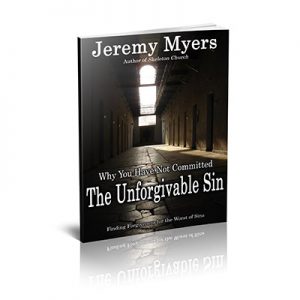 I recently wrote a book about the unforgivable sin, which you can get on Amazon. It is titled, Why you have not committed the Unforgivable Sin.
You can read a short summary of the book here and learn about the unpardonable sin. Below is an the text of a sermon I preached on Matthew 12:31-32, which is where Jesus warns about the unforgivable sin.
All Christians can Commit All Sins
But did you know that there are people in the Bible who have committed one or all of these sins whom we all expect to see in heaven? Let me show you.
Take divorce first. Did you know that God is a divorced person? We read in Jeremiah 3:8 that God divorced Israel. Yet we certainly all expect to see God in heaven.
What about abortion? They didn’t really have abortion back then the way we do now, but if you believe, as I do, that abortion is taking the life of another human being, then we can call abortion the murder of babies. Abortion is a form of infanticide. Yet we know from Ezekiel 16:21 that many of the Israelites did this as a form of idol worship. They offered their children to false idols as human sacrifices. While not all Israelites had eternal life, some of those who did this will still be in heaven.
Then there is adultery. David, the man after God’s own heart committed adultery with Bathsheba (2 Sam. 11:4), as did many of the other kings and rulers of Israel. Paul sometimes writes about adultery among church members who will make it to heaven, but will lose their inheritance and reward there. Suicide is talked about too. Samson (Jdg. 16:29-30) committed suicide, and we believe he will be in heaven. King Saul also committed suicide (1 Sam. 31:4-5); 1 Chr. 10:4-5), and he will be in heaven as well. The most famous example of someone who rejected and denied Christ is Peter. He even used profanity and curses in denying any connection to Jesus Christ. Yet we know that he was forgiven and will be in heaven.
In fact, there are a whole host of other sins mentioned in the Bible that true believers have committed, yet we know from other Scriptures that these people will still be in heaven. The Bible talks about believers who commit idolatry (1 King 11:1-10). We read of others who believe only for a while and then fall away (Luke 8:13). We read of some who do not continue in the Word of Christ (John 8:31), do not abide in Christ (John 15:1-8), become disqualified in the race of the Christian life (1 Cor 9:24-27), resist God’s correction up to the point of physical death (1 Cor 11:30-32).
Others stray from the faith (1 Tim 1:5-6), shipwreck their faith (1 Tim 1:18-20), fall away from the faith (1 Tim 4:1-3), deny the faith (1 Tim 5:8), cast off initial faith to follow Satan (1 Tim. 5:12-15), stray from the faith by loving money (1 Tim. 6:9-10), stray from the faith by teaching false doctrine (1 Tim. 6:20-21), and deny Christ and live faithless lives (2 Tim 2:11-13).
We have the examples of people in the Bible who murdered and committed adultery, and yet were said to be saved (Jacob’s sons). Other men, like Solomon, Amaziah and Uzziah will most likely be in heaven, but did not live very faithfully to God during their lives. Some of them committed adultery, had multiple wives, committed murder, and fell into idolatry.
Then there is the righteous man who commits unrighteousness and dies as a result of it in Ezekiel 18, and the man in 1 Corinthians 5 who was involved in an incestuous relationship with his mother in law. Lot who committed incest with his daughters. Ananais and Sapphira in Acts 5 and so many other examples in Scripture of genuine believers who fell away.
The point of all of this is to show that the grace of God runs deeper and wider than most of us will ever know.
The ocean of God’s grace never runs dry. The limits of God’s grace never are reached.
But what about when someone commits the unforgivable sin?
Is There A Sin God Does not Forgive?
We have all encountered the troubling passage in Matthew 12:31-32 which indicates that there is a sin which the grace of God does not cover.
Matthew 12:31-32 is often pointed to as proof that we can lose our salvation. The sin mentioned in this passage is often referred to as the unpardonable sin or unforgivable sin. It is said that if you commit this sin, then no matter how good of a Christian you have been up to that point and no matter how much you repent or confess afterward, you will not make it to heaven.
Let us take a closer look at Matthew 12:31-32 to see what it really says. Let’s begin with Matthew 12:31.
Matthew 12:31. Therefore I say to you, every sin and blasphemy will be forgiven men, but the blasphemy against the Spirit will not be forgiven men.
We learn in Matthew 12:31 that every sin will be forgiven, except one – the blasphemy against the Spirit.
Let’s look first at this concept that every sin and blasphemy will be forgiven men. We know what sin is. It is when we do something contrary to God’s character or will. When God tells us what He wants us to do, and we don’t do it, we sin. James puts it this way, “Anyone who knows the good he ought to do, and doesn’t do it, sins.”
Blasphemy is similar. The most basic definition of blasphemy is to speak evil or injuriously about God. So blasphemy is a sin of the tongue. A sin that uses words and thoughts rather than actions. So right away, all of this sins listed above that involve actions are not what Jesus is talking about. In fact, the only sin mentioned above that involves actions and thoughts is the sin of denying Christ and speaking against Him. So blasphemy against Christ is to speak evil or injuriously about Him. But jump ahead to Matthew 12:32. Look what Jesus says there. He says that speaking against the Son of Man will be forgiven.
So all of the possible sins we began with are now seen to be forgivable. Divorce, adultery, abortion, suicide all fall under the category of “every sin” and these are all forgiven. If you have committed any of these sins, you are forgiven! Jesus said it! All sins will be forgiven!
But what about blasphemies? Blasphemies will also be forgiven, even those spoken against Jesus Christ. If you have spoken a word against Jesus Christ, this too is forgiven. You have been forgiven.
It is only the blasphemy against the Holy Spirit that will not be forgiven.
But what does this mean?
What is Blasphemy Against the Holy Spirit?
What is the blasphemy against the Holy Spirit? Matthew 12:32 helps us answer this question.
Matthew 12:32. Anyone who speaks a word against the Son of Man, it will be forgiven him; but whoever speaks against the Holy Spirit, it will not be forgiven him, either in this age or in the age to come.
The sin that will not ever be forgiven is not speaking against Jesus Christ, but speaking against the Holy Spirit.
But what is this sin, and how is it committed?

There are at least four different theories on what it means to speak against the Holy Spirit.
1. The Unforgivable Sin is Israel’s Rejection of the Messiah
The first theory is that this sin is Israel’s national rejection of the Messiah when Jesus was ministering in Israel. This theory states that this particular sin is only something that Jewish people living in the days of Jesus could commit. It is not a sin that we can commit today because Jesus is not engaged in his earthly ministry right now.
This theory is one I held for quite a while. It is a very compelling theory.
In the context, the Pharisees claim that Jesus is performing miracles by the power of Satan (Matthew 12:24). Later, Jesus calls this generation that rejected Him an “evil generation” which deserved condemnation for rejecting the Messiah (Matthew 12:39-42).
So these Jews are rejecting Jesus as the Messiah even though they know the prophecies about Him, have heard His teachings, and have seen His many miracles. Yet they still rejected Him and accused Him of being in league with Satan.
According to this view, then, the unforgivable sin is committed by these particular Jewish people. They lived in the time of Jesus and saw what He did, but attributed His work to the devil.
If this view is correct, then nobody can commit the unforgivable sin except for the Jewish people living at the time of Christ. According to this theory, since we are not Jewish and we are not living at the time of Christ, we cannot commit this sin.
This theory, by the way, is the one I was taught in Bible college. It is also held by such people as Warren Wiersbe and John MacArthur.
Though this theory has a lot going for it, I no longer hold to it because it seems this warning applies to “anyone,” not just Jewish people at the time of Christ. Furthermore, although the context does help us understand the unforgivable sin, it has to be something beyond rejection of the Messiah and speaking against the Messiah, because Jesus says that these things will be forgiven men, but not speaking against the Holy Spirit.
So while it is true that these Jewish religious leaders were in danger of committing the unforgivable sin, the context of the passage seems to indicate that the sin is something more than just Israel’s national rejection of the Messiah.
2. The Unforgivable Sin is accusing Christ of being in League with Satan
The second theory is that the unforgivable sin is committed when someone accuses Jesus of Satanic allegiance. One variation on this theory is that the unforgivable sin is committed when people attribute the work of the Holy Spirit to Satan.
One person who holds this view said this: “When we write off supernatural healings, prophetic utterances, the gift of tongues, etc. as coming from the devil, we are denying the power of the Holy Spirit. We are being disrespectful to the Holy Spirit. We are committing blasphemy against the Holy Spirit!”
Of course, the behavior of some charismatic Christians goes way beyond healing and prophecy and speaking in tongues. Sometimes they get into holy laughter, barking like dogs or braying like donkeys, getting slain in the Spirit, rolling in the isles, and claiming their tooth fillings were changed to gold. Certain Christian leaders have said that these are counterfeit miracles from the devil. In response, certain charismatic leaders have said that such accusations are blasphemy against the Holy Spirit. Then the finger-pointing and name-calling really begins in earnest…
But I don’t think this is the best interpretation of the passage. Scripture is very clear that not everything that appears spiritual is from the Holy Spirit. Satan can and does counterfeit the works of God. So we are supposed to test the spirits and see if they are from God (1 John 4:1). If we are convinced a certain activity is not from God, but is a counterfeit deception from the devil, it is our obligation to stand up for the truth. And we shouldn’t have to worry that we might be committing the blasphemy against the Holy Spirit by denouncing something that is actually from God.
Years ago, when the holy laughter phenomenon began to spread out from Toronto into other churches around the world, there were many who were saying that this experience was not of the Holy Spirit, but was of Satan. Those who were involved in the Toronto Blessing phenomenon claimed that such statements were blasphemy against the Holy Spirit. They claimed that if God was doing something through the Holy Spirit, and other people said that these things were from the devil, then that is the unforgivable sin. They get this idea because in context, Jesus is performing miracles and casting out demons, and the Pharisees say that He does this by Beelzebub. Jesus then accuses them of having coming close to committing the unforgivable sin.
There are, however, similar ecstatic experiences cropping up in Mormon and Jehovah’s Witness churches, as well as among Buddhists, Hindus, and Muslims. There are even such experiences among the pagan, animistic cults. Are we prepared to say that these also are from the Holy Spirit? I doubt very much that charismatics would be willing to say they are. Yet if they say that such experiences are from the devil, are they not also in danger of possibly attributing the work of the Holy Spirit to the devil?
We cannot say the experiences of people in these other groups are from the devil, just in case God really is working among people in these other religions. But then, can we say these experiences are from the Holy Spirit? We cannot say that either, for we just don’t know.
The point is that this second theory becomes impossible to practically live out, because there would be no way to tell with certainty what is from the Holy Spirit and what is not. We would have to accept everything as possibly being from the Holy Spirit so that we did not accidentally commit the unforgivable sin.
 So this second theory has weak evidence in context, and is impossible to live out practically.
3. The Unforgivable Sin is a Failure to Believe in Jesus
The third interpretation is one that I held for a few years, and it is the idea that the unforgivable sin is simply a failure to believe in Jesus for eternal life.
Someone who does not believe the gospel will of course not be forgiven in their unbelief. If they continue in their unbelief until death, then they will never be forgiven. This is the view of Charles Stanley and many others.
The reason I eventually rejected this view is that the warning here by Christ seems more serious than this. Jesus indicates that this sin cannot be forgiven, whereas unbelief can be. And if this sin is unbelief, why not just call it unbelief?
4. The Unforgivable Sin is Consistent and Willful Rejection of the Spirit’s Testimony about Jesus
The fourth view is the one that makes the most sense. It is kind of a mixture of all three previous views. It keeps the strengths of these other views, and avoids their weaknesses.
The fourth view is that the unforgivable sin is a willful and slanderous rejection of the Holy Spirit’s testimony about Christ.
One reason I eventually came to this conclusion is through a deeper understanding of the work of the Holy Spirit among unbelievers. The Holy Spirit is at work in the world convicting them of sin, of their need for righteousness, and the coming judgment (John 16:7-11). He also helps draw and woo people to Jesus Christ.
If a person is being convinced by the Holy Spirit that Jesus is the Messiah, and that person lashes out verbally at the Holy Spirit by saying something about how Jesus is of the devil or accuses the Holy Spirit of being Satanic, this could be the blasphemy against the Holy Spirit.
This is different than simple resistance of the Holy Spirit. When non-Christians resist the Holy Spirit, they are trying not to hear what the Holy Spirit is telling them. They try to drown out His still small voice with constant music, recreation, entertainment, sex, alcohol, and drugs.
But it is not so easy to commit the unforgivable sin. If you are reading this post, and are concerned that you have committed it, be encouraged – for there is clear evidence you have not committed this sin. Let us look at how this sin is committed.
How Does Someone Commit the Unforgivable Sin?
All unbelievers naturally resist the Spirit. But from this condition of resisting the work of the Spirit, one of three things will happen.
First, the person may stop resisting, and submit to what the Holy Spirit is saying, and as a result, will believe in Jesus Christ for eternal life. They are now and forevermore a Christian. Once a person has believed, they can no longer commit the unforgivable sin, because it is only a sin that unbelievers can commit when the Spirit is drawing them to Jesus.
Second, the non-Christian may continue to resist throughout his or her life, and will die in a state of resistance. Since they never believed in Jesus, they do not receive the benefits of eternal life. They never committed the unforgivable sin, but they also never believed in Jesus for eternal life. They simply resisted the work of the Spirit their whole life.
Thirdly, a person may get tired of always resisting what the Spirit is telling them about Jesus, and may lash out in anger against the Holy Spirit for what He is trying to tell them.
This person knowingly, maliciously, and repeatedly rejects and slanders the Holy Spirit for His efforts to bring them to Jesus. This is blasphemy against the Holy Spirit.
When a person commits the unforgivable sin, the Holy Spirit stops trying to convict them of sin, righteousness, and judgment.
They once and for all choose to remain on their path of rebellion. The Holy Spirit will no longer convict them of their sin, of the offer of salvation, or of impending judgment. Such people have demanded to be left alone, and their request will be honored.
This view is a combination of the three first theories. The first theory was that the Jewish people had rejected the Messiah. People in our day who commit this sin also reject the Messiah, but it is more than that. The second theory is that this sin is when people attribute the work of the Holy Spirit to the devil. This happens when people say that the conviction of sin and the convincing of a need for Jesus Christ is of the devil, but again, the sin is more than that. The third theory was that this sin is nothing more than unbelief. And it is unbelief, but willful, hardened, blasphemous, and verbal rejection of Jesus Christ and especially the work that the Holy Spirit is trying to do in that person’s life.
When an unbeliever lashes out in this way, this reveals a heart hardened beyond hope of forgiveness. They will never be forgiven because there is nothing left for the Holy Spirit to appeal to. The Holy Spirit stops attempting to draw, convict, and convince people who commit the unforgivable sin.
And without the Holy Spirit’s work in this way, no person will ever be saved.
Have you Committed the Unforgivable Sin?
So, how do you know if you have committed the unforgivable sin?
First, if you have believed in Jesus Christ for eternal life, then you have eternal life (John 3:16; 5:24; 6:47) and it is no longer possible for you to blaspheme the Holy Spirit in this way.
Since you have believed in Jesus for eternal life, the Holy Spirit has stopped working upon you as He does with non-Christians, and is now indwelling within you to mold you, shape you, and form you into Christlikeness. Yes, you can still sin against the Holy Spirit by quenching or grieving the Holy Spirit, but you cannot blaspheme the Spirit in the way Jesus talks about in Matthew 12:31-32.
So if you are a believer, don’t worry about committing the unforgivable sin. The chance to commit it is forever in your past.
If, however, you are not a Christian, and are worrying about whether you have committed this sin, be encouraged. Nobody who commits the blasphemy against the Spirit wonders if they have.
People who have committed the unforgivable sin do not care that they have committed it. They do not even wonder if they have. They simply don’t care about such things anymore because the Holy Spirit has stopped convicting them of sin.
The unbeliever who commits this sin has become so morally and spiritually blind that their heart is hardened to the point that they no longer care about spiritual things and will never believe in Jesus.
So if you are worrying about whether or not you have committed this sin, be encouraged … for caring about whether or not you commit it is clear evidence you have not!
If you still worry about the unforgivable sin, then make sure you will never be able to commit it. How? Believe in Jesus for eternal life (John 3:16; 5:24; 6:47). The Holy Spirit is drawing you to Jesus, and He wants you to believe in Jesus. If you believe in Jesus, then the Spirit regenerates, indwells, baptizes, and seals you, and you can never commit the unforgivable sin. Ever. Why not? Because this sin can only be committed by those who are not yet believers and upon whom the Spirit is working to draw them to Jesus. Once they are “in the family” the work of the Spirit changes from drawing you to Jesus to conforming you into the image of Jesus. And no matter what, He will never stop doing this. Never.
Yes, you might have committed some terrible sin. You might have said something you really regret. But guess what? Whatever sin you may have committed, whatever words you may have said, you are still being convicted by it, which is good. This means the Holy Spirit is at work in your life to point this out to you. God has not abandoned you to your sin. So simply confess this sin, and abandon yourself to the love of God.
God’s grace covers over all your sin, past, present, and future.
God wants all men to be saved, and through the Holy Spirit, He draws all men to Jesus Christ. The light shines in their lives and grace calls them to Jesus.
If a person wants forgiveness and desires the love of God, God will never turn such a person away. Not ever.
The person who has committed the unforgivable sin does not want forgiveness, does not desire the love of God, and does not even have a thought for God in their lives. People who blaspheme the Holy Spirit have so hardened their hearts that they do not realize the condition they are in, nor do they care. They are not crying out to God for light or help or salvation. They just live their lives without a thought for God or a care in the world for spiritual matters. The Holy Spirit has ceased to work on their hearts and they are completely given over to the darkness of their hearts and the spiritual blindness of their eyes.
Blasphemy against the Holy Spirit is a serious sin that only unbelievers can commit, and even then, only when they have resisted the Holy Spirit for many years and have come to the point that they so completely reject what He is trying to do in their life, that they openly and verbally denounce Him and Jesus Christ and the feelings of sin and guilt in their own lives as the work of Satan in their lives.
 I am not sure if we can ever know if a person has committed the unforgivable sin or not in their lives, but one thing we can know – if we have believed in Jesus for eternal life, we have already responded positively to the Holy Spirit’s work in our life, and so the opportunity to commit the unforgivable sin is past.
The unforgivable sin is not a sin a Christian can commit.
At the same time, if an unbeliever fears they have committed this sin, then they clearly have not, because someone who has committed the unforgivable sin would have such a hard heart that such thoughts would not even enter their mind.
If you’re afraid you’ve committed the unpardonable sin, stop worrying. Jesus is not a liar!
If you believe in Him for eternal life, then you’ve got it. It’s that simple. He guarantees it.
Did this page help answer your questions about the unforgivable sin? If so, please support the ministry of this website by buying my ebook about the unforgivable sin on Amazon. There are paperback and eBook versions, and if you get the eBook version, you can be reading it on your device in less than five minutes.
If you are concerned that you have committed this sin, you really need to get the book, because it goes into greater detail about how you can find hope and forgiveness.
Do you fear that you have committed the Unforgivable Sin?
Fear not! You are forgiven. You are loved.
Fill out the form below to receive several emails from me which explains how you can know that you are loved and forgiven by God.
(Note: If you are a member of RedeemingGod.com, login and then revisit this page to update your membership.)

I have sought after God but He has soundly rejected me. I am legally changing my first name to Reprobate…I am morally disciplined but I am pre-determined for damnation. Why i don’t know. it’s very discouraging. I didn’t seek god my own way but his, via accepting jesus into my life. i’ve tried my best to follow his will but i am going to hell…god does not accept everyone and I am proof of that. I am Reprobate C. i “knocked on the door” so many times i work for a christian organization and i am damned to hell.
RC,
Why do you think you are damned to hell? As long as you are alive, the offer of eternal life is available to you.
But notice that eternal life is given freely to all who believe in Jesus for it. We do not receive it by asking Jesus into our life, submitting ourselves to Him, or trying to follow His will. These will always lead to one things – a certainty that we are damned.
anyone can commit the unpardonable sin i know because i have , i used to be a born again christian and i went back to my old life , i wont get into details but satan fooled me and made me believe god hated me and that i should have never became a christian so i told the holy spirit to leave me alone and i felt it leave me ,since that day my head was practically possesed by evil spirits and they would torment me and tell me to kill myself and they wouldnt leave me alone, I prayed everyday and went to many diferent churches they even performed deliverances and prayed for me but nothing worked i even went to a psiquiatrist and they medicated me thinking that i was crazy,but it didnt work obviously ,only time has made the voices stop and now i can have a “normal”life , i have been like this for almost a year now , no conviction , no joy , no fruits of the spirit , just boring gray meaningless life the worst thing is that im only 19 years old , it doesnt sound like something god would do because god doesnt reject anyone who wants to repent but its true its biblical and it happened to me ,this is a warning for anyone that is a christian and has decided to go back to their old life , i dont want to scare you but i really suffered and i dont want anybody to go throght what i went through and even worse loose their salvation like i did so if youre reading this ask for forgiveness before its too late he will cleanse you of all sin , trust the lord dont waste that beautiful gift of salvation dont waste your life on things that have no value , i know its hard to leave the sinful life behind but its worth it god wants people that are commited to Him,and for those of you that believe you have commited the unpardonable sin but youre not sure ask the lord to take away those fearful thoughts dont let fear dominate your life that is the enemy lying and trying to make you doubt , i hope many people get to read this , JESUS is the lord.
Wooow, thank you. But you gotta know that with the words you wrote, helping someone else out, that you are NOT Dammed TO HELL sir. You already know HIS grace and mercy is too wide and BIG for you to think that he’ll is your portion!!! Nope, not the God I serve, you just still feel guilty, I’ve done some horrible things that I thought were unforgivable, but his WORD proved me wrong, that’s why I love JESUS, his ways and thoughts are NOT like mans. Be encouraged sir.
I am 13 and I need help. I have been Christian for a long time. I remeber when I was a little girl I use to pray ever single night. But now something has changed. I have committed a sin and I feel so guilty and ashamed of my self. I prayed for forgiveness and then keep doing it again over and over. I for some reason think about death and suicide. I listen to a radio station that plays Christian music. It helps alot and its my favorite radion station. But I keep feeling guilty. I am confused and I dont know what to do. I have actually cryed about. I am right now and I need advise and some help! Please help me!! ;(
I recently had worries about if I have committed the unforgivable sin but after praying for forgiveness and taking my worries away patiently and reading this article, my worries started to fade away. It is like this article said, if you worry about it, it means you have not committed the unforgivable sin and there is forgiveness still for you. I recommend you just to keep praying with a true heart, putting trust in God and Jesus, they will take away your worries
Sweet young lady, it is the nasty demons that are whispering in your ear to have you feel guilty so that they have legal right to harass you. You also may have a demon of suicide. You need to rebuke these thoughts each and every time to feel them. If you confessed your sins to God and renounced it and ask God for forgiveness it is a done deal. DON’T LISTEN TO THE DEMONS WHISPERING IN YOUR EAR. Keep repeating out loud… I rebuke you demon of guilt, suicide or any other challenge that is coming on you. If you have to say I rebuke you in the name of Jesus Christ of Nazareth 10 times then do it. You can also look on line for a deliverance ministry in your area for a pastor to cast those demons out. What may be occurring to you is the demons are attempting to put a strong hold on you so that they can remain tormenting you because of your tender age. DO NOT LISTEN TO THEIR LIES. Get deliverance little sister. Little sister, it is also mandatory that you confess all your sins every single day without fail so that the demons do not have legal rights to harass you via feeling of guilt or suicide. Please get to a pastor on line or in your area and have the pastor cast the demons out via Deliverance. May God bless you, deliver you and heal you in the name of Jesus Christ of Nazareth, amen
Kelsey, don’t believe a spirit that tells you to Kill yourself!!! Satan is a liar and the Father of it!!!! Don’t believe his lies!!! The bible says, “If we confess our sins HE(Jesus, God) is FAITHFUL and JUST, to FORGIVE US OUR SINS and TO CLEANSED FROM ALL UNRIGHTEOUSNESS.” THAT MEANS ALL! Blasphemy is what was written of earlier, and like he said, you would have no more Consciousness of sin, and it is obvious, by both your posts (yours and the one before you, that Satan has convinced they have no hope) but it is obvious that you both are still being led by the Spirit of God, because you are still witnessing about Christ to others in your posts! Does Satan do that? Absolutely Not! He would tell people there is no God, he wouldn’t tell people about Jesus, and lead people to him like you both have!!! So stop doubting and Believe!!! Repent of unbelief and Confess it to God! Then believe God’s promises and in his faithfulness!
So, if you confess to God everything, even your lack of faith, and trust in God’s Faithfulness, then rebuke Satan, in Jesus name, the Devil will flee from you. Look up the words, Faithful, Just, Cleanse and All unrighteousness, in the Strongs Concordenence, and read this verse over and over 1 John 1:9, Read the Gospel of John also that says that No one can say that Jesus is the Son of God except the Spirit of God be in them. Also, to the previous person who believes they are damned, rebuke Satan, because he is lying to you, rebuke him and tell him to leave you in the name of Jesus!!!! You would not be out confessing and drawing others to Christ, which is bearing Fruit for God, if you have been rejected by God!!! People can only bear fruit for God, by the Spirit of God, which is in them, so stop believing Satan’s lies, and start believing Jesus’s promises ok! Read John over and over and focus on how the Holy Spirit prompts you towards Kindness and Goodness and Love towards others, and remember, those actions NEVER come from Satan, but ONLY from the Love of God, that is IN JESUS CHRIST, our LORD.
Repent and sin no more!
“There is therefore now no condemnation to those who are in Christ Jesus, who do not walk according to the flesh, but according to the Spirit.”
Romans 8:1 NKJV
Dear Kelsey I’m 12 I don’t know if your having bad terrible thoughts ( that’s my problem ) but I’ve had the same problem and I’m just worried about not being forgiven but I was always taught that it’s not even unforgivable until after Jesus comes back a 2nd time
Kelsey—find a mature committed Christian to talk to—pray and God will lead you to one—today—if you in fact accepted Christ as your Savior He is waiting for you to come to Him
Pray to be led to someone that will help you find your way back
Hey brother,
I’m a suicide survivor and no amount of counseling, medication or psychiatrist stopped the thoughts. The only thing that quieted the voices and thoughts were when I not only accepted Jesus into my heart, but I began to read Gods word for myself. Read the whole book of John. One chapter a day until it’s finished. If you stumble on a word or it’s meaning google the word and what it means biblically, in Greek and even Hebrew. I came to this link and I’m grateful I came across your comment. You are going to be fine and I assure you those thoughts will quiet as time passes and you heal and grow closer to Jesus. To end I want to thank the author of this book and message thread because I to thought God gave up on me, but he didn’t. I’ll forever believe in our Creator and his teachings. Your life was purchased with a life and you sir are worth more than the most valuable resource in the world. God Bless and thank God for you and everyone else on this thread.
As for me, I have been raised Christian, and unfortunately not thought of it seriously. I have strayed, not read the bible, and prayer was hard, thanks to videogames, which led to avoiding negative emotions and getting good ones in it’s place. Playing after time, my soul felt hollow empty. I realize now that gaming makes our brains loose the ability to break down complex tasks, just doesn’t know (I really mean it) and when you try to do some better things, there will be this voice in your head trying to convince you why you can’t, and so this dopamine dependance and seratonic (low confidence) aversion of tasks, and this stockiness of learning. I Became an enemy of my progress, realizing that, I saw the magnitude of Issaiah 55- But as the heavens are higher than the Earth, so are my ways greater than your ways. Back then as I have dipped and jumped out of depression, I was looking for hope. While I still was mislead for another 2 months counseling with school assistance volunteers, or paras as it is called in my middle school. I realized that all was demonic. I tried to read God’s word, Pray, he would guide me, in the middle of May, conviction of my past would start to build up, I would resist a while in the summer with my worldly desires, and today at 15 years old God as I was watching a self help video, his advice sounded a lot like (resist the devil and he will flee from you) and reading the James chapter 4, rereading it became very clear, compounded conviction I have been touched by the holy spirit, verses 7-10 are the my most favorite lines of scripture. After came a very hard convictous, increasing more convictuos than the last I had over time prayer. As finishing reading James chapter 4, conviction was peaking, not a hint of joy, but conviction. It was a very tough journey, being reignited for the Lord a couple times.
What I learned today was I was sowing into my flesh this whole time, did not hurt. That existential guilt hurts because we are seeing our fleshly acts in the spirit. The spirit is repulsed of the flesh. So this condemnation is God’s will I concluded. When it comes to walking in the Spirit, we need to decide to take the first step, the Holy Spirit does not give up leading you the way all glorious God sees fit. When we stumble, we need to turn away from the world, (repenting) preferably as fast as possible because then one gets dragged off the path with temptations. Thinking of the stumbling action as wrong do requires condemnation, we resist the snare and keep walking in the spirit. Condemnation in the walk of the Spirit, is Normal, don’t listen to the lies of it not being, because what does it lead to? Cancelling negative emotions and rigging them with just good ones, experiences one does not learn from.
my prayer is to give you some comfort and make you aware of the absolute love and
grace that is Jesus Christ, Savior and Lord, Redeemer!! I have recently come across
a ‘point of view’ that is very much worth considering. instead of looking at our selves
and what we have done, we need to look to Jesus and what He has done!! also, salvation
is not a ‘feeling’. whether feeling saved or not saved. it’s not too late, you are not beyond
hope. while you have breath, you can call upon the name of the Lord. two scripture verses
i hope you consider. John 6:37, “All that the Father gives to Me will come to Me, and the
one who comes to Me I will by no means cast out”. This is from Jesus Himself! would you
say then, that this scripture is not true?! MAY IT NEVER BE!! also, 1 John 1:9 “If we
confess our sins, He is faithful and just to forgive us our sins and to cleanse us from ALL
unrighteousness”. also, please read Romans 3. i urge you to turn to Christ who is faithful
and more than enough for all our needs. His sacrifice is all sufficient and complete, the bridge
to the Father. you are so young. please read Proverbs 3:5, “Trust in the Lord with all of
your heart and lean not unto you own understanding”. hold fast to this !! if you can step back
and read again your post, you contradict your self when you say, God doesn’t reject anyone
who want to repent but it’s true. i tell you now! God is not confused!! trust in His words!!
His word which is faithful, steadfast, reliable, true and unerring!! Numbers 23:19 God is
not a man that He should lie, Nor a son of man that He should repent; Has He said, and will
He not do it? Or Has He spoken, and will He not make it good? there is also much comfort
to be found in reading the Psalms. Psalm 34:22 ‘ The Lord redeems the souls of His
servants and none of those who trust in Him shall be condemned’. some might say that
this is just cherry picking verses to make people feel good. these are just some scriptures
that i hope will encourage you. read His word, there you will find rest and strength, hope
and life. trust in Jesus and His word!! it will not lead you wrong!! there is a wonderful and
adventurous life in walking with Jesus just waiting for you!! just take His hand!! rely, rely
rely and rely again on His word! Jesus would not turn anyone away with a repentant
heart!! we have all said or thought something in haste or on purpose. no matter. do you
think that God is so cruel that He would give you or anyone just one ‘chance’? or the first
time you mess up, you’re outta here!! don’t think so!! again, please stop looking to what
you have done and stop thinking but i, but i, but i…… rely , rely, rely and rely again on His
word and not your opinion. His word which cannot lie and can be trusted, always!!!!
peace to you in our Lord Jesus Christ
This was excellent encouraging words!!! I have a question for you that troubles me, what is your Scriptural understanding of this.
I was raised in a home of an alcoholic and abusive father. I have 9 sisters and my mother was very young about 15 or 16 when she married my dad, and my dad was very domineering and not only abused her, but me and my siblings as well. He treated her that if she ever sought to divorce him or leave him, he would find her and kill her. She believed him and so did me and my sisters. During our adolescent years my mom started to develop a huge crush on our grammar school Principal and school teacher, which she would talk about openly with me and my sisters in a way that was obvious to all of us that she was in love with him, she often times would cry and say she wanted to kill herself in order to be able to be released from the marriage to my dad. I totally sympathized with her, and her adulterous feeling for this other man throughout my childhood, but unfortunately, I think somehow, through this lifelong experience, I developed a disrespectful attitude toward the covenent of marriage and had been married and divorced 5 times before I really came to know Christ personally. I was baptized in 2010, and have since read in the bible, that if anyone divorces and marries another, they commit adultery, and he who marries the divorced woman commits adultery. Also, my current husband and I had a moment in our marriage, after my baptism in Christ, where Satan tempted us both, into a One time act of adultery against one another, we have both forgiven one another completely and our marriage is very good with no hard feelings, but my question to you is, If I am remarried to my 5th husband, would I still be considered an adulteress, if I stay in my marriage and am remaining faithful to it, even though I have confessed all my sins to my husband, and to God, and does the word of God require that I depart from this marriage in order to Not be considered an Adulteress anymore in the eyes of God? In another words, by remaining in this now, very loving and now faithful marriage, would I be living in a perpetual state of adultery or will God look at this marriage as if I never sinned and had any other, if I have repented of all my sin as 1 JOHN 1:9. Anyone who has a strong Theological understanding, please read this and respond as well. I need help to understand the Scriptures in this manner. Thank you all, who wish to respond.
I was also fooled
Do not worry friend, I have only just become Christian and even I can tell that you are still in God’s grace. Listen to what you said that you WERE a CHRISTIAN whether it be born again or not you still are. As for the unforgivable sin, as it was stated in this article, Christians can NEVER commit the unforgivable sin! As the article also states, that when you confess all your sins and accept Jesus into your life the Holy Spirit then sees that you have accepted it and the dwells within you henceforth the rest of your life and you can no longer comment the unforgivable sin as you can no longer blaspheme it. So do not worry brother, repent and ask for God’s forgivness and I’m sure that he will undoubtedly grace you with his presence again! I pray for you, through the lord, that you might yet see the light again, in Jesus name, Amen.
I experienced the same thing at 24. I could literally feel something leave my body and I notice everything in my mind got harder. I was not a church goer so I was not aware of the Holy Spirit and what it was. I didn’t know anything about Christian doctrine at all and what the bible said. I started going to church at 27 and realized what I had and what I lost at 24. I was uniformed and ignorant. But still held accountable.
Hi I’m 13 but I know something that can help u cuz I went threw this believing that u committed the unforgivable and I also did it out if ignorance but that’s forgivable because Paul did horrible things and said horrible things but he was forgiven because he did it out of ignorance I also am still going threw this unforgivable sin thing because I called God Jesus and the Holy Spirit bad things that I regret before accepting Jesus.but u haven’t lost anything because you did it out of ignorance like me because I used to be atheist so u insulted god but now I accepted Jesus and love him so if you did commit the unforgivable you wouldn’t tell us because when u commit the unforgivable the Holy Spirit leaves you but since u are scared and sad the Holy Spirit is convicting you meaning that he didn’t even leave you!!! You still have a chance. Sorry for the bad Grammar I was just rushing
Hi I’m glad that I read your comment it’s interesting. I’ve got baptized into a Pentecostal church. They said to me that I need to ask for the holy spirit so that I can start speaking in tongues, and I tried but I’ve got baptized without repentance and one day I felt God’s love so intense like he wanted to take over my heart but a that point I’ve got paranoid with something and I’ve closed my heart and my heart was full with other things after that and it start cursing God’s kingdom. I can’t pray no more, I can hear a voice tormenting me,telling me that I’m gonna burn in he’ll for doing that , it’s speaking continuously, when I go in church I feel burning , when people pray for me,and I don’t know how to come back to God,because it’s like my heart it’s saying the same word’s continuously,it doesn’t stop, I’m scared. please advise me,I need help.
Madalina, Who is the Father of Lies, The Accuser? Answer that question and you’ll know where that voice is coming from. When you go to God in prayer, God will not turn you away.
Have you been baptised in water ?
Problem 1: You’re relying too much on your feelings instead of the facts of the truths of the word of God.
Problem 2: You were taught false doctrine. When a person gets saved they are indwelt and sealed by the Holy Spirit at the very moment of salvation. The idea that you have to ask for the Holy Spirit is false teaching. You were also told you need to speak in tongues which is more false teaching. Signs and wonders throughout the Bible are done primarily for the Jews. Since the nation of Israel as a whole rejected Jesus as their Messiah God has set them aside temporarily and is working today through the church. Signs and wonders had ceased by the end of the first century and with the completion of Scripture we don’t need the signs and wonders. We walk by faith and not by sight. I think you’ll find if you will depart that Pentecostal church post haste and find a sound Bible believing church a lot of your doubts and confusion will disappear!
And yet Craig Giddens, as missionaries all over the world can testify – they continue. It is true that Jesus, Paul and John all warned us about being idolatrous and seeking signs, but signs do follow the preaching of the Word and those who are living radically for Christ.
And… the Holy Spirit can still be blasphemed, but I agree with the author of this article in saying that if you are truly God’s chosen and born again into Him then I fail to see how it is possible that you could blaspheme the H.S. for He leads our spirit to Christ who in turn intercedes on our behalf with God the Father.
OK so wow I can actually help you because I actually did commit it. If you ever fully came to christ, you can come back to him always (difficult as it may be). Use the word of God to get back to him and be stubborn about it. The unpardonable sin is when someone is almost a Christian and looks back to the world. That’s what I did. I’ve been possessed in my inner spirit by demons for 5 years now. I used to be able to repent and read the Bible, but now I suffer severely. It is the worst thing in eternity to happen to you. I was waiting to step out in faith after he gave me many great revelations. Instead I got discouraged and looked back to the stupid world, I said to God that I would get up and repent the next day after I sinned. I woke up to demons like a ten pound weight on my chest. I Want to repent so bad, been seeking him, but when the devil has access to the heart and progress you make gets destroyed. Remember, he sparred not the angels,- always revere him
That’s not what the unpardonable sin is. The unpardonable sin can’t be pardoned. That’s why it is called the unpardonable sin. You didn’t commit the unpardonable sin, unless maybe you were living at the time of Jesus’ earthly ministry which is when it could be committed.
JohnB
How are you doing? Have you tried repenting? Do you still feel the weight? I have a weight that I fear is a hardened heart from not listening to the spirit. I am hoping to hear from people who have this who were restored, but I am losing hope. Most of the people who talk about a hard heart are being metaphorical, this is literal for me.
Everything I was terrified of seemed to have happened. Falling away, blasphemies the holy spirit and a hard heart. I was saved a year ago, God kept me in his grace and tried to deliver me with the gift of faith but I didn’t listen carefully to what the spirit was telling me and I failed to exercise the faith gift appropriately. He tested me and I failed. I hadn’t seen the big picture. For months I prayed soften my will, soften my heart I know I’ve been stubborn without realizing it. I would never actively want to go against god, but somehow it kept happening. At one point I prayed if I’m going to fall away please take my life before that happens. The warnings scared me so much that I was constantly afraid of doing something to fall away.
I only wanted to serve and worship him in a mighty way I don’t understand how this happened.
Lord, please know that I would never willingly deny the one who saved me a year ago. You revealed that pride was the root sin for my rebellion, which makes sense to me now, though I didn’t see it as pride then. I’m sorry for not seeking you specifically about this. My heart is hard and I am afraid I am in a place where I can no longer repent. I know the truth but am unable to believe unto righteousness. How is it that everything I feared seemed to have come true. I truly longed to serve you and still do, why didn’t I see and do what you wanted me to do? We only live once and this is the most important thing we will ever do. Please, Lord do not look upon me with wrath but save me from your infinite kindness and mercy. It is only by your grace that I can stand. Please reach out to all the lost sheep on here who fear they are lost and show them the way. Do not the evil one triumph over us. Amen.
Do you feel a difference in your heart, like it is literally hard?
Yea it’s bad. I try to seek and go insane for awhile. Then end up just living a normal life. I need help this is terrible
Have you sought deliverance, johnb?
The Spirit was convicting me to trust Jesus when I was scared about losing salvation. This happened right after I got saved. A bible passage got in my head and the fears started. I thought I was doing what the Holy Spirit wanted. I spoke scriptures, meditated on the truth, etc but the fears kept expanding. The convictions stopped in Feb and now I’m fighting even more terror. I was rebelling against God without knowing it. I’ve confessed and repented, but no conviction has returned. I also got tricked into keeping the law, (mentally) and then couldn’t stop. The fear mounted when I realized what I was doing. Again, it was because of misinterpreting scripture. I had the beautiful peace of God for about a month and it’s been fear and terror ever since. I’m clinging to the faith I have left.
Spiritual warfare is real and it’s dangerous. Put on the full armor of God everyday. There were days I forgot and I deeply regret it.
Johnb,
You can come back too. You need good prayer warriors to help support you. You need other Christians around you who understand, and help you- meet often to encourage and help discern the lies of the enemy.
God bless you. I pray that I give all the energy I have left to try to follow God and get set free. I NEED deliverance BAD. The torment, uncleanness, and demons in my heart block me from receiving the spirit and being able to sense him. I feel that HJ definitely has hope still. Pray for my inner being if you read this post
……..
Romans 7:15-25New King James Version (NKJV)
15 For what I am doing, I do not understand. For what I will to do, that I do not practice; but what I hate, that I do. 16 If, then, I do what I will not to do, I agree with the law that it is good. 17 But now, it is no longer I who do it, but sin that dwells in me. 18 For I know that in me (that is, in my flesh) nothing good dwells; for to will is present with me, but how to perform what is good I do not find. 19 For the good that I will to do, I do not do; but the evil I will not to do, that I practice. 20 Now if I do what I will not to do, it is no longer I who do it, but sin that dwells in me.
21 I find then a law, that evil is present with me, the one who wills to do good. 22 For I delight in the law of God according to the inward man. 23 But I see another law in my members, warring against the law of my mind, and bringing me into captivity to the law of sin which is in my members. 24 O wretched man that I am! Who will deliver me from this body of death? 25 I thank God—through Jesus Christ our Lord!
So then, with the mind I myself serve the law of God, but with the flesh the law of sin.
Hi, I just wanted to remind you the parable of prodigal son which our Lord and saviour shared the love and grace of our God the Father. Son was holding the son ship before he went on his worldly ways and then returned to father, not in anticipation of claiming his sonship, but before any a word said by son, father saw him from long distance and not looking at dirt he got, returned his son ship.
Have you received one of the gifts from the Holy spifit yet? If not you may be able to come back
Ask for the gift of faith
You get the Holy Spirit when you get saved and you get at least one spiritual gift which God gives; not something you ask for.
1Corinthians 12:3 Amen
Maybe you should read through this article again…The fact that you care and are trying desperately to reclaim your place with Jesus.. That means your heart isn’t hard, maybe he is not as active as he once was within you but that may be yet another lie from the enemy and you are in fact forgiven with your salvation in tact! According to this theory, if you were not still redeemed then you probably wouldn’t care and you def wouldn’t be telling your story to help anyone else or claiming JESUS is Lord! Who do you think is doing all this great work within you? Only the perfect love of our father!
Only a person who is a non believer can commit the unforgivable sin. If you have once before accepted Jesus Christ as your savior, then he now dwells within you. The unforgivable sin, is when a non believer who knowingly commits blasphemy against the HOLY SPIRIT! You are not a non believer, or you would have never accepted him to begin with.
first forgive yourself and then you can feel Jehovah and Jesus in you again.its simple you are your own worst enemy..
what if the holysprit left you what can you do
Some people could be demon possessed, I say this because I read some of these stories in here and went through something similar to them. I profaned God and was possessed and haunted by demons for 2-2 1/2 years because I prayed for the wrong thing(or was it deeper than that, was I allowed to go through this for profaning God? I don’t know) I had prayed for God to abound every kind of demon, devil, and fallen angel in me because I mistakenly used the word abound instead of bound when trying to cast them out. I went through hell, seeing a demon while I was wide awake, seeing shadows, hearing them, smelling them, and feeling them and when I went to sleep it was worse, it was torment. I was in hell, in the bottomless pit. The feelings you feel are so evil, so bad, so sad it’s just hard to express in words. It emotionally and spiritually hurt so bad, I can’t explain it. During this time I thought to myself the same as alot of these people in these comments, that I committed the unpardonable sin, but God helped me in, through, and delivered me from all of this. I heard a Pastor one day on t.v. (don’t remember who it was) say you have to Bind the demons before you can cast them out. (Mark 3:27) So I did(since then I’ve added extra to it so I’ll text how I say it now, and I say it aloud, out my mouth like you should) I said Dear God, I bind, I cast out, and I cast away the devil, satan, lucifer, the spirit of satan, the ancient serpent, the great dragon, the dragon, the beast, the mark of the beast, the evil one, the enemy, jezzebel, the whore of babylon, physical and spiritual death, death, the angel of death, every demonic, santanic, evil, wicked, corrupted and dark spirit, every principality, power, and ruler of the darkness of this world, every spiritual wickedness in high places, and every demon and devil( I just like to name all that they are, don’t like to miss anything dealing with them monsters lol) in Yeshuas name I pray, Amen. And they were gone. Then I would read Psalm 23, 37, 91, and 119 everyday, sometimes twice a day, morning and night as well as Matthew 5-7 to keep my mind full because of what Matthew 12:43-45 says.
Can a 12 year old commit unforgivable sin
I’m 13 and I’m also scared that I did this before accepting Jesus because I called God Jesus and the Holy Spirit all sorts of things and I’m very scared
God knows your heart and that you were just angry and frustrated when you said those words. You are loved, accepted, and forgiven by God.
Years ago I knew someone struggling with the idea that she had committed blasphemy
and there was nothing she could do to be forgiven. But God showed me that anyone that
truly blasphemes God will NOT CARE one bit that they did, because when they said it
they meant it and won’t just change their minds. If you didn’t care you would not be
concerned, in fact you’d be bragging about it, instead of being disheartened. Satan is
trying to make you THINK you’ve gone too far, but you haven’t, since you’re concerned
about it.
Hey man, I don’t know If your going to end up reading this or not. But first of all, I want to start off with saying that Satan hung this over my head long enough for me to start believing it as well. I can now tell you that I know with 100 percent knowing knowledge that our Lord and savior Jesus Christ does not turn ANYONE away. He loves us all equally and will never turn us away. I felt led to respond to you on here when scrolling on an old tab on my computer, now to me, this seems like the Holy Spirit working through me to show you or whoever else needing help, that you are OK!. He loves you, infinately, passionately, and without limits. Trust God to be a rightous judge because He is. Man guys, let me tell you, I’ve been in the gutter, with pshycedelics and every other kind of drug out there. I thought I was apsolutely insane. I can tell you that our God is amazing because I’ve been miraculously healed from all of it. Use those verses that the other Jeremy Meyers guy listed. These are apsolute truth. It overrides everything else, God is a God of his word. I promise He won’t turn back on it. Believe and you will be saved. It is a PROMISE, just accept it. Now go and give God praise for making it so simple, and live a rightous life. I know I gave him praise when I realised this, and became filled with the Holy Spirit like never before. This Is what I want to finish with, when we accept Christ, we become NEW PEOPLE. COMPLETELY. HE LIVES IN US. It is AMAZING. Nothing in this world can ever change or take that away from us. Love to everyone who reads this. Be changed, and go in peace, live like Jesus.
No no no. You’ve got it all wrong. God excepts everyone. If you knock on his door, he will open it with love and joy, and let you in.
God hasn’t forsaken you, he is always right next to you. You just have to be Patient and look. Always trust in him and he will come through for you.
U sound so out of touch with the true means meaning of having a relationship with Jesus Christ. U sd u did it on His Terms not yours. May I ask you to please explain that. Reading ur comment what struck me was ur lack of feeling. U speak of a relationship with Jesus like you followed the directions that were tld to you. Than you keep saying Jesus rejected you. Sweetheart the first think I wld like me to to say is you seem to show little emotions. You are very cut n dry. Doing all the ethical things in like life, following the law etc is not what makes you in like with Jesus. Not once did I hear you say you love Jesus but i feel R jected by Him. Ur comment…I have a relationship with Jesus but it is on His terms not mind sounds like ur bitter. Sounds like u feel ur relationship with Jesus was shoved down ur throat. U say u do the right things but what u don’t talk about are it feelings. U don’t talk about what’s in ur heart. How u have compassion n forgiveness for everyone. Jesus hasn’t rejected you because you haven’t really given ur heart to him. What you think is a relationship with Jesus Christ I don’t think is a relationship at all. Ur just following directions
Remember it is not by our own might nor strength but by His grace. we come into His presence by the Grace which is all sufficient. don’t condemn yourself, anytime you feel down remember to pick ypurself up. when life humbles you allow it because it is for your own good.
What if a person accidentally rejects the holy spirit i was reading the bible and watching the christian channel i got to a verse that said confess your trespasses and be honest with your brothers i got confused and thought it meant confess to a family member or friend a tresspass i commited against them that they didn’t know about when i did i felt the spirit leave my body but at the time i didn’t know what happened i felt weird so 2 or 3 days later something told me to look up blasphemy at that time i didn’t know the term blasphemy at the time then when i read what it meant i realized that’s what I’ve done i stared yelling i did this didn’t know i did this im sorry lord i was trying to be obedient i thought i was i wanted to prove to Jesus that want be one his servents and i still do there was times i cried my eyes out begging please forgive me i didn’t i mean it i still ask for forgiveness and after the holy spirit leaves the body it tends make a person lazy it make you think since your your going to hell there is no point furthering education about Jesus but i say those to people committed their lives to Jesus when you accept Jesus in your spirit will change the holy spirit will enter your body and a change will happen while your goinf through that keep praying and God will answer this for people who are new and dont know much about the bible and dont know much christianity. But the people who already accepted Christ and commited the the unforgivable sin will know what im talking about here holy spirit will leave your body then you feel shame then you feel that there is no point in continuing learnin about all the gifts and favors of god and i say to that don’t give up keep praying reading the bible goinig to church although u may be lost God will never forget the good you’ve done in time here so what for those of you who are new to the word and accepted Jesus hearts when you start feeling attacted and other things that dont feel right prayinly and ask Jesus to help you threw it and he will and to thoses who have commted the unforgivable sin still keep prayiny keep reading keep going to church because Jesus will be always be with you even in hell he’s with you
You are not damned to Hell. Why would you think such a thing? Why do you think it? What did you do? In this article it already said that if you are a christian you can not commit the unforgivable sin.
God does not ever reject you , Satan is the great deceiver of life every new Christian gets invaded by Satan to detour us from God and Jesus you need a good church listen to Jefferson bethke why I hate religion but love Jesus.
Quit feeding Satan for every neg. Satan find the positive out of the neg. Look around out of every bad thing something good comes from weather its a friend ., or a rebirth of life good luck my friend I hope this message reaches you God bless you
You are not pre determined for hell, nor did you commit the eternal sin here.
Christians still sin RC. Christ understood that and it is his purpose to reconcile his followers with the Father when they stand before judgement. Becoming a Christian doesn’t transcend you from the lusts and passions you had before, it merely means that Christ’s sacrifice was yours and those sins are attoned. If you feel convicted about sinning after conversion that is evidence of the Holy Spirit in your heart trying to make you a better man.
like… except the phrase that says, God is a divorced person… God is consistent. He will not say one thing and do another… In Malachi, God said, “I hate divorce”.
Yes, God does say that in Malachi. But He also says in Jeremiah 3:8 that he has divorced Israel. He gave her a certificate of divorce. How do you understand that verse?
Take a look at Jeremiah 3:14. This is why I now read whole chapters, not just verses.
An alternate translation of the passage in Malachi is, “I hate the putting [sending] away.” This referred to the practice of isolating and cutting off their wives, preventing them from having sons to look after them and not giving them a bill of divorce so that they could seek sustainance from someone else.
Katherine,
Interesting. I admit I had never looked it up. I will have to do this. Thank you very much for the tip!
Jeremy, you stated that the fourth view “that the unforgivable sin is a willful and slanderous rejection of the Holy Spirit’s testimony about Christ” is the correct understanding. The problem is that most people who continue to reject the Holy Spirit’s testimony about Christ and die in their sins do not actually “blasphemy” the Holy Spirit verbally. This fourth view does not meet the definition of “blasphemy of the Holy Spirit” and therefore is not the correct understanding.
Rather I would maintain that the first view, “Israel’s Rejection of the Messiah” is the correct view. Specifically it was the blasphemy of the Jewish religious leaders saying that Jesus was doing miracles by the power of the devil which was obviously the blasphemy of the Holy Spirit to which Jesus was referring. Here is some excerpted exposition in the subject by the great Messianic Jewish scholar Dr. Arnold Fruchtenbaum:
The Blasphemy of the Holy Spirit: Matthew 12:30 37
“Yeshua then laid a charge against the Pharisees: they were guilty of the blasphemy against the Holy Spirit.”
a. The Characteristics of the Sin
This sin has three characteristics. First, this sin was specifically directed against the Holy Spirit.
The second characteristic is that this sin was determined by a special situation, showing the extreme wickedness of the Pharisees who were really the ones who sided with Satan. The special situation was that this sin was committed while Yeshua was present on earth, and while He was offering Himself to Israel as their Messiah. This sin requires the visible, physical presence of the Messiah, offering to Israel the Kingdom of the Jewish prophets. Throughout this passage, there is an emphasis upon this generation. The emphasis is that this generation was uniquely guilty of this sin.
And the third characteristic of this sin of blasphemy against the Holy Spirit is that it is eternally damning. There is no forgiveness. It is the unpardonable sin.
b. The Nature and Content of the Sin
With these characteristics in mind, what exactly is the nature and content of the unpardonable sin or the blasphemy of the Holy Spirit? First, IT IS NOT AN INDIVIDUAL SIN, but a national sin. It was committed by the Jewish generation of Jesus’ day and cannot be applied to subsequent Jewish generations. Secondly, the content of the unpardonable sin is the national rejection by Israel of the Messiahship of Yeshua while He was present, on the grounds of being demon possessed.
There are five key ramifications that should be noted concerning the nature and content of this sin. First, this generation, the generation of Jesus’ day, was guilty of the unpardonable sin.
The second ramification is that the sin of the blasphemy of the Holy Spirit was the national rejection by Israel of His Messiahship while He was present, on the grounds of being demon possessed.
The third ramification is that it was a national sin committed by the Jewish generation of Yeshua’s day.
The fourth ramification is that it was not an individual sin of that day, nor is it a sin anyone can commit today. On this point the Bible is very clear: no matter what sin anyone commits, then or now, every sin is forgivable to that individual who will come to God through the Messiah. But for the nation of that generation, as a nation, it was unpardonable.
And the fifth ramification is that it was unforgivable and judgment was set against that generation. Judgment came in A.D. 70 with the destruction of Jerusalem and the Temple and with the world wide dispersion of the Jewish people.
c. The Results of the Sin
There were two results of this unpardonable sin. First, the offer of the Messianic Kingdom was withdrawn. It would not be set up in their day, but will be re offered to a future Jewish generation that will accept it. And secondly, the A.D. 70 judgment was certain and nothing could alter it.
Terry, that is a good alternate view and I held it for many years. I highly respect Dr. Fruchtenbaum, and would not argue with him! There are a few other reasons I hold to the view I do now, the primary reason being that if Fruchtenbaum is right, it does not appear that anyone is able to commit this sin today. I suppose that could be a good thing, but the passage in Matthew seems to indicate that people of other generations would also be able to commit it.
I do not believe The theory that blasphemy cannot be committed by believers, the word warns us about becoming lukewarm, that He would rather us be cold or hot, but if we are lukewarm
We will be spewed out. If we again become ensnared by what we have been freed from…if we have been enlightened and we fall into willful habitual sin there is no atonement for we are crucifying the Son of God all over again. The word says that these people shall be reserved for outer darkness, where there is weeping of teeth. Wouldn’t this suggest that blasphemy can be committed by believers? If sexual immoral, adulterers, drunkards, etc.., shall not inherit the kingdom of God, then what about someone like me who was born again, only to get involved in an adulterous affair less than two years after I was forgiven ALL of My past:( Technically God forgave me of adultery when I got saved, I was married before and my husband left me, he found
Someone else and I did before divorce was final and we ended marrying and still are today. My heart is so troubled from these verses, I had so much confidence before, now I face fear every day. My husband forgave me instantly
When I confessed what I had done. How could I claim to love God and be so wicked and disobedient? 🙁
Blasphemy against the Holy Ghost which is attributing the works of Jesus to an unclean spirit can never be forgiven, but it could only be committed during the time of Jesus’ earthly ministry when He was here on earth(Mark 3:28-30). After the cross all who believe the gospel are united with Christ through being baptized into the body of Christ and are indwelt by and sealed with the Holy Spirit unto the day of redemption. Anyone can now be saved and eternally secured through Christ regardless of whatever sin they may have committed.
BTW Paul called himself a blasphemer
“And I thank Christ Jesus our Lord, who hath enabled me, for that he counted me faithful, putting me into the ministry; Who was before a blasphemer, and a persecutor, and injurious: but I obtained mercy, because I did it ignorantly in unbelief.” (1 Timothy 12:12-13)
“Study to shew thyself approved unto God, a workman that needeth not to be ashamed, rightly dividing the word of truth.” (2 Timothy 2:15)
“And ye shall know the truth, and the truth shall make you free.” (John 8:32)
Did Jesus say that it doesn’t have to be spoken because it’s something in your heart because he already responded to the Pharisees before they spoke (please correct me in I’m wrong) also can’t the unforgivable sin be anything that you choose not to repent just like Judas cuz he choose not to repent? (Correct me if I’m wrong) also I’m 13 and I’m very scared that I may have committed the unforgivable sin since before accepting Jesus I spoke bad about God Jesus and the holy spirit and I did this willfully because I was atheist so u really didn’t care but know I found God and I do care and I repented so have I committed the unforgivable?
If you’re saved you haven’t committed the “unforgivable sin”. If you’re lost then get saved and the “unforgivable sin” will be forgiven.
No, you have not committed the unforgivable sin. You are loved, accepted, and completely forgiven.
i have been very concerned myself that i have commited this sin, i had experienced myself go into a very mystical experience last year, after an extremely long life of searching for the answers to the universe, i came to a point in my life, where everything fell apart, and something through that experience had changed me deeply, i experienced a divine knowledge starting to grow within me, i felt a light grow in and out of me, all around me, scriptures of all sorts started to open up to the spirit within me, i found a great compassion in all things around me, i felt myself being lifted out of darkness and drawn to the light, out of hell, and into the heavens. im not sure that my body died exactly, but in a way it did. i found myself walking with god, in god, speaking in tong like a buddha, or christ being. light ingolfed my entire being, and i found myself gone to the world, i as an individual was just not. i felt and saw myself connected to all things, all people, god itself. it was beyond all concept of thoughts. i just became. i was just gone. after some time something inside shifted back though, i can not explain how, but i felt some force bring me back into my body. it felt like a mac truck hit me from behind, coming back was very painful and distorting, everything was dark, hard, frightning. people looked like people, but appeared as demons to me. i was very thirsty, hungry, scared. everything hurt. there is no doubt that what i tapped into was god, because when i was in great pain on the verge of suicide after loosing all i had in life that i had been pulled out of the darkness from some divine force, and given another chance to live, a new life to live, and i did for some time. although i had experienced this great release into spirit, it has not made life any easier for me, i think now i suffer more after it, but in a way i am learning to view this suffering as a blessing, new groundwork to be laid to come back, to hopefully be able to guide others through there own spiritual journey into spirit. i came here because i wonder if i had blaphamised god, reading others talk about there own worries of this, the worry of being damned, there is something inside that tells me that this is just not possible to commit the unpardonable sin, or to worry about it. although i find myself, seeing that others are still working through great pains and worries about god, tells me that we are all still here working to connect with ourselves, others and god, and i think, i feel we should continue our paths to uniting with god, forgiving ourselves, others for our errors, sins, and continue to grow in compassion, forgiveness, in love, for ourselves, each other, for god. i thank god for this pain, for without it, i would never be able to know what god wants of me, of us, i could never understand others, myself. i hope all of us, all of humanity can find the love within themselves and others, and come back to our truest nature that is the radiant love that is god, that flows throughout the world itself. it transends our religious differences, dogmas. i just want to say that i love all of you, i hope we all find this light. i am by no means perfect spiritually, but god has given me this body, this mind this heart this will to work through my errors. perhaps the sin is to think you do not have an opportunity to rise out of darkness that is the unpardonable sin, to give up the will to live, to love, and give into the sin of a dead spirit that god has given you. it is giving into the devil mind that tells you that you can not love, be love, be forgiven, that you can not forgive others as well. i pray that love and understanding grows out through the world. truth is that we do not know when or how we will die, but we should learn to accept ourselves and others now, work to build this love and compassion and love in ourselves now. work our bodies, minds and hearts to come into the light of god that is us. we have all commited sins in our past, but that is now the past. god wants us to forgive all into him, for our own salvation of love, peace and understanding of the love we are. its not that our past will no longer come into our future, but that in the moment we forgive all, so it will not haunt our future self, so we may live with no regret, no worry that we accept our flaws, and move forward to change them out of love. i know this is a long message and tangent, but i hope that the love i find radiating out of myself now may touch others, that others find peace in this world and worlds to come. – with one love, one light.
For the past 3 months i have and still feel Guilty, i have been under attacks from satan that started back in september 2011. voices keep saying holy spirit is Demonic. and then says i am Demonic and i am going to Hell. when this first happened i screamed out loud and started weeping. wailing and crying… then before the voices it was unwanted thoughts saying the samething.
i am still afraid i have ‘committed this sin’ because i allowed this to happen. i am still afraid. and i did stop going to church and stop reading my bible. then i recently started reading the word. and the voices came back. and i know Now it is satan trying to get me to fall away.
this has caused me great stress and depression. can somebody please reply to me?
Carl,
You might be dealing with some depression, and if possible, I would recommend you go talk to a professional counselor. Be very careful about going to a pastor, because depending on where you go, they may say you have committed the sin, or are possessed by a demon, or some other such nonsense.
In fact, it sounds like maybe you have already become the victim of some very bad teaching about sin, Satan, and God’s grace.
So let’s start at the very beginning.
The first thing is to make sure you have the gift of eternal life, and everything which comes with this, including the indwelling Holy Spirit.
The gift of eternal life is not earned or worked for. There is nothing you must DO to get it, but simply receive it by believing in Jesus for it. Do you believe this? Do you believe that you have eternal life because Jesus has given it to you? If you have a Bible nearby, find and read John 3:16, 5:24, and 6:47 and then let me know what you understand these verses to be saying.
what do you believe? i just dont know anymore
Carl,
God will not abandon you. Try reading those 3 verses I mentioned, and then talk to God openly and honestly about your struggles, doubts, and fears.
do you believe i blasphemed the holy spirit
Carl,
These are some very difficult questions and there is not a simple yes or no answer. Nothing that you have written so far would lead m eto believe that you have committed the unpardonable sin. In fact, it is my belief that the only sin that cannot be forgiven is to die having resisted the work of the Holy Spirit your whole life. In the unbeliever, the Holy Spirit’s job is to convict us of our sinfulness and our need for Christ’s work on our behalf. I believe that the blaspheming of the Holy Spirit is in essence ignoring or refusing to accept His work in our lives.
If you have accepted Christ’s offer of salvation, you cannot commit the unpardonable sin. If you have not, you may be saved as long as you live (John 11:26). If you have believed in the person and work of Christ for your eternal destiny, then there is no longer any question of unpardonable sin.
I hope this is helpful to you. I will pray that God quiets the voice of the enemy so you can more clearly hear the calling of the Holy Spirit.
God Bless,
FedEx,
President,
Men of Praise Motorcycle Ministry.
Carl,
I could not answer better than FedExMOP, and I agree with what he wrote.
God wants to love you and be with you for eternity! No matter what!
How are you feeling now Carl? If you’re still feeling the same way you HAVE to remember like you have that this is a seed the enemy is trying to plant. I’ve had the exact same thing happen to me, they set me up and tried to utterly destroy my faith. I took a hard blow but we should not focus on what we temporarily lost, we can’t give them the glory. If you’re still experiencing this try to focus on Christ alone, remember that he is a good God and a God of love. Worship him by loving others and take your time getting to know him again. I’m walking the same walk you are or have been but we have to trust in Christ.
@alec i am doing fine
It sounds like you may have a religious form of an anxiety disorder called OCD (Obsessive Compulsive Disorder). Blasphemous intrusive thoughts are a common symptom that people with religious OCD experience. Check out: Christianforums.com, scroll down to the Mental Health section of the site, and click on the Obsessive Compulsive Disorder link. You may find that there are a number of other people who experience similar things.
Also, you may want to check out the International OCD Foundation: http://www.ocfoundation.org/ to read more technical information about OCD and find providers who can assess and diagnose and treat the disorder. If you cannot afford conventional treatment for OCD, and through you reading other peoples’ experiences it seems to you highly likely that you have OCD, there are cognitive behavioral therapy steps you can do at home that can reduce your symptoms. You can go to this website which gives four steps you can do on your own time: http://hope4ocd.com/foursteps.php
God bless you.
i do Not Have OCD Or a Mental Illness thank you for your offense
Hi Carl, I really was not trying to be offensive, and I apologize that it came off that way and I offended you.
I have actually have religious OCD myself. I have seen countless people with religious OCD describe their symptoms and what they go through. I am not diagnosing you; there is no way that I can definitively say what you are going through. However, blasphemous intrusive thoughts are a prominent documented symptom of religious OCD. What you described sounds textbook similar to what people with religious OCD suffer through.
If a person experiences religious OCD, it does not mean that the person has a “character defect” or that they are “mentally unstable”. Actually, people with OCD are known to be of above average intelligence, and highly aware of their surroundings. (This is different than someone with mental illness who is psychotic and has mentally broken off from reality.) Martin Luther, a man who has been noted as having deep spiritual conviction regarding Christianity, as been indicated as someone who suffered with religious OCD. Even today, he is considered positively as one of the most influencial Christian figures in history.
OCD has pathology that is somewhat out of the control of the sufferer. It largely has to do with a neurological glitch in the cortico-striato-thalamo circuitry in the brain. A sufferer may get a number of unwanted intrusive thoughts. In OCD the amygdala is hyperactive and responds with an immediate fight or flight response to these thoughts. (It is normal for a person to experience revulsion at an ugly intrusive thought appearing once in a while, however they are usually able to dismiss the thought as weird). However, with OCD, someone may experience emotions like terror or panic and ruminate excessively on whether or not they meant the thought, and or take precautions to avoid having the thought again (like avoiding Bible study – if that’s when the thought occurred before *which would be an example of an avoidance compulsion done to alleviate the anxiety). Resulting, the brain may generate more of these intrusive thoughts because the fear has not been dealt with. There is nothing wrong with wanting to please God and taking measures to do so. However, OCD is opportunistic and will generate thoughts with content that are usually the opposite of what a person MOST cares about, or thoughts will be generated that have to do with what the person MOST fears.
I started experiencing symptoms of OCD about 10 years ago, my symptoms were few and far in between. I did not know I was experiencing OCD, and I certainly would not have thought I had it because the thoughts were few and far in between and I was not like people you see on tv or hear about who have it. However, over the past 10 years the disorder has become increasingly worse and has hugely interfered with my life. I never thought I would be here 10 years ago. OCD for some becomes increasingly worse and more frequent with time. This is why it may be a good idea, if you are having symptoms (like the ones you described), to look into the idea of privately consulting with a professional who knows about the disorder. IF you have it and catch it early, you can use CBT therapy to help reduce the symptoms so it does not become increasingly worse.
From your post, it sounds like you did not want these intrusive thoughts, in fact just the opposite. That shows that you are a person who loves God and wants more than anything to do the right thing. I am not trying to shame you by suggesting you read up more on religious OCD to better understand it, otherwise I would be shaming myself as I actually have the disorder. I was simply trying to help by providing information from my own experiences and knowledge base as a resource for you to look into if you so choose to.
Whatever you do or don’t do, either way I hope you find peace.
God bless you.
Wow. It’s good to read this and be able to reply. I also have been diagnosed with OCD and that “doubt” about committing the unforgiveable sin has plagued me for 7 years. I have convinced myself many times that I have committed it and that I should kill myself because I could not stand the thought of not knowing I’m going to heaven. But I have a very supportive family, pastor, and husband that has reassured me many times that there is no way I have done that. When I understood better what the sin was through research, my mind started trying to think THAT thought so I would really be committing the sin. At times it’s unbearable. I am seeing a dr and am currently taking medication for it. I got off my meds recently and it all came back. I’m 3 weeks in on my medication and it takes longer to be effective against OCD. It has helped before so I know it will help again. I always think I can get off the medication and be fine because it does work so well. Then, when I do, all my anxiety and fears and intrusive thoughts come back. I hate it. I just want a healthy relationship with God without all of these fears.
Dude! the one supposedly with OCD????
You are normal! LOLOL, A Normal believer that sometimes has doubts; sometimes gets mad and curses, and such. I had a devout friend, very religious have mental pictures of Jesus on Cross and St. Mary doing weird stuff to him – this would pop in and attack his mind. Paul says, fear not!!!!! many of your THOUGHTS YEE are NOT the author of! Mental thoughts FLOAT through and about our world, from and between people, to and fro – they are IN THE AIR (like the Ackashic Records – the global humanit pool of thoghts) and in certain conditions, we become “RADIO-Receivers” to these thoughts. I myself will sometimes get FLASHES of pictures of hideous images, and religious ones too! Even while driving where jesus turns into the exercists girl. !!! LOLOL. Boy, my brain must be reall desparate to be creative??? Horrible ones! I have learned to laugh BECAUSE I used to make horror movies and consider my thoughts LIKE A MOVIE STUDIO – it can run rampant! and bad too!!!!! So, STOP stressing that “YOU ARE THE ONE GUILTY” of these OCD thoughts. Just think, admit, stop denying, laugh at them, and maybe say: “WOW!!! that’s terrible! I just witnessed and watched “THE EXERCIST”…. and go about your loving christian life, even with all it’s defaults. Hey, you wouldn’t believe the sick blasphemy that spews from my lips sometimes, when I have STUMPED my little toe real real real bad to bleeding on a metal bed frame!!!!! OOOOhhhhMY GOD!
So, JOIN the blasphemy party, and relize your forgiveness.
PS. IFFFFFFFFFFFFFFFFFFFFFFFFFF God still held against us such, quote: “Blasphemy of the Holy Spirit”, THEN???, NOT A DAMNED SOUL WOULD BE GOING TO HEAVEN and Satan would have ALL MANKIND! Now, again, why would he pick on just a few people then, IF we are ALL guilty of this?
Well, I have not met a man yet that has not CURSED some real bad crap!!!!
So, wake up, and STOP being a self flagulating self punishing woes-me petty sobbing, victim, and get out and tell people about the good news.
Actually, I do have religious Obsessive Compulsive Disorder. Your comments show that you do not understand the disorder. It is different than the weird thoughts that a normal person may experience. Some of my worst times with the disorder were having blasphemous intrusive thoughts 50 – 100 times a day along with compulsions to go with it. The disorder got so bad I was no longer able to eat or make decisions for myself. That is not normal. I understand you have a counter perception, but please, do not invalidate my real life experiences. You don’t know me, and you do not know the hell I have suffered through with this disorder. It wasn’t anything close to the severity it is now 10 years ago, but the disorder sometimes becomes increasingly worse to the point it is disabling. I was simply trying to offer the poster a resource to look into, because what he was describing was as I mentioned textbook similar to OCD pathology. I suggested it is worth looking into because my OCD started out with a few weird bad intrusive thoughts and has become something I live with day in and day out experiencing numerous intrusive thoughts a day and compulsions that go with it. I fight this disorder everyday. My life has become almost all about intrusive thoughts and CBT therapy to counter them. I am getting better now that I am treating the disorder, but I would hate for someone to have to suffer as much as I have because of not looking into it and getting treatment early on. OCD is actually a very common disorder, but many sufferers do not seek a diagnosis right off because they are afraid of stigma about conditions that affect mental health, and because they are afraid of disclosing the content of their thoughts to another person for fear that they are crazy, etc. The disorder is treatable though, but it is key to catch it early before it gets out of hand if someone is having tell-tale symptoms.
God bless.
Hmmm? Maybe it is Christian Territs Syndrome? My mouth sometimes slips and says real bad things, and just as quickly I catch myself and ask, DANG??? where the hell did that come from.Well, even though Jesus atoned for us and saves us, we are still CORRUPTED in BODY and MIND – but our SPIRITS have been made PERFECT. I realize there is a part of me, my old Man, that still fights against my NEW MAN, and thus I find I have TWO natures. One wills to do good, but does just the opposite; the other wills not, but does what God wants!?//???!@#$%^&* hell I don’t know!!??? I’m just a rotten sinner saved by GRACE! BY GRACE!!!!!!! and NOT BY WORKS or human efforts, or human merits!!!!!!!!!!!!!!!!!!!!!!!!!!!!!!!!!!!!!!!!!!!!!!!!!
If and when I ever stand before GOD at the ”works” judgment, and He asks me – Boy, you did spread the bible, gospel, preach and such, but you lived a pretty rotten pathetic life???? What yee say to that?
My reply would be:
YES SIR!!!!!!!!!!!!!!!!!!! THAT’S RIGHT!!!!!!!!!!!!!!!
Now go talk to Jesus, your Son, about my RANSOM!
Hey, I wish that were true. But I can’t doubt the spirutal wickedness that exists in this world and from all that has happened to me and cannot see a reasonable cause for such doubting and blasphemy. I’ve been spiritually attacked and still am now and that’s what I believe to be the cause for such things. The thing is, is that it’s not just happening to me but a whole host of other people right now who are trying to get the word out of Jesus Christ SOON return. While no man knoweth the date or the hour, God gave me a couple months ago two words, Isaiah and Revelation. I was and still am such a new Christian that I hadn’t even known about Isaiah before when this happened. I swear to God and all that is holy that the message is he is coming soon. Very soon. And so many of us are not ready. Prophecy is fulfilling itself as we speak and the tribulation is near.
Thank you for your concern, please pray for me that the wicked spirits wont harm me anymore and more importantly if you don’t believe what I am saying I ask you to do this one thing, possibly tonight, pray to God and ask him if this is true, please do this. It’s all I ask.
God bless you, kind soul.
hello there. I myself go through this. Makes sense. I know I love Jesus. But my mind and ffeelings torture me. I try my best to resist. At times it feels like its me. And i make mistakes by giving into it. I try a lot harder to resist these urges to think on wrongful thoughts. Im so tired. And defeated.
Carl, it sounds to me like you might be experiencing demonic oppression.
Hi carl…. I think a lot of people have suffered this form of attack, and the fact that it increased when you returned to God is proof its from satan. The devil can whisper little thoughts innto our ears… and its a common enough phenomenon that you don’t need to worry that you are alone in this. The very fact that you WANT so much to be saved would indicate your heart is open to God and that your desire is very much to be with Him. The sin against the Holy spirit is hardness of heart against what God is goind… and you seem to be very open to God.
The devil loves to deceive and make people fear and go into desperation…and he has continued with you because he got a response of fear. However this is a battle and you need to remember that Jesus said that ALL who call on the name of the Lord and ALL who believe in Him ( Jesus) in their heart and repent of the sins, will be saved. Examine your heart and know what you believe… be more disciplined about reading scriptures and get to KNOW Jesus’ character. When the disciples wanted to call down brimstone on the unrepentant city Jesus firmly said NO! You do n ot know what spirit you are of. For I did not come to destroy but give eternal life !!! The devil tries often to portray Jesus as wanting to destroy but He clearly says He came to bring eternal life and rejects the disciple’s idea of punishing them…. Jesus wants and came to bring life….. the character of Jesus is one of love, asking others to forgive and love, show compassion to those who do wrong, offer kindness…. compare this with a religious spirit which does not have love. Jesus’ compassion lay with the little people who mourned (like you are now) and were poor in spirit…those who sinned but did not ” know what they were doing” – He forgave those who nailed Him to the cross… but Jesus’ anger was against the pharisees because they had a religious spirit and said they were themselves right and other s were wrong– they showed no compassion on the multitudes. Jesus came to set the captives free and bring forgiveness for those who were in bondage. Thats you… He has compassion on the poor in spirit… He didn’t come to condemn but to set us free. Some ”religious” christian teachings are not in step with Jesus’ character who came to show love and teach us to love. They seek to condemn everyone and throw the first stone. SO when you hear small whispering voices, remember who can do that ( the devil can!) and remember the devil comes to destroy whereas Jesus came to set us free. Find some believers who are genuinely loving and read the gospels and absorb the character of jesus.. learn from your christian friends how to take your thoughts captive – if anything bad is whispered. It tllk me around 4 years to go from having very long, DREADFUL and fearful thoughts.. but by taking them captive I learned to slowly stop them. ANd also counter the bad thoughts with good thoughts about God and His love … you are still here and God loves you.. learn how to grow in spiritual things… learn to really know Jesus and meditate a bit on the good message He brought everyday…the battle is hard sometimes but this is where we learn…. if you are ever stuck find christians you do trust and see are motiviated by love and seek good counsel by being honest and also being prepared to deal with what comes up to you….. God bless x x
Carl if you are a christian and have accepted Christ as your Lord and savior and have asked the holy spirit to come into your life then satan cannot take over your life.Just speak and tell him you are covered by the blood of Jesus and he has no power over you anymore.He has to bow to Christ as he is Lord over all principalitys and powers.Have you been involved with the occult or even previous generations you must cut ties by repenting for yourself and your ancestors otherwise satan has a foothold over you.Jesus came to set us free to bring us out of darkness and into the light it is his holyspirit that protects us from the evil one the devil is a liar.He will try and bluff and use fear to keep you under his control but in Christ he has no power over us than what we give him so fear not be bold be courageous as the Lord is your strength.Keep in touch and let us know how you are going remember you are not alone as young christians the battle is fought in the mind so let us know how you are going so we can pray for you and see you get the victory over the enemy.brentnz
God wants you to have eternal life so accept Jesus as your savior and God has forgiven you. He who believes in God will have eternal life because he does not want you to perish.
Paul the apostle was a pharisee right? Yes and a zealous and committed one at that. Can we presume that Paul was one of those Jesus was speaking to about this sin? Not sure what this means but it is just a thought.
Enjoyed your message. The Gospel of Grace and mercy endures all of our doubts and failings.
In Christ
Mark
Mark,
It is very possible. There is some indication in 1 Corinthians (or is it Galatians?) that Paul may have even been a member of the Sanhedrin as well. We cannot be too dogmatic about it, since the Scriptures are not crystal clear one way or the other, but it is is interesting to consider.
Paul was a Pharisee, and instructed under Gamaliel, but he used to blaspheme and said he even compelled others to blaspheme and deny Christ, and even consented to the Murdering of Stephen as he was holding the coats of the people who stones him to death. But Jesus still chose to Call him out of his Blasphemy and spiritual darkness by revealing himself to him on the road to Demascus, and the light of Christ’s brightness gave Paul a Thorn in his flesh( conic eye problems) as a result, which is why Paul says in Galations, that the people would have plucked their own eyes out and given them unto him for the blessedness they had received of him in his preaching to them the Gospel of Jesus Christ. I am not writing this to criticize you, you clearly have been given a knowledge of scripture by God, I just thought this tidbit of info. I was made aware of could be information you could also benefit from. I agree with you on your posts about Blas Hemingway the Holy Spirit and God’s love and Grace. I too suggest with faith issues and scripture interpretations concerning marriage and remariage, and would really like it if you would read my previous post on this matter and share your Scriptural wisdom on this matter with me. I value your opinions, and the opinions of many on this post. Thank you for you enough mentioned and Christian Love. 🙂
Heidi I read you post earlier, and I hope you don’t mind but I would like to share a story with you…… I have not always been Christian, and as a matter of fact I have never understood what it meant, or what it was to be Christian other than being something that most people say, but don’t live out. At the age of 19 I had a gf, and we fell in love with each other. After a few months we decided to lose our innocence with each other. Even after that happened I never considered myself sinning, because we loved each other, and we wanted very to much to marry. I thought that even though we lost our innocence to each other, and even if we get married then its not sin, because we have only been with each other. At the time I did not realize how wrong I was in this thiking, and I know now that no matter what I thought or felt that it was very sinful, and something that I know now I did wrong. However one thing that you, and I both experienced is was before after. What you did, and what I did was before I became Christian. The moment that we become Christians, and put our faith in Jesus immediately every sin that we have ever done before that has been forgiven. It’s like it never happened. So to answer your question was it a sin YES, is it still a sin ABSOLUTELY. But it is not a sin that you have done since, and since it’s not something that you have done after you came to Christ then it is not a sin that you nolonger have to worry about. I have read lots of scripture, and can quote it alot, but I cannot remember the book, chapter, or verse that I read it so I do apologize. One thing Jesus did say was that a believer is not to divorce an unbeliever, but if a unbeliever decides to divorce the believer then we are to let them go, and it is not sinful for that divorce to occur. I hope this helps, and I use to worry about all my sins before I became a believer, and then after praying, and reading much about it I realize now that any sin that I did before I became a believer was forgiven, but now I worry about the sin that I have commited since I became a believer 🙁
Mark 3.28-29
28 “Truly I say to you, all sins shall be forgiven the sons of men, and whatever blasphemies they utter;”
29 ”but whoever blasphemes against the Holy Spirit never has forgiveness, but is guilty of an eternal sin.” (NASB)
Every orthodox theologian worth their salt will quot the above verse to prove Biblical Universal Reconciliation false. They usually claim that Universalists state that there is no such thing as an unforgiveable sin. Because, all people who have ever lived will ultimately be reconciled to God; All people who have ever lived must thus be forgiven. But, they point out that verses in Matthew and Mark state that there is a sin that will never be forgiven – it is an eternal sin. Therefore, Universalism is a false salvation theology.
This is a straw-man argument. Because, Universalists do not say that there is not taught here an unforgiveable sin, or more literally an ”un-pardoned” sin. The above passage actually is very clear that there was a sin that was un-pardonable – but, Universalists teach that it was only an un-pardonable sin for a certain period of time. Actually, most of orthodoxy also teaches that it was only applicable to the days of Christ. Thus, the anti-Universalists present a false premise only to end with a false conclusion, though the logic is sound.
WHAT DO THESE VERSES SAY?
Now, what do these verses in Matthew 12:31-32 and Mark 3:28-29 really say? Christ, in the first place, positively affirms that “all manner of sin and blasphemy shall be forgiven unto men.” That is, ”the sons of men, and blasphemies wherewith soever they shall blaspheme:” And,”whosoever speaketh a word against the Son of Man, it shall be forgiven him.” But, it is also positively declared by him, who cannot lie, that ”whosoever speaketh or blasphemeth against the Holy Ghost, never has forgiveness, but is guilty of an eternal sin.” And, that this particular sin ”shall not be forgiven him, neither in this world, nor in the world to come.”
WHAT DO THESE VERSES MEAN?
Now, just because a sin is not pardoned by Christ in no way disproves universal reconciliation. If we look a little deeper from the shallowness we are steeped in, we might see that this non-pardoning is for an age and for another age that follows. And that this restraint on forgiveness does not go beyond these two ages, for we are very familiar with the expression ”in this world or the world to come.” The second ”world” is not in the plural. Thus, we see only two worlds or ages.
Conservative traditionalists love to use the NASB and other similar translations to support their cause for eternal damnation. Yet, coincidentally, in translating their versions they just happen to leave out certain words which are in the Greek. They even add word not in the Greek that change the meaning of the verse sometimes to mean the very opposite! Let us really look at the Greek texts of these two passages and see what has been left out or changed by the translators, plus see whether we can correct any mistakes, if any. Let us read the passages in the Greek and see what results in a proper ”literal” translation.
Mark 3.28-29 (LITERAL TRANSLATION)
amEn legO humin hoti panta aphethEsetai ta hamartEmata tois huiois tOn
Amen, I am saying to you that ALL shall be pardoned THE penalties of sins the SONS of the
Verily I say to you, All sins shall be forgiven unto the sons of
anthropon kai blasphEmiai osas an blasphEmEsOsin hos de an
humans and blasphemies as much as ever they should be blaspheming who YET EVER
men, and blasphemies wherewith soever they shall blaspheme: But he that
blasphEmEsE eis to pneuma to hagion ouk echei aphesin eis ton aiOna
should be blaspheming into the spirit the Holy not is-having pardon into the EON(Age)
shall blaspheme against the Holy Ghost hath never forgiveness x x x
all enochos estin aiOniou kriseOs (Greek)
but liable is of-eonian judging (Lit. Ver.)
but is in danger of eternal damnation. (AV)
Verses 28 and 29 present a contrast between all sins being forgiven and one sin that will not be pardoned. This sin is blasphemy against the Holy Spirit, that is, that Jesus did His miracles by the power of the devil. Verse 29 shows that there is an exception to all sins being forgiven by using the word ”but” (Greek ”de”). This word qualifies that there is an exception to the first statement. Now, the verses do not say that ”all sins are forgiveable”, [i.e. ”ALL sins shall be forgiven” (AV)] but rather, it says that ”ALL [humans] shall be pardoned THE penalties of sins” [i.e. ”that ALL shall be pardoned THE penalties of sins the SONS of the humans” (CLV)]. If one uses the erred Authorized translation we ‘hear’ a slight contradiction. One minute ALL SINS are forgiveable, then one that is not. What is said here is ALL humans can be forgiven all sins but one!
Yes, this one sin will not be pardoned. Now, how may Universalists explain this? It shall be seen that this one sin, which is not to be pardoned does not in any way undo God’s will in reconciling all mankind. Notice that in the above translation certain words are left untranslated, and for good reasons too. Look at the untranslated ” x x x ” empty space in the follow study below.
Many translators make the Matthew 12:32 parallel passage to Mark say, that this sin against the Holy Ghost, ”shall not be forgiven him, neither in this world, neither in the [world] to come.” But, this is a very poor if not deceptive translation.
Here we have the Greek word ”aioni” translated ”WORLD”, an English word that should be used for the Greek word Kosmon (‘system’). Yet, Limitarians prefer to flop words and meanings around to avoid confessing to ”aioni” meaning AGE in every context it is found. How can the adjective ”aioni” mean ”eternal” in one passage, but then also mean the noun ”world” in another? It can only do this out of a newspeak lexicon. Let us look at the Matthew passage.
Another superimposition is found stuffed over the word ”mellonti”, a Greek word meaning ”impending” or ”being about to”. Yes, the verse alludes to a second aioni, like the first one, but does need to mention it. It is implied. It’s like saying: ”this aioni and the about to be.” The AV shows us that the translators did consider the word ‘aioni’ to be a noun or a ”thing” that had a limited size. It seems that they did not want to carry this idea of the noun designating a ‘thing” that would have a limited time amount. That would contradict their usage of ”forever” or ”ever”, & etc.
Matthew 12:32 (LITERAL TRANSLATION)
ouk aphethEsetai autO oute en toutO tO aiOni oute en tO [ mellonti (GREEK) [”mellonti” also can mean ”to-being-about” or ”being-about-to”]
NOT it shall be being pardoned him, neither in this the EON/age or in the one-impending (LIT)
shall not be pardoned him, neither in this AGE nor in the which is impending.'(CLV)
it shall not be forgiven him, neither in this world, neither in the [world] to come. (AV)
TO WHAT EXTENT THIS APPLIES
In Mark it is said of him that blasphemes against the Holy Ghost, that he “hath never forgiveness, but is in danger of eternal damnation.” Now, says Mr. Guild, ”there is no language here expressed that alludes to eternity. It is simply signified, that such an one would not be likely to receive forgiveness or amendment in that age; consequently would be in danger of the judgment or condemnation coming upon them.” They actually were in danger of (aiOniou kriseOs) ”age-lasting judgment”, which was certain to overtake them.
Matthew says that such a person shall not be forgiven in ”this world or the world to come.” The words used here are ( aiOni oute en tO mellonti ) ”EON/age nor in the one-impending.” Rather, what Matthew is really saying is ”neither in this age nor in the age to come”; that is, according Mr. Guild, ” ‘neither in this age when the law of Moses subsists, nor in that also when the kingdom of heaven, which is at hand, shall succeed to it.’ This is a strong way of expressing how difficult a thing it was for such a Jewish sinner to obtain pardon. Christ does not say to him that blasphemes and then repents, but only to those that blaspheme; and, therefore, he means those that continue in their blasphemy, for with God there is no sin that is un-pardonable. This “age” (aioni) was the Jewish dispensation at that time and that which was to come meant the Christian, which was going to be established. Christ meant neither in this ‘dispensation, viz., the Jewish, nor in that which is to come, viz., the Christian.’ ”
COMPARISON OF MATTHEW WITH MARK’S PASSAGE
ouk echei aphesin eis ton aiOna
not is-having pardon into the EON (Age) = makes too much sense; contradicts tradition.
hath never forgiveness x x x = no one will believe; we’ve created the Cassandra Complex.
hath not forgiveness for the world?) = does not make sense
hath not forgiveness for THIS world?) = does not make sense
hath never forgiveness, for this eternal) = does not make sense
hath never forgiveness for x ever) = awkward, but could work. But one would have to remove ”ton” the definite grammatical article THE and change
”aioni” from a noun into an adjective.
Theologians my speculate as to what “ages” are being referred to, whether they be a reference to this material world or to the post mortem world after physical death. But, no matter which position is taken or argued for, there is surly this second ”impending” age mentioned. For, ”Aioni” is a Greek term referring to ”an Age-period” and not to some eternity. It does not mean forever, ever, eternal, everlasting, world, or never-ending. How foolish to think that ”aioni” means eternal, for if this were true, we should have the verse say: ”shall not be pardoned him, neither in this ETERNAL not in the ETERNAL which is impending.” Therefore, blasphemy of the Holy Spirit will be forgiven after the second AGE (EON) mentioned. We state that Mark 3:29 must be interpreted in light of the proper translation of Matt. 12:32.
Apparently, there has been some fiddling with the Greek between these two passages. The translators for Mark totally leave out ”into (for) the EON”, because it is almost impossible to use any other word other than AGE. Notice that the Concordant Literal New Testament above gives what the translators left out, from the Greek . . . “is having no pardon for the eon.” Yet, very reputable scholars do not translate these words! Notice the majority of Bibles in use today are done by Eternal Tormentists. Notice also that in all these cases these Greek words are not translated!
TO WHOM IT APPLIES
We will now inquire, upon the admission that the above texts teach the doctrine of endless misery, how many persons can possibly be exposed to that state. For, the subject of the “blasphemy against the Holy Ghost” is often brought up as an indisputable objection to the doctrine of universal reconciliation. A full commentary by Mr. E. E. Guild explains the extent of the application of this postponed forgiveness.
”Among all the sins and blasphemies ever perpetrated on earth, or any which may be committed in all coming time, there is but one solitary exception; viz., the sin against the Holy Ghost. Reader, how many do you suppose have committed this sin? When this question is settled, we have data from which to determine, at the least, how many will eventually suffer endless misery. What shall we do with all the wicked rebels, from Cain down to the period of our Saviour? For the Holy Ghost was not presented, either for man to receive or reject, until the day of miracles by Christ. And what shall we do with all the wicked unbelievers, drunkards, murderers and revelers, from Christ’s day down to the present period? And how shall we dispose of all the blasphemous infidels and atheists, from the beginning of the world until now? For all manner of sins and blasphemies shall be forgiven unto men, with one exception. Upon the premises we have admitted the only result is this: none ever were, or ever can be, sent to hell, save those very few of the Jews who stood by, saw Christ work miracles and accused him of doing the same by the power of Beelzebub, the prince of devils. It is not possible to involve any others, for all, excepting those, “shall be forgiven.” In Mark 3:22, it is said, “And the Scribes which came down from Jerusalem said, He hath Beelzebub, and by the prince of devils casteth he out devils.” The sole foundation and only reason why our Saviour made the expression, “he that blasphemeth against the Holy Ghost hath never forgiveness,” is based in this verse and in the expression, ” by the prince of devils casteth he out devils.” As evidence of this, observe the 30th verse; after having stated the result of their expression (which was sin against the Holy Ghost), he adds, “Because they said, He hath an unclean spirit.” This solves the problem why the expression, “sin against the Holy Ghost,” was made at all; and necessarily confines that sin to the very few who had the privilege of seeing him perform those miracles by the power of God, and at the same time attributed it to the power of Beelzebub, the prince of devils. This is the only conclusion to which we possibly can arrive. Hence, upon the admission of the common opinion of this subject, it proves too much for those who adopt it. It would reduce their hell to a mere speck, and its inmates to a simple unit. It would also overstock heaven with millions upon millions of those which they had falsely supposed committed this un-pardonable sin.
Mr. Guild continues to say that, ”When our Lord says that such a sin has no forgiveness, he is to be understood that the body shall be destroyed, as under the Jewish dispensation; while mercy may still be extended to the soul. Notice that Christ prays that they all be forgiven for they knew not what they were doing. The punishment of presumptuous sins under the Jewish law, to which our Lord evidently alludes, certainly did not extend to the damnation of the soul, though the body was destroyed; therefore though there was no such forgiveness to be extended to this crime as to absolve the man from the punishment of temporal death, yet, on repentance, mercy might be extended to the soul, and every sin may be repented of under the Gospel dispensation.”
Mr. Guild concludes with: ”The fact is this, their blasphemy was a slanderous reproach against Christ and the power by which he cast out demons (cured diseases); and the nature of this crime was so malignant, that justly they deserved strict condemnation, either under the administration of that age or the next one to come, the Gospel Age. Such was the infamy of their hearts, that they were actually in danger of remaining unmoved, and consequently of suffering the common calamity of their age and nation, as a just retribution of their slanderous and malignant conduct. No intimations are here or anywhere else given, that God will ”eternally” cast off or damn any one. Neither is there such a sentence as ” the finally impenitent” in all the word of God.” [E. E. GUILD. ”The Universalist’s Book Of Reference”. 1901]
CONCLUSIONS:
These passages do teach that there was an unforgiveable sin in the time of Christ and this Universalists do not deny. But, the passages do not nullify God’s plan of universal reconciliation of all mankind as the Traditionalists suppose. The passages have been incorrectly translated and do very clearly foster a false view of the scope and extent of this un-forgiveness. The proof lies in the hap-hazard usage and interchangeability of the words ”eternal” and ”world”, an obvious blunder of changing nouns into adjectives or using the wrong noun. Last of all, the verses do not speak to nor do they apply to present day human beings, as most agree humanity is under the dispensation of grace and thus, there are no sins that are unforgiveable. Christ died for the SIN of the world, and after he died ALL sins are covered under this atonement through repentance. Yet, before His crucification one may rightly agree with our Lord that, ”he that shall blaspheme against the Holy Ghost is not having pardon in this Age, nor into the Impending Age, but is liable of Age-lasting judgment.”
AMAZING write-up here. Thank you.
I need help. I have been a Christian but all of the sudden I doubt and revbel ga st god in my mind. I have had the un
Dylan,
Missed the rest of your point there…but I get the gist. Look, God loves you more than you will ever know! Doubts are okay, but go to God with them, telling Him about your doubts! He is not scared off by doubt. Tell Him, “God, I believe; help my unbelief.” That is a prayer He loves to hear.
How do I know if i’m saved or not i’m worried about this sin and I don’t know if i’m saved
There is Eternal Security and ”Assurance of salvation”. The first is a doctrinal statement of fact – something not so much experienced as realized. The second is our emotional feeling or response, depending on situation and mood. No one has 100% assurance all the time, but a THE RULE we can know we are His – even from memory of our being different than when we did not know Him. Doubt is ”an exception to the RULE” and can be looked at as an intrusion into our assurance realm. memory is good at throwing out doubt. One does NOT DOUBT what He does not actually KNOW. Just as one does not really HATE what they do not really love. Love and hate seem to be temporary partners in this fallen state. Even so, assurance and doubt are the Cain & Abel factors in our own internal battle in fighting the good fight of faith. Grace increases even more where doubt and sin raise their ugly heads – an insurance gift from God. Q. A TEST: Can you ”disbelieve” you ever knew God? can you make yourself believe you never had a Mother or Father?
Ross,
That’s right. A lot of people put faith in the emotional side, but it isn’t. It is being certain of a known fact. When you know something, you believe it. Sometimes, we can be persuaded or convinced to believe something against our will even, based on evidence.
QUOTE: ”In fact, it is my belief that the only sin that cannot be forgiven is to die having resisted the work of the Holy Spirit your whole life.” –FedEx
ANSWER: This is pure hog wash.
As long as one is un-believing, they will not enter God’s Kingdom. But God forgives even our un-belief. And no one maintains 100% pure constant knowing belief. What we ARE talking about is someone who is not enlightened (saved) and who cannot believe yet, until God opens his eyes. The Evangel brings ”ability” to hear and listen, but not the action – the Message is just a message, with only enough power to change the hearer from heathen to ”hearer”. From this point, its between them and the Holy Spirit as to whether and when one becomes enlightened. Ultimately, Jesus DRAWS ALL unto Himself, breaks down unbelief, and imparts or ”imputes” this ability to respond to the effective Holy Spirit. In the end, all unbelief breaks down under God influences, so that God may reconcile ALL unto Himself, that He may be ALL in All. Al, shall stand and see Him for who He really is, and their will not be any more desire to resist or disbelieve. PEOPLE ARE NOT cut off eternally when they die in un-belief / non-belief / no-belief / dis-belief. What of those who had no evangel preached to them in THIS LIFE?
Well, THE GOSPEL IS PREACHED TO THE DEAD as well! One the most profound and clear verses substantiating the teaching that human consciousness continues after physical death and that even the dead are still evangelized, is 1 Peter chapter 4, verse 6. Listen to what it says.
””For (into) for this evangel is brought to the dead (those that are below) also,
that they may be judged, indeed, according to men (ones above on earth)
in (that are still in the) flesh, yet should be living according to God, in
spirit.”” – Concordant Literal Translation
So, if the preachers misrepresent or misinform some, as MOST do today, the dead are properly ministered to, until they do understand. ”ALL FLESH shall see the salvation of God.” Ps. 65:2; Luke 3:5-6.
PS. Very little known verses!!! Why the churches do NOT read and teach on such verses????????????????????????????????????????????????????????????????????????????????????
TELL ME! Answer contrary to this???
Hosea 13:14
”From the hand of (the) Sheol (HELL, hades) will I ransom them; from death will I redeem them. Where is your plague, O’ Death? Where is your sting, O’ Shaul? Regret shall be concealed from my eyes.”
[”I WILL ransom them from the power of the grave [Hell = Sheol = Hades, ‘unseen realm’]; I WILL redeem them from death: O’ Death, I WILL be thy [death’s] plagues; O’ Grave [SHEOL, Hell], I WILL be thy [death & the grave’s] destruction.”
I much prefer your second version. Adam Clarke comments: “O grave, I will be thy destruction – I will put an end to thy dreary domination by rising from the dead, and bringing life and immortality to life by my Gospel, and by finally raising from the death the whole human race in the day of the general resurrection.
שאול sheol, which we translate grave, is the state of the dead. מות maveth, which we translate death, is the principle of corruption that renders the body unfit to be longer the tenement of the soul, and finally decomposes it. Sheol shall be destroyed, for it must deliver up all its dead. Maveth shall be annihilated, for the body shall be raised incorruptible. See the use which the apostle makes of this passage, 1Co_15:54, 1Co_15:55; but he does not quote from the Hebrew, nor from any of the ancient versions. He had to apply the subject anew; and the Spirit, which had originally given the words, chose to adapt them to the subject then in hand, which was the resurrection of the dead in the last day. Instead of דבריך debareycha, thy plagues, one of my oldest MSS., ninety-six of Kennicott’s and thirty-two of De Rossi’s, have דברך debarcha, thy plague, that which shall carry thee off, as the plague does them who are affected by it. To carry off, carry away, is one of the regular meanings of the verb דבר dabar.
What can possilby be so confusing about: Heb 9:27 “And as it is appointed unto men once to die, but after this the judgment:
Heb 9:28 So Christ was once offered to bear the sins of many; and unto them that look for him shall he appear the second time without sin unto salvation.”
I have been saved my whole life! But when I was taught about the unpardonable sin I still couldn’t resist the temptation to think it! Then a few years later at 25 2 years after I learned about this sin I verbally screamed it out in anger! But still to this day any time I try to live in sin I feel as empty and without life as I could even imagine! And there would be no imagination cuz in sin I feel like I don’t even exsist! It’s a bad feeling I can tell you that! Does this mean the Holy Spirit is still molding me? I mean if I were rejected by God and was is sin I’d feel just fine no matter what the sin right? Plz let me know?
Dillon,
Yes, you are right. If you have believed in Jesus for eternal life, the Holy Spirit is still with you and in you.
I am not sure what you were taught about the unpardonable sin, but from the little you have shared, it sounds like you were taught incorrectly.
You have not been rejected by God. You are fully and freely forgiven. God loves you still.
I realize this is 5 years old; however, it was exactly what I needed. My experience with the unpardonable sin is much like that of Dillon’s except without the anger. Once I learned what this sin was, my mind would NOT let it go. It’s the complete opposite of what I know and believe in my heart to be true. So when it would just randomly pop into my head, I would feel GREAT condemnation. In fact, it has rendered me completely useless for the past month AT LEAST. However, my heart still yearns to follow God. I think surely this means that I cannot have possibly committed this sin.
I think we ALL should not worry so much about ”being IN Sin”, because we are gonna sin oftf and on… it would be better to just go about our simple lives, and CONCERN ourselves with stuff that is of God’s minsitry and have FUN doing it. If we spend AL:L our lives fighting SIN all the time, arn’t we wasting GOD’S time? Wasting time we COULD be doing fun stuff, ministry work, occupations, vocations, relationships, etc. And besides, WHERE is GRACE? FORGIVENESS? SELF-FORGIVENESS? LIBERTY IN CHRIST?… Nope!, There is NO SIN so powerful that it could take us away from His atonement work. YES, I believe, all people do have some conscience, but those who don’t seem to KNOW Him yet, really NEVER worry or fret over their salvation. You never question THAT which you don’t know. EXAMPLE: Everyone is born with cancer cells. When we get older, we MAY actually have cancer and not know it – do we worry about the cancer we do NOT KNOW about, yet? No. THEN, one day, the DOC tells us we have cancer. OK, do most people worry about cancer when they are told they have it? YES! Q. Are you atoned for? YES. Do you sometimes worry about it as if it COULD BE a myth? Yes. Everyone still has the flesh, and that flesh still carries ”feelings” of not being saved. Thus, there is a small part of us all that still will contemplate atheism. Just like an atheist will sometimes dabble in religious talk and thoughts. BUT, they do NOT worry about it like we do. They do not worry about NOT KNOWING v. we worry sometimes about BOTH!!!! I hope this helps. YES, YOU’RE A NORMAL CHRISTIAN! LOLOL :o)
I had sinned this too, or thought it at least, and I just felt dreadful but God is so good that a couple nights later I awoke from a dream and he gave me the words, “Repent. Repent. Repent, fallen one.” God does and will forgive you of all sins, the harder part is forgiving ourselves and moving on. Like you Dillon, I couldn’t resist the urge to think it and I was battling a demonic force before hand like Carl trying to plant seeds to suggest the same thing, it’s terrible I know. You have to understand we have forgiveness through Christ’s salvation.
I think I have done this. I was saved in 1991 and about 4yrs later went down hill fast. I spoke out against God, so I thought. I told Him I did not need Him or want Him in my life and that I was through. I did not know what I was doing. I feel dead and empty and have for yrs.
Hi, Trisha,
I had a similar experience. I was raised in a non-Christian home but my brothers and I were sent to foster homes as children. At one of my foster homes – a Christian home – CHRIST found me. I trusted in him and was saved. So much so that when I had to move to another foster home, I begged to be placed into a Christian home, because I knew I needed Christ’s body.
Within six months of accepting Christ, I was reunited with my family. My witness was mocked, and I was reminded that we were Jewish. I never went to church and I dropped Jesus like a hot potato and went back to being Jewish. I lived in this backslid den state for sixteen years, until as an adult, I realized that I was wicked, mean-spirited, cruel, and selfish. I knew I had ZERO hope. I prayed to God and remembered back to the glorious day He had saved me. I told Him I had botched everything up and asked for His help because I knew He had a purpose for my life.
The Lord Jesus Christ was faithful to answer my prayer that day. Tell Him, from your heart, exactly where you are at and how you got there.
Read Luke 15. God loves it when His child comes to his or her senses and comes back to Him. Don’t go by your feelings – “dead and empty inside” – do the opposite…take God at His Word: “I am come that [all who believe in Me] might have life, and have it more ABUNDANTLY!”
Now you mention that you essentially booted God out of your life. You mean, like the Apostle Peter did?
THREE TIMES? I think I have not yet met the believer who can say, “Yep, I am perfect in all areas of my Walk with God.” Peter would tell you the same.
The fact of the matter, Trisha, is that at some level, we have all slammed the door in God’s face. Some for longer periods than others. But know this: He will never leave You, nor forsake You.
Have a heart with God and tell Him that You don’t feel it’s so, but by faith you are trusting Him that He has done, is doing, and will always keep doing, this precious promise of His Word.
so how are you now what do you fell
Unpardonable sin: Look, Jesus came to take away (all) the SIN of the world. To say there is an unpardonable sin for eternity, is to cut the promise short. It is unpardoned for ”only the ages of the ages: This age time and the next one; after that it IS pardoned. READ THE BOOK@!! in all its contexts. Some verses CLARIFY others. this one does not define the other. It would led to the above contradiction. Plus, Jesus prayed for those very unpardonable sinners – that His father forgive – for they knew not what they were doing.
Come on people: Do Thomas Chain reference studies on words such as word studies. Take ‘SIN” and look up all relative verses. Then find the ones that DEFINE the term; then find ones that define the EXTENT; then what christ does to ALL! All ”tings” have time limits on them, including SIN. Especially in context of jesus ”TAKEING SIN AWY”. here ”SIN” is in the singular tense form – so all sins (plural) are considered by him as ONE SIN – ”the SIN of the world” – i.e. of mankind.
Thsi sets a parameter for the word ”unpardonable” to only be such for a ”time”. QUOTE: ”In this world and the next”, but NO FURTHER!!!!!!!!!! believe it or not, there is ANOTHER world after that last ”next” one.
Example” THIS WOPRLS = NOW
THE NEXT WORLD = the Grave
The world after the grave = then resurrection world. REV.20:13
Dead and Hell give uop their ownership of the DEAD.!!!! Even those unpardoned sinners.
here and then, at the resurrection and judgements of works, the unpardonable sin is then pardoned, because it is NOW outside that parameter -zone of unforgivness.
DOES THIS MAKE SENSE>????
Otherwise, jesus’ prayer that the Father forgive them is a prayer made IN VAIN and in VANITY.
FIRST: Study the Greek Scriptures until you rsolve negatives – for the News is GOOD NEWS and GLAD TIDINGS of Great JOY to be brought towards ALL MEN to the ends of the earth, and beyond.
Ross,
I wouldn’t have stated it exactly the same way, but I pretty much agree. I do believe that some people will be eternally separated from God, but this will not be due to unforgiven sin. People who are eternally separated from God are just as fully forgiven as are those who spend eternity with Him.
An oximoron: =
”eternally separated” = ”fully forgiven” ????
=
”I feel so GOOD, that it depresses me.”
”My Mom loves me so much, she told me she hated me.”
”God so FULLY forgave me, that he eternally separated me.”
”God did not elect ‘will’ me to believe, so now I am damned because I did not believe in Him.” Or, as we would make God say:
”Sir, it is impossible to believe in Me,
if I do not elect you to believe in Me;
Now, I did not elect you to believe in Me,
and I am thus, damning you to eternal Hell
because you refused to believe in me.”
Or,
”Sir, I am now damning you to Hell forever,
because you did not free-willfully believe in me.
And so, now, even if you from this point want to believe in Me,
I just can’t allow that.”
Or, ”I, The Lord God Call everyone (offer irresistable grace to everyone);
but I am only choosing a few;
The rest of you I gift with the gift of eternal resistance in the pits of Hell.”
But, fear not, I will bring forth death and Hell
and they shall give you all up, to the judgement day of works. Rev. 20:13
= Oximoron: ”Hell is an everlasting place for the dead,
until all the dead are called out of Hell at judgement day.”
AND, this orthodox TWADDLE continues on still to this day…
Ross, you are in serious scriptural doctrinal error. I would seriously recommend you study very prayerfully and carefully something like “Hell under Fire: Modern Scholarship Reinvents Eternal Punishment” by Editors: Christopher W. Morgan and Robert A. Peterson.
If your heart is behind all of this spouting, you are not filled, you do not understand what you read. How can you understand or accept gospel. Ask to understand and be filled.
My view is that the unpardonable sin is rejection of the life saving power of Christ. I believe Jesus meant the accusations against Him of His human form and existence will be forgiven but the rejection of God as the Spirit received at the time of rebirth is the unpardonable sin.
If a person is not saved, the Holy Spirit cannot convict the sinner internally because the sinner does not have the Spirit living inside of him. The conviction can only come through the word of God and the working of the Holy Spirit through believers. That is why I reject #4. Sometimes we look too deep at something and usually the obvious answer is the correct one.
No I’m not.
The Grave, ”the unseen realm” the world beyond physical life, does have compartments, and one of them is hades, or ”hell”, where unsaved people are housed, while believers go to be ”immediately with Christ”, in waiting for the resurrection and judgement day.
But, HELL is NOT everlasting in the sense that it eternally KEEPS its occupants imprisoned, without release. IF YOU CANNOT SEE THE FOLLOWING TRUTH, then you are more blind than a Bat.
Why? Rev.20:13, IN BIG FAT BOLD LETTERS says,…
”And the sea gave up the dead which were in it;
and death and ………..********hell delivered up the dead *******
which were in them:
and they were judged every man according to their works.
What about that fearful swim in the lake of fire? How does that dovetail with the Universalist position?
Shalom
OK, YOU ASKED FOR IT…
3.) LAKE OF FIRE & ITS PURPOSE
THE FALLACY OF AN EVERLASTING HELL
AND AN ETERNAL LAKE OF FIRE
The teaching of the everlasting captivation of damnable souls by the insatiable apatite of Hell is a Roman farce precipitated further by the ignorance of Protestantism.
Is God willing to put an end to the torments of Hell, but not able? Then he is not omnipotent. Is he able, but not willing? Then he is malevolent. Is he both able and willing? Then how can Hell possibly last for all eternity? — Randy Olds, 1967
The answer to this above question resides in the thirteenth verse of the twentieth chapter of the Book of Revelation (The Unveiling of Jesus Christ), where it reads,
“””And the sea gave up the dead which were in it; and death and Hell delivered up the dead which were in them: and they were judged every man according to their works.”” — (Rev. 20:13. AV, KJV)
GOD NEVER SAID, “ETERNAL HELL”!
“I testify to everyone who hears the words of the prophecy of this book: If anyone adds to them, God will add to him the plagues which are written in this book; and if anyone takes away from the words of the book of this prophecy, God shall take away his part from the tree of life and from the holy city, which are written in this book.” — REV. 22: 18-19
“You shall not add to the word which I am commanding you, nor take away from it”– DEUT. 4: 2
[The rest of the comment was deleted by the blog owner. See comment below.]
Ross,
That was a lot of information, but way way too much for a comment on this blog. Your comment was nearly 11,000 words! I don’t mind posting alternate views in the comments on my blog, but if your comment is going to be over 300 words or so, just write a post on your own website, and then link to it from the comment section here. Thanks!
If, by chance, you did not have your entire comment saved in your files, and want a copy of it to post on your website, I have saved a copy of the comment in my files and would be more than happy to email it to you. Just let me know!
Thanks to Ross for your post on Universal Salvation. Obviously, it is not a mainstream doctrine but I will not lie or try to fool you. I have never given it even a whimsical thought previously dismissing all such notions out of hand which, quite frankly, isn’t very Christian so I am sorry.
There are many “winds of doctrine” floating around these days but you have obviously given this theology some very serious thought and done a lot of research. If as most would say you are teaching false doctrines then at the very least you deserve as learned an answer for the doctrine of a truly eternal damnation just as learned as you gave in favor of Universal Salvation. I do not currently have one for you. I do not say it doesn’t exist only that I don’t have it. I challenge anyone in this forum with the knowledge and the skill that opposes the doctrine of Universal Salvation to make the case point by point with all due respect to Ross.
One thought does come to mind for me. The gospel is good news but only to those who find themselves in a paradise for eternity with God and their fellow believers. Those who are utterly convinced beyond consoling that they are lost forever because of the unpardonable sin cannot even fathom the concept of good news. (continued in next post due to the new 300 word rule)(Sorry Jeremy but there is a way around every rule….LOL)
Mark,
Ha ha ha! The 300 word rule is not hard and fast. I don’t have it written anywhere, and I don’t mind longer comments. Many people often write longer comments.
But, with all due respect to Ross, 11,000 words was way too long for a comment.
Actually he only used 274 words. So he is within your “300 word limit.” And seriously what kind of rule is that lol. Pretty absurd in my opinion.
(continuation of Mark’s post)Reading your post for just a short moment the sky seemed a little bluer and the sun a little brighter for if what you say and teach is true then there is truly hope for all without end. Then I had to remind myself Universal Salvation is a false doctrine. I also, shamefully, was resentful that those I am so comfortable feeling superior to according to your view of scripture will ultimately share the benefits of heaven. How shameful and sick a thought is that for a so called “christina”? The prodigal son’s older brother and I must have the same DNA.
According to Jeremy your post was about 11,000 words but I was glued to my little I phone reading until I absolutely had to go to work and left about 2,000 of them on the table so hopefully I can retrieve the post.
God bless you and all of the precious souls here in this forum. You who think you have committed the unpardonable sin please know that you are loved and cherished as brothers in Christ. You are truly precious in the sight of God and of your brothers. Thank you for sharing your pain and your suffering with us here in the forum. My heart goes out to you as one who himself does still from time-to-time deal with the “voices” and was once paralyzed by the fear of eternal damnation knowing for sure that I had committed this grievous sin you all have been speaking about.
Thanks for the blog Jeremy and sorry but seems I just broke your new rule of 300 words. May I please have a variance?
In His love to all,
Mark
Well, I do not think we have to worry about ”the Un-foregiveable SIN” that is being argued over here. WHAT we DO have to worry about is the HIDDEN heresy and another unpardonable SIN, as taught by orthodoxy – and not Universalists. It is…
”The unpardonable SIN of UNBELIEF.” i.e. If you are an unbeliever, God give you a twinkle of an eye life span, then CUTS you off forever, never to be forgiven? And never to allow you a chance to change heart. Seems another heresy of the Church is, for this to ”stick” eternally, God has to GIFT those unbelievers with the ”gift of eternal resistance” in defiance of ”irresistable grace”; make Christ DRAW ”SOME” men and not ”ALL” men unto Him; make ”SOME FLESH see the Salvation of God and not ”ALL FLESH”; make UNBELIEF nullify the Law of God, rather than Not. It is not we who teach heresy, and it is not we who hold the torch of the Last Days Great Deception Lie, – the BAD NEWS – but the orthodox majority. See my above web site for further readings, IF you choose to try to refute our position. I cannot say ALL I need to say here…
Ross,
you misunderstood or took out of context the passage. The dead you’re talking about are the dead whose names are recorded in the book of life (Rev 20:12). Rev 20:15 says that whose names were not found written in the book of life were thrown in the lake of fire. (second death Rev 20:14, the final one) You seem to have read right around the truth.
Ross, that just simply means, that the Spiritually Dead, unbelieving in Christ, those who refused Salvation, will be raised again from their state in Hades, after the mellinial kingdom, (Christ’s 1000 year reign on earth) and then be judged by their sins, transgressions of the commandments of God, that he placed in their hearts, because they have rejected the Only Means of their Salvation, and the Blood of the Lamb of God, that provided for their blood atonement. Had they only believed and obeyed the Gospel of Jesus Christ, they would have had a substitute for their sins and would have been forgiven of them. But, because they refused their redeemer and God, they will be Judged by their OWN WORKS, as they cannot have a Savior whom they have never believe in! They will be judged by their unbelief and sins that they have continued to practice, and will be cast into the Lake of fire with the Devil and his angels. Sadly, they will not be saved!!! Without the shedding of blood, there is NO FORGIVENESS. Jesus, shed his blood for us, and is THE WAY, THE TRUTH, AND THE LIFE, and no man comes unto the Father, BUT BY HIM. Without him, they cannot! Also, it is appointed for men ONCE to die (in their flesh) and then comes Judgement. We only get this life to repent and turn to Jesus or not, and then comes judgement. No where does it say, that after someone dies and goes to hell for sin, God redeems them from that state. I am sure your intentions are good, it’s just you have unintentionally misinterpreted that part of scripture. I am sure God will forgive mistakes though if we are not too stiff necked or prideful to admit them. God gives Grace to the humble heart, but the heart of pride will be abased. We all fall short, but praise be to God, who gives us the VICTORY THROUGH JESUS CHRIST OUR LORD. God bless you Ross. 🙂
So… if one were to commit the unforgivable sin early in his or her life, and then later on come to believe in Jesus Christ, would he/she still be able to go to heaven? I know of many people who have probably done this, but if they were to go to hell…how could I be happy in heaven?
I just don’t understand….God says that all sins are forgivable, but then he says that there is an unforgivable sin. I’ve believed in God my whole life, but things seem to be controdicting themselves now. I could never bring myself to turn from God, but I feel as if I am drifting.
And I do have OCD (most likely religious OCD), and I to tend to hear voices that seemingly come from my own head. I never agree with these voices. If they are coming from my head, does that mean they are my thoughts? If one of them were to speak blasphemy about the Holy Spirit, would I be damned to hell?
Please reply. ~JT
JT,
Well, in my view, a person who truly committed the unpardonable sin is someone who never believes in Jesus for eternal life. So I do not have a definition of the unpardonable sin that would allow your opening statement to be true. No one who believes in Jesus for eternal life will end up in hell. If you have believed in Jesus for eternal life, you will are not headed for hell. There is now no condemnation for those who are in Christ Jesus.
Hi it’s me Owen again and I’m super worried because I had thoughts that swear on the Holy Spirit ( like when someone swears to God) even when I knew what what I was swearing on wasn’t true and I’m worried that I can’t be forgiven pleases respond and keep me in your prayer
I was wondering if you had a I message or Instagram where I could talk to you in private or a phone number I could call
Hello Jeremy,
I totally disagree. Matt. 12 Verse 32 says, “And whosoever speaketh a word against the Son of Man, ([Son of Man is the name Jesus used for himself]) it shall be forgiven him: but whosoever speaketh against the Holy Ghost, it shall not be forgiven him, neither in this world, neither in the world to come.”
I just repeated this for easy reference. There are people in this world who claim they have received Christ. They read the bible, they spread “their version” of good news. But they do not believe or support any of the people who make claims that they have received gifts from the Holy Ghost. How many churches do you know that do not put any emphasis or even try to persuade people to live up to the standards set by Apostle Paul in 1st Corinthians chp. 12? I know plenty. They are blaspheming against the Holy Ghost. You ask them if they received the Holy Ghost and they say yes when I received Jesus. He has already been a part of us. However, I received the Holy Ghost before receiving Christ. It does not matter when you receive him but its not usually at the same time!
There are many people out there, preachers even, who are not guided by the Holy Ghost. I wish to stress today, that if thou does not acknowledge the Holy Ghost and does not receive him nor does he desire earnestly spiritual gifts and speaks evil against the gifts of the Holy Ghost is not saved.
Point 1: There are many people who do not know about his 2nd coming, but more people who do not know to acknowledge the Holy Ghost. There must be a great awareness made of this scripture, I feel the Holy Spirit has lead me here to say this.
Point 2: Today all people who are Christians are not saved. Some are, some are not. They might be doing “God’s work” but not doing His will. Matthew 7: 21-23 “Not everyone who says to Me, ‘Lord, Lord,’ will enter the kingdom of heaven, but he who does the will of My Father who is in heaven will enter. 22 Many will say to Me on that day, ‘Lord, Lord, did we not prophesy in Your name, and in Your name cast out demons, and in Your name perform many miracles?’ 23 And then I will declare to them, ‘I never knew you; DEPART FROM ME, YOU WHO PRACTICE LAWLESSNESS.’”
Point 3: Doing the will of God and the “works” are two different things. I plan on making my own ministry one day. Rick Santorum is even claimed to be a faithful man. He will be justified by his faith in God, not by his works. Therefore we can not expect to carry out God’s will apart from the guidance of the Holy Ghost, whom was released to us after Jesus’s cruxification. We must first obtain a blessing of the Holy Ghost then become ambassadors for God. Be baptized by the Holy Ghost from a preacher so that you can be faithful in your walk. So that you may be guided correctly to God’s service, not by your carnal mind but by the guidance of the Holy One. Desire spiritual gifts.
Point 4: The unpardonable sin remains unpardonable. We must remember that Jesus did not write the bible. However, his words are written in read in my bible. “All scripture is given by inspiration of God, and is profitable for doctrine, for reproof, for correction, for instruction in righteousness.” 2 Timothy 3:16. We do not know if this is truly the correct interpretation of what Jesus was trying to say. But we do not that it was not. My advice is this: Do not let yourself be in trouble by working against the Holy Spirit.
Thanks.
Rebeca S. Please feel free to write back any time!
Bex,
You are in error scripturally. Salvation is by “grace” alone, through “faith” alone. It is not received by faith plus future works of obedience as you suggest. You are proclaiming a “different gospel” (Galatians 1:6-8).
Even so after I had done this God woke me in a few days later from a dream with the message, “repent, repent, repent, fallen one.” To this day we truly don’t understand what Christ’s sacrifice on the cross truly meant. The holy spirit still lives in me, I’ve seen it try to do good through me. You are not damned. Your relationship with God might be saved but he said do blaspehme the holy spirit that you were ENDANGERED of losing salvation. Not undoubtedly so. I believe it is a sin you have to be committed to. The devil will most likely will push you that way, so stay on guard, guard your thoughts, rebuke the bad ones, never surrender. This is a battle I might have to fight till I die. But just try to remember and FOCUS on all the good that God has done, and the spirit itself, when has it ever done you wicked? I cannot think of a time. I am putting up a wall of blessings just to remember that fact.
God bless you, all those who have fallen, rise once against in Christ’s gift.
Bex,
I think you are confusing many various sins against the HOly Spirit. There is a huge difference between quenching the Holy Spirit, resisting the Holy Spirit, and blaspheming the Holy Spirit. All of the examples you cited would fall into one of those first two categories, but not into blasphemy against the Holy Spirit.
Jeremy, I am writing this because I think I might have committed the unforgivable sin. I read a article and this on it and had bad thoughts about Jesus being satanic. I know this isn’t true and I’ve always been a Christian but I had a hard time believing it wasn’t true and I’m scared about having a hardened heart. Will God allow a Christian to have a heart that hard, if I ask him not to let me believe he’s satanic he won’t let me be live that right. Please respond.
High bex,I want to comment on your post with point #2. The scriptures you posted here in your comment, is speaking of people who are not in the lords church. “Instead” they are in a man-made church, which GOD does not recognize (“except”). There are some 45,000 pagan churches today. Do your research on this. Sneak a look at proverbs 14:12. Here we are warned of being in a pagan church and our demise . The church named in n.t. Is the church Christ established. There are 7 branches to this, of which some of them were less faithful than others, and GOD says he will spew them out. Man has hid the lords church today, and this is very sad. Your yellow pages under churches ,attest to this fact. How can you find it, if you do not know. This is why “ narrow “ is this road that few findeth it.
………….Oh God?… after 35 years of classical university 332 credits and a PH’deee He Hehe ha ha ha… I find so many people ignorant of the most simple book to read… the bible. Does ANYONE even believe in a totally LOVING GOD anymore???
For now, until I can figure out how to post the 11 million word chapter i wrote to you all.. read my web site, and these others.
http://www.UniversalAtonement.com
http://www.GodSavesAll.org
http://www.tentmaker.org
Ross, did you read the parts about humility, gentleness, meekness, Love. These are the Greatest Gifts of the Holy Spirit, and the bible says, without love, we are Nothing, because God is Love. Let’s make sure we share God’s love in a Spirit of love, because anything not done in love, is not of God, for God is love. He is not Religious pride. That is a Spirit of the self righteous. God bless you Brother, as you contemplate these things. Jesus saved the Tax collector, who went into the temple and prayed to him, having nothing to offer God, but his “Sinful Condition”. The Self righteous Pharisee, who thought he had plenty to offer God, was rejected by God in this parable, as an example to all, who think they have anything to offer God, other then their complete and utter dependance upon him, for their Salvation, and a kind, loving and forgiving heart, who extends the love and Mercy of God, that they were given by THE GRACE OF GOD ALONE, to others. God be with you Ross, please contemplate these things brother in Christ.
Thank you very much Jeremy!
With all that has been said I do believe that Jeremy has rather succinctly answered this rather perplexing question. With that being said it seems to come down to this.
Trust in the Lord with all your heart, And lean not on your own understanding; In all your ways acknowledge Him, And He shall direct your paths. Do not be wise in your own eyes; Fear the Lord and depart from evil. It will be health to your flesh, And strength to your bones.
Proverbs 3:5~7 NKJV
Thanks, Jim. That is another good verse. We must trust in God’s guidance and protection.
You have truly been blessed with a gentle, loving and humble spirit. Thank you for your words of love and encouragement in these posts to all that are seeking God with all their hearts. God bless all of you who are seeking the knowledge of God as well. Never give up perusing him! 🙂
“Just wanted to share that i now know i am not Guilty of this sin. God revealed himself to me and told me i am not guilty and that i did not blaspheme the holy spirit. Many christians i have told this to have told me the holy spirit revealed the samething to them.
The Voices are Demonic! and i am under Demonic attack. they not only have uttered blasphemies against jesus christ. and the holy spirit. but have also spoken things to me. demanding my soul. wanting me to give them my soul and worship them or they will continue to utter blasphemies.
for almost 7 months i have been blaming myself and have been fearful of “Unpardonable sin” Thinking i have done this. for months the lord has been speaking to me through many people. telling me it is NOT ME! BUT THE VOICES. who are doing the blasphemies.
I agree w/ you and are happy that you got that revelation! Plus I wanted to add to everyone else the verse in Mat 12 that says: 30 “He who is not with Me is against Me, and he who does not gather with Me scatters abroad.” Let our hearts tell us whether we are for or against God. The Pharisees were obv against him so tried with all their might to stop his teachings. That’s where this blasphemy is first mentioned. It also says a couple verses down: 33 “Either make the tree good and its fruit good, or else make the tree bad and its fruit bad; for a tree is known by its fruit.” What is our fruit? Obviously we know if we are bringing about bad fruit, or deeds. That’s another indicator of whether we are for or against God. Therefore, it is impossible to commit the “unpardonable sin” if we are trying to live for God and are trying to live according to God’s Word. Therefore let God bless each and every person going through this horrible thing, and may he provide wisdom and strenght for everyone out there (including myself)!! God bless
Hey, I am really proud of you Carl! Right now, I’m facing something similar you’re facing.
I hear voices saying that the Holy Spirit and its works are demonic. Then I say to myself and to the voices that this is not true, I will not get fooled. And then I put the truth in front of those voices because I know that satan can’t stand the truth and it works, the voices go away when I say the truth and convince myself with the truth, but later on that day, they come back again. I get really frightened because I think I just committed the unpardonable sin and that I lost my salvation but then I try to convince myself that It wasn’t me who thought this thought (I’m not the one commiting the sin) and that I’m defending the Holy Spirit with the truth.
Help.
ok everyday this comes to my thinking it swears at god and jesus and the holy ghost the badest names you could think of like unclean they cast out you know what i mean and they are the d word you no that bad guy with the d starts with his name ok when that happens i say no out loud i swear at the devil and isay i love god and jesus and the holy ghost this come in my thouts i dont speack it with my mouth when this happen i dident ask to forgive because i feel so bad then for like a year i was in the middle i wasent sure if there was god are not i stilled pray when i ate my food and isent blasphemy when you speack with your mouth i watch this vidoe about the new world order it said how do we know if we are praying to the wrong name it said they have made the bible to control are minds so isaid in a chat i said how do we know if we are praying to the d instead of g you know i dident mean it that way i ment what happens if we got the name wrong because they say godbless trust in god and they beleave in the devil so did i do blasphemy i need to know
Randy,
I am a little unclear on what is happening to you, but the answer to your question is quite clear: No, you have not committed the unpardonable sin. God still loves you and always has. His grace through Jesus Christ covers over every sin you have ever committed, and every sin you will commit.
If you believe in Jesus for everlasting life, you are eternally secure in God’s hands.
I have found this to be one of the most interesting posts I have ever come across. Several points I’d like to make were Waaay to long to post here, esp. since it’s my first one, per the host’s request. *smile*
I’d appreciate anyone, especially Mr. Ross with his “literal translations,” and our presumed ignorance of such simple works as the Bible, interested in seeing what a couple of classic commentators, Adam Clarke’s *Commentary on the Bible*, published 1810 – 1826, and Albert Barnes’, *Notes on the Bible*, published 1847 – 1885, both in the public domain, offered regarding these passages. I posted it on my nearly dead, now resurrected, blog:
http://www.halleluiahanyhow.com/response-the-unpardonable-sin
I’d be interested in following any comments that are posted here, so I’ll be getting notifications.
Oh, and always remember, those that are unbelievers or fence-sitters pose no threat to the Kingdom of God. I believe that is why James offered this encouragement to us: My brethren, count it all joy when ye fall into divers temptations;
James 1:2 (KJV)
Grateful Al,
Those are very interesting quotes! I had not read them before, and will need to seriously consider them. I really like the points they make and the way they lay out their case.
I tried to leave a comment to this effect on your blog, but for some reason, commenting seemed to be turned off? Anyway, thank you for this information from master Bible scholars of the past.
Thanks for the heads-up regarding the comments not working. I removed the Disqus plug in and all seems okay again.
So I am a bit confused. I have always been told that if you committee suicide that you will be sent to hell since you don’t have that chance to repent. Which I have a hard time with this because I think that if you believed in Jesus and the Holy spirit that he would not banish you to hell but welcome you with open arms to come and be with him forever. Sometimes people just can’t handle life or live with the things they have done and want to be with Jesus what are your thoughts?
Brit,
Suicide is definitely not the unpardonable sin. You are right about why people say it is unpardonable, but this idea just shows that they do not grasp the complete forgiveness of God given to all through Jesus on the cross for all sins, past, present, and future.
I will discuss this in more detail in my forthcoming ebook.
It seems as though people spend to much time concentrating on this! I have examined my life and have never come close to committing that sin!! Also, concerning some of the comments posted on here… There are many called, but few are chosen! 41Then shall he say also unto them on the left hand, Depart from me, ye cursed, into the eternal fire which is prepared for the devil and his angels:46And these shall go away into eternal punishment: but the righteous into eternal life.not to mention…24Strive to enter in by the narrow door: for many, I say unto you, shall seek to enter in, and shall not be able. 13And the sea gave up the dead that were in it; and death and Hades gave up the dead that were in them: and they were judged every man according to their works. 14And death and Hades were cast into the lake of fire. This is the second death, even the lake of fire. 15And if any was not found written in the book of life, he was cast into the lake of fire. Last but not least…21Was not Abraham our father justified by works, in that he offered up Isaac his son upon the altar? 22Thou seest that faith wrought with his works, and by works was faith made perfect; 23and the scripture was fulfilled which saith, And Abraham believed God, and it was reckoned unto him for righteousness; and he was called the friend of God. 24Ye see that by works a man is justified, and not only by faith.
Buddy,
Well, even if you haven’t, many have and do struggle with this sin. Do not look down on them for struggling with something you may not struggle with. We each have our own struggles and areas of weakness.
What is yours?
I don’t look down on them… That is not the intent of the message. The intent of the message is to remind the children of god that god looks at the heart of each individual! Gods word also states that we are not to stress and worry about such things as these, especially when a topic like this begins to effect their relationship with the lord! For someone to commit an unforgivable sin they would have to have almost no love for the father!! If a person has committed a sin of that magnitude he or she will know it without a doubt and probably wouldn’t care anyways!!! I speak on behalf of my relationship with god! Jesus is the example set before everyone who desires life and to have a relationship with god. He was born in the flesh by a woman under the law(word became flesh)! He was circumcised, baptized and received the holy spirit! He was not born with the fathers spirit in him! Jesus was born through the seed of his father outside of the bondage of sin! Jesus suffered in the flesh… Had weakness in the flesh… But had the same choice we have today!!! Just as we are instructed to do… Jesus put no confidence in the flesh, but instead chose to abide in the same spirit the father has given to all his children… Including us!! Jesus was tempted to the max and simply remained in the spirit and quoted scripture when faced with temptation! We are to do the same on a daily basis! He committed no sin and through prayer and fasting and of course obedience he became perfect! People say well he is god… His word says he chose to take the form of a bond servant… According to the word he was given the same exact everything that the child of god has today plus…plus we have Jesus going to the father on our behalf too!!! The only weakness I have is the same weakness Christ had… His flesh!! So I choose to follow the same commandment he followed! 16But I say, walk by the Spirit, and ye shall not fulfil the lust of the flesh.18But if ye are led by the Spirit, ye are not under the law.25If we live by the Spirit, by the Spirit let us also walk.4that the ordinance of the law might be fulfilled in us, who walk not after the flesh, but after the Spirit. 9But ye are not in the flesh but in the Spirit, if so be that the Spirit of God dwelleth in you. But if any man hath not the Spirit of Christ, he is none of his.14For as many as are led by the Spirit of God, these are sons of God.People need to quit putting faith in false teachers and commentaries from people they don’t know and start trusting in the holy spirit to teach them what they need to know!!!!! For example; 27As for you, the anointing which you received from Him abides in you, and you have no need for anyone to teach you; but as His anointing teaches you about all things, and is true and is not a lie, and just as it has taught you, you abide in Him. Hey man I got to go this thing is about to die… Sorry if this was a little bit long!!!
thanks for Accepting my friend request on facebook jeremy
Hey I have a question for Jeremy on behalf of BRIT. If Jesus would not have followed his fathers commands and decided that he just did not appreciate the life god gave him!! So instead he decides that he was going to shoot himself…or hang himself…or… Cut his own head off!! According to Satan and all his angels in heaven that ( REBELLED) against god what do you think The outcome would be for Jesus?? Also, would other son’s and daughter’s of god be treated the same as He…???? (PS. WOULD A BORN AGAIN CHILD OF GOD WHO LOVES GOD AND HIS NEIGHBOR AS HIMSELF EVEN WANT TO TAKE HIS OWN LIFE… REMEMBER BORN AGAIN AND CHILD OF GOD… REPENTANCE!!!!!!!) Hey how about one for the road…19“And I will give them one heart, and put a new spirit within them. And I will take the heart of stone out of their flesh and give them a heart of flesh, 20that they may walk in My statutes and keep My ordinances and do them. Then they will be My people, and I shall be their God. Now does that sound like the kind of person that will commit SUICIDE?! No… Oops I answered the question for you!!!!!!!!! THAT’S NEW COVENANT…
Buddy, I don’t believe Jeremy is teaching that faith in Christ, by any means gives anyone a license to sin, he is simply saying that God will forgive ALL SINS, that are repented of, Sins of the past, the present, and future sins we commit, yes, we even commit sins AFTER, we have been baptized, and perfection in Christ will only be obtained by Christians, when we are given HIS ROBE OF RIGHTEOUSNESS, which is why in the 6 CH Rev. John is asked, “Who are these, in White Robes, and Where did they come from?” Then he is told, “They have Washed their Robes, and made them white, IN THE BLOOD OF THE LAMB, not because they were perfect in their flesh, but because they obey God’s Commandments, and have not DENIED his name. This Perfected state of cleanliness is Given to them by God Grace alone because they believed and followed Christ, from their heart, by his in dwelt Spirit and the gave testimony that they believed in Christ and have not denied my name. If someone repents of this, he can still be forgiven, as all through the book of Revelations God is still calling people to repentance. That is why it’s speaks of those who repented not to Give God Glory, that they should not worship idols, and for all their other sins and blaspheme they were committing against him. No matter how well we think we understand everything written in the bible, God’s word and wisdom is infinite, it is so far beyond man’s wisdom that no man will ever have complete understanding. God will reveal this to all of us who think we have obtained all knowledge and even perfection, that will only Come from God and be revealed to us all at the return of Christ only. God bless you and just humbly walk in the Lord as Jeremy, has clearly, been espresso by God to do. We all have BEAMS in our eyes! Let’s stop removing the SPECTACLE from the others, and just recognize all of our own short comings while loving and ensuring others in the truth of the Gospel. 😉
Well i Now Know i have not “Committed” this sin. for 8 months i have been tortured with countless demonic voices, Images, that were not of Me. BUT! i Now know that it was Satan who was doing it. especially when i stopped reading the bible. and wanted to give up on this. the voices stopped. the minute i came back the voices came back. this time they were saying stuff like they wanted my body for them to live in, and that jesus never died for me. jesus has demons harassing me. ect.
God himself has been speaking to me and leading me to scriptures that i have never really read before. one! i need to put on the full Armor of God. he has been speaking to me about this for a while. aswell as 2timothy1:7 where that verse says god has not given me a spirit of fear. but of power love and a sound mind
Also Many have told me if i did “commit” this sin i would not even be concerned. the voices go as far as to say the holy sirit has demons harassing me. i know its a lie! and i know satan is using this to keep me in Bondage of fear.
one of the things i need to get over is fearing satan and his voice. he even gave me a ultimatum once that if i did not renounce my faith. he would utter blasphemies and drive me crazy. i at one time thought about “suicide” but i know that is not the answer.
i am glad that God has put Biblical counselors in my life. who has been counseling me about these things and other things. mainly fear.
i know 500% certain that i did not and never did blaspheme the holy spirit. i know for months i have but after God himself spoke to me and even came in a dream and spoke to me and led me to many scriptures. and assured me i was still his. i am not free.
do you mean you are “now” free; or “not free” was it a typo?
Carl,
This is great news! Thank you for sharing it! I pray for all the people who come visit this site as many of them are struggling with fear about this sin and other related issues.
I am thrilled to hear that you have been delivered from this fear.
Praise God!
Praise be to God, Carl! He has set you free! If Christ has set you free, you shall be free indeed! Praise be to God, and our Lord and Savior, Jesus Christ! Your savior too, Carl!!!! Rejoice! He has set Satan’s Captive free! Again, I say, REJOICE! 🙂
….sigh….
*chuckle*
Dear Jeremy I’ve been really afraid because of awful thoughts I had and I’ve read your post so many times I’m 12 and i think I have OCD. I’ve been so scared I’ve committed this sin I’ve thought about killing myself and have had severe depression. It’s like the bad terrible thoughts never stop and I can’t tell if there mine or not. My grandpa says there’s no unforgivable sin until after Jesus comes back plz reply and tell me if this is true. I’ve just been so scared and everyone in my life seems to have just given up on trying to tell me I’m saved and I need your help
You have not committed the unforgivable sin, Owen. If you have believed in Jesus for eternal life, you have it, and nothing can take it away from you. Rest assured… you are safe in the arms of Jesus.
Thank you for your reply I’m just worried about rejecting the spirit and have had thoughts about it but I don’t want to. Will God forgive me I’m really scared
Hey Ralph,
I would like you to show me according to the comment I posted (copy&paste) where I committed a sin! If I committed a sin please… Show me!! Your responsibility as commanded by god is this; 1Brethren, even if anyone is caught in any trespass, you who are spiritual, restore such a one in a spirit of gentleness; each one looking to yourself, so that you too will not be tempted. Now, nowhere in the scripture does it state that you are to call your, “fellow brothers in Christ” a “Pharisee”!!! Also, I don’t completely understand how it is that you think I am a Pharisee from the comment posted!! Let’s compare… I follow after Jesus’ example! The Pharisees despised Jesus! I Give my life to Jesus! The Pharisees sought to take his life! I love Jesus! The Pharisees hated Jesus! My favorite… I keep Jesus with me… They never wanted anything to do with him! Please, for your sake do not wrong me, by insulting me with names!!! 31It is a terrifying thing to fall into the hands of the living God. Just for the record Ralph, you and I are still ok!!!!! Let’s get back to teaching the word shall we?! I have two questions for the, “commenters”! Where in the bible does it state that a person, “begotten of god” commits/makes !!!!!!!!!!!!!!!!SIN!!!!!!!!!!!!!!!???? Can a person transgress and abide not in the doctrine of Christ and still have god in their heart????
Hey.
I don’t know about all of you, but people who POST in here squeeling about committing the Unforgiveable SIN is getting to be real enable-ing…. I SUGGEST we all tell these LAZY folk Brothers to start GOOGLE Searching up answers for themselves… LEARN to LOOK things up, read commentaries, take notes and then decide for themselves. IF they end up believing they have committed IT, then SO BE IT!!! Then, if that’s what they believe, then let them ALSO believe that JUST WHAT THEY BELIEVE and let them go to hell believing in Jesus. Ain’t that rediculous!!!! LOL. But I don’t know about you all, but I’m TIRED of doing THEIR HOME WORK FOR THEM. I all ready posted a huge article that ANSWERED THIS QUESTION. IF they cannot see the truth their, then they CANNOT see it anywhere. It’s called ”BLINDNESS”. – sorry for the spelling….R
Hey Self Righteous Ross. your own comment just shows you don’t even care about your fellow brothers struggling with this. the same with buddys comment. both you and him seem so Pharisee ISH
It’s easy to say so, but if you’re not going through it yourself, you will never ever know how it feels. It may be a trial for some that have to go through this firey furnace in their lives. If I were you, I would just thank God that you’re not going through this instead of judging the ones that are and maybe even praying for them. Saying “they are blind” or don’t have faith is very weak commentary for a Christian to his dear brothers and sisters.
NO!!!!!!! that’s Not true… I just KNOW that if and WHEN you finally tell someone to go LOOK it all up, THEN come back and ask questions AFTER they have done some homework, they will better understand and appreciate things we do have to say. NOW, if they go off and do nothing, what does this tell us? The times I’ve learned the most is when I did a little studying FIRST!!!!! before I ground on my teachers. How dare you call me a JEW! Boy arn’t we quick to judge!
@Ross. like you are Quick to Condemn and look down on your brothers instead of Encouraging them.
BTW. i never called you a JEW! i said Pharisee. Now Judging by your comment. and how offended you got. then it must be true
if the shoe fits wear it!
1.) if one TRIES to find answer… I help.
2.) if they do not at least study the problem… doing their ”work” for them does not help. We EACH are to study to show ourselves approved… etc..”. If they are not doing this, well…. you answer that question.
3.) Giving people answers does no good if they are not doing the above.
A wise man seeks much council.. but a wise man has to KNOW what questions to ask, and have done a little reading first…..
if they can’t read, then this is another story…
Im not opposed to helping people – spent my whole life doing it, while most aquired properties and have more then I will ever have… I ended up in a trailer!!! with head knowledge, while they ended up with 200K houses and SUV’s…..I have 332 credit units and a paupers income. So, first, don’t call me a Jew; 2.) don’t say I don’t sympathise with the poor in spirit; 3.) With 45 years of being a PING-PONG ball between church denominationalism, sectarianism, separatism heresies, don’t tell me that I DO NOT KNOW what it is like to ask questions and get 1000+ different answers from perverted bible translation folk? i.e. one will answer from the NIV, another from KJV, another from Fenton’s; Strong’s; NAS; ASV; etc…………………………each with a different ”twist”…..
So how are the bible translations Perverted?
Ralph, that is a very legitimate question, brother! A couple of years ago I ‘accidentally’ came across this website:
http://www.avpublications.com/avnew/home.html
I downloaded some of the materials (free) and later purchased some of the books. Amazing stuff. I can honestly tell you that *In Awe of Thy Word* took me to a whole new level in my appreciation of His Word and my love for Him. Before anyone starts jumping up and down and screaming, I know Ms Riplinger has been challenged by many. I just know that her research is quite impressive. And the results are quite shocking.
So, the question is, do we believe in a God that is mighty enough, and big enough, to preserve his precious Word(s), His love letter to us, the Manufacturers Handbook? There is a well-documented case for everything up to and including the King James Version.
After that? Well, seek for yourself, please.
”i never called you a JEW! i said Pharisee”…
What’s the difference?
Are you just looking for a FIGHT today? you seem to be a bit provocative?
hey read my next Ethics question and have fun…
(Stop being a barker.)
wow such mature christians…
Grow up. i called it the way i see it. your own statement you made about the others tells me you don’t care about your fellow christian brothers who believe they did blasphemed the holy spirit.
Last i read in scripture it says share and carry each others burdens. Not Be Condemning.
Pharisee
SITUATIONAL ETHICS QUESTION:
You and a close friend are Astronauts in a future time. You land on an Alien planet. You both are captured. Both wake up from a deep sleep and
find yourselves in a small room. You are holding a gun with only ONE SHOT. You are looking at your friend trapped in a barred chamber next to you. He is slowing being compressed to death with NO WAY to escape and NO way to survive. His death obviously will be a very horrible and painful one as the chamber squeezes the life out of him. Now you are watching this take place and have to make a choice. [Now remember, you both are real devout Christians!]
1.) Shoot him.
2.) Do nothing.
3.) Shoot yourself.
Questions to ask before you make a choice.
a. What’s the aliens intentions?
b. Are the aliens nice or not?
c. Is this a ”test” or ”a death sentence?
d. is the machine programmed to continue or to stop at some point?
Whether you wait or not, there is no way to tell if the machine will continue or not. If you shoot him can you justify it ‘as mercy killing” as opposed to the 10 Commandments? ”Thy shalt not kill (murder?).” What of those believers in the lion’s den? Do nothing and bare the horrible scene? Then, wait your turn to see what happens to you. Powerful amount of indifference on your part!
Shot yourself? Suicide is just as questionable as against God’s Will as mercy killing is?
PICK AN ANSWER and try to explain WHY you would do it and what repercussions this has on / with Scripture teachings.
Jeremy and others
What does god say i have to do If I want to go to heaven?
Believe in Jesus for eternal life.
That’s it.
John 3:16, 5:24; 6:47. Acts 16:30-31; Rom 4:4-5; Eph 2:8-9, etc.
I care about the Brothers.. see above HUGE commentary on the Unpardon. Sin…
Quoting what you said earlier! and yes you were looking down on your brothers.
It seems as though people spend to much time concentrating on this! I have examined my life and have never come close to committing that sin!! Also, concerning some of the comments posted on here… There are many called, but few are chosen! 41Then shall he say also unto them on the left hand, Depart from me, ye cursed, into the eternal fire which is prepared for the devil and his angels:46And these shall go away into eternal punishment: but the righteous into eternal life.not to mention…24Strive to enter in by the narrow door: for many, I say unto you, shall seek to enter in, and shall not be able. 13And the sea gave up the dead that were in it; and death and Hades gave up the dead that were in them: and they were judged every man according to their works. 14And death and Hades were cast into the lake of fire. This is the second death, even the lake of fire. 15And if any was not found written in the book of life, he was cast into the lake of fire. Last but not least…21Was not Abraham our father justified by works, in that he offered up Isaac his son upon the altar? 22Thou seest that faith wrought with his works, and by works was faith made perfect; 23and the scripture was fulfilled which saith, And Abraham believed God, and it was reckoned unto him for righteousness; and he was called the friend of God. 24Ye see that by works a man is justified, and not only by faith.
Reply
Whether purposely or by mistake = perversions in translations.= (But we CAN CORRECT THEM! If we allow ourselves to stand corrected as well.)
The Use of “Easter” in Acts 12.4
http://www.trinitarianbiblesociety.org/site/articles/easter.html
Exodus 22:18 Thou shalt not suffer a witch to live
http://voices.yahoo.com/mistranslated-bible-quotes-thou-shalt-9165647.html
Tons of other translation errors…
http://www.angelfire.com/hi2/graphic1designer/errors.html
http://bible.org/article/why-i-do-not-think-king-james-bible-best-translation-available-today
ONE REAL GOOD SITE:
http://www.biblestudy.org/basicart/what-are-the-errors-in-king-james-version-bible.html
@Ross: How very tolerant you are. I again suggest this is one of the most profound comment threads I’ve seen in quite some time. And this section of scripture is something that has terrorfying consequeces and can be easily misunderstood.
I heard once that no one is capable of committing this sin of blasphamy against the Holy Spirit because we will never be in position to denouce all of the answers (glory) that await us on the other side of the ‘dark glass’ we are now seeing through. In other words, we are only capable of spewing nonsense out of ignorance in this state of being.
For instance, Satan stood against God and 1/3 of the idiot angels fell in league with him. Even now he stands as our accusor before God and prowls the world looking for those to devour by way of his mode of operation- via lies, deceiption and deceit. Satan and his minions (fallen angels) SAW and expeienced ALL of God’s (The Trinity’s) Glory and Majesty and Power. He still had the gall to suggest to God he could do things better, esp when it came to the highest order of His creation – us.
Where in the world would you find room for forgiveness for one such as that – that level of rebellion?!
Who of us would be so fully possessed with all of the Gifts and Presence of the Holy Spirit to be able to save countless souls, heal the sick, perform countless miracles, even raise the dead? How insane would it be to then deny God (His Spirit) all the credit? Where in that situation would you see forgiveness from God being ‘just’?
So, in a nutshell, I believe this addresses, as briefly as possible here, the ‘short-comings’ of “Universal Salvation” as I understand it.
In that belief system, it seems we are attempting to project on God OUR sense of fairness, compassion. love, and understanding. “I certainly wouldn’t condemn ANYONE to eternal pain or suffering.”
Well, where in all of that is the element of being Just or justice being done.
Deu 32:4 He is the Rock, his work is perfect: for all his ways are judgment: a God of truth and without iniquity, just and right is he.
If you went to court one day for NOT believing in a STOP SIGN and ran it, and the judge says guilty! Then you are thrown into JAIL for the rest of your life (eternity), and it just so happens according to churchianity, that this life is eternal! Would you consider GOD just and fair and merciful? PLUS, where does it really say PLAINLY that GOD stops and CUTS off a man’s ability to SEE and believe? At death? NO. WHY doesn’t GOD leave ALL lost souls IN HELL to ROT for ever, rather than DRAW them ALL OUT to judge them for good and bad works? pffffffffff !! WE ALL believe in the Immortality of the SOUL, and so, does GOD NOT have as much time as He can manufacture to wait till the LAST SOUL repents? Of course! This is mercy and this is justice.
Ok people keep telling me that I need to repent or I will perish. They are also saying that I cannot continue living in sin. Are they right? Some people also say that I have to bear fruit. Do I have to bear fruit… I don’t understand
No to everything.
Repentance is for the purpose of maintaining relational fellowship with God and other people. Just like if a family member sins against you. Does their sin cause the destruction of the family tie between you? Of course not. You are still “family.” But their sin may make you not want to go to their house for holidays. But once they repent, and ask your forgiveness, then the fellowship between you is mended, and you can enjoy spending time with them again.
The same with good works and fruit. Our eternal life is not dependent upon these things. But God wants us to live in righteousness and obedience rather than sin, because, frankly, it is the better, happier, and more free way to live. Who wants to be enslaved to drugs or alcohol? Who wants to live their life in prison? Who wants to get divorced and remarried multiple times? Nobody. But that is where sin leads, and if we follow God’s advice, our lives will be more full of joy and peace. But again, sinning or not sinning has absolutely nothing to do with gaining or keeping eternal life and membership in God’s family. Once you are born into God’s family by believing in Jesus for eternal life, you cannot be unborn from God’s family any more than you can go back and be unborn from your earthly family.
Jeremy I don’t believe you are saying correctly what the bible says about repenting, fruiti and sin. Can you show me the scripture that supports what you are saying? Can you explain what this means?<> I am the vine, ye are the branches: He that abideth in me, and I in him, the same beareth much fruit: for apart from me ye can do nothing., <> Every branch in Me that does not bear fruit, He takes away; and every branch that bears fruit, He prunes it so that it may bear more fruit. <> If anyone does not abide in Me, he is thrown away as a branch and dries up; and they gather them, and cast them into the fire and they are burned. Thank you
Ashley,
Yes, there are dozens of passages in the Bible that people use (incorrectly, IMO) to say that Christians need good works to gain, keep, maintain, or prove their eternal life.
I have good exegetical reasons to hold different viewpoints about all of these Scriptures.
What it really comes down to is this: Is eternal life by faith alone, or by some sort of combination of faith plus works?
If it is by faith alone, then it must be by faith alone from first to last. If it is by faith plus works, then we are really no different than any other world religion and the grace of God is pretty much meaningless.
Thank you Jeremy but you still didn’t answer the question that I had asked. I’m really not trying to be rude I just believe that if someone is going to teach people about god they should explain through his scripture! I had asked before for some scripture that backs up what you are teaching. will you please explain what the bible is talking about… I’m in John 15 verses 2,5,6 and Jesus says that he is the vine and we are the branches and every branch(ASHLEY) that is in HIM bears a lot of fruit(GOOD DEEDS)!! He also says that if Ashley(THE BRANCH) does not bear a lot of fruit(GOOD DEEDS/WORKS) then I will be taken out of him!! Finally, Jesus says that if I don’t abide(STAY) in HIM then he will throw me away and I will be burned with all the other branches in the fire! I know that only a Christian can abide in him…
By the way, your question you asked me: “What it really comes down to is this: Is eternal life by faith alone, or by some sort of combination of faith plus works? “To answer that I went to god;
[JAMES 2:14 What use is it, my brethren, if someone says he has (faith) but he has no (works)? Can that faith (save) him?]
[JAMES 2:18 But someone may well say, “You have faith and I have works; show me your faith without the works, and I will show you my faith by my works.”]
[JAMES 2:20 But are you willing to recognize, you foolish fellow, that FAITH WITHOUT WORKS is DEAD!]
[JAMES 2:21 Was not (ABRAHAM) our father (JUSTIFIED) by (WORKS)when he offered up Isaac his son on the altar?]
[JAMES 2:22 You see that (FAITH) was working with his (WORKS), and as a result of the (WORKS), (FAITH) was made perfect;]
[JAMES 2:23 and the Scripture was fulfilled which says, “AND ABRAHAM BELIEVED GOD, AND IT WAS RECKONED TO HIM AS RIGHTEOUSNESS,” and he was called the friend of God.]
[JAMES 2:24 You see that a (MAN) is (JUSTIFIED) by (WORKS)and not by (FAITH) alone.]
[JAMES 2:25 In the same way, was not Rahab the harlot also justified by works when she received the messengers and sent them out by another way?]
[JAMES 2:26 For just as the body without the spirit is dead, so also (FAITH) without (WORKS) is (DEAD).]
So to answer your question… A man is justified by his works and not faith alone (JAMES 2:24)
Ashley,
Yes, I know I didn’t answer your question about John 15.
Here is why. I have had thousands of these conversations over the years, and without fail, every single one of them goes like this:
Questioner: I hear you saying that eternal life is by faith alone, but what about Passage X?
Me: Yes, I have studied that passage too. Here is what passage X means.
Questioner: That can’t be right, because what about Passage Y?
Me: Yes, I have studied that passage too. Here is what passage Y means.
Questioner: That can’t be right, because what about Passage Z?
Me: Yes, I have studied that passage too. Here is what passage Z means.
And on and on and on it goes. I did not answer your question about John 15 because I knew you would probably go to James 2 next, or if not that one, Hebrews 6, or Hebrews 10, or Matthew 7, etc, etc.
Note that these are all very good questions and that all of these Scriptures must be discussed. I believe that all theology should be based and founded on Scripture. But an endless debate about various Scripture passages gets us nowhere.
So in recent years, I have decided to start taking the opposite approach, and try to nail down theology first. I try to get people to see that there are two ways of reading Scripture regarding eternal life: one views eternal life based on works, and the other views eternal life based on faith alone in Jesus Christ alone.
Do you see how the reading you are familiar with regarding John 15 and James 2 leads you to believe that works are required to gain, keep, maintain, or prove your eternal life? Please note that there are other explanations of these passages than the ones you have been taught.
To begin to understand all these troubling passages in new ways, you need to first be open to the idea that Jesus was correct when He says in John 3:16; 5:24; 6:47, etc, that eternal life is freely given to those who believe in Him for it.
Anyway…. if you really want to see a rough sketch of what I believe regarding the two passages you brought up, here are some old sermon texts I gave from eight years ago:
https://redeeminggod.com/Text%20Sermons/John/John%2015%201-8.htm
https://redeeminggod.com/Text%20Sermons/Misc/James%202%2014-26.htm
How about James 2:17 ?
Even so faith, if it has no works, is dead, being by itself.
Jeremy, I didn’t know you believed that repentance is not necessary for Salvation, and before reading this, I defended you, as not holding this belief, in my response to Ross in your behalf, now I realize that this is the position you hold. I do believe you are Wrong on this post dear brother, and I hope with an open mind you will re examine the scriptures, asking the Holy Spirit to reveal this to you. Belief in Christ, is determined by our response to God’s Grace, and faith without Works is Dead. It doesn’t mean that by responding to God’s Grace(unmerited Favor), through repentance and good works, means that we somehow are doing Works that can EARN us salvation. That, Jesus did for us in his death on the cross. But, Jesus calls us to repentance, as did John the baptist, as this is the EVIDENCE of the things not seen. (IT IS THE FRUITLESS OF THE HOLY SPIRIT) Without fruit, their is no NEW BIRTH, and NO SPIRIT, which means, without the MANIFESTATION of the Holy Spirit, there is no true faith and belief. Transformed lives are the EVIDENCE of our belief and faith in God. Fruit is the EVIDENCE, of the Holy Spirit of God living in and through us. That is why James says, “Show me faith without works, and I will show you my faith BY MY WORKS. Paul states, “If, by the Spirit, we PUT TO DEATH, the DEEDS of the Body,we shall live.” Jesus says, “Unless a man be BORN AGAIN, he CAN NOT ENTER, the kingdom of God. Why? Because he has no true Belief or faith in God, therefore, no response, no new life, no transformation of life, No spirit. The Spirit of God will be able to lead someone to repentance, someone who is void of the spirit will never respond to God with a heart of Gratitude and obedience, because he really doesn’t make God Lord (Authority) over his life, but is a servant of Satan, who is LORD over their life. We are a seventh to whom we obey. Repentance doesn’t earn salvation but repentance and obedience to the Holy Spirit’s commandments is the Proof that we are truly Converted to Christ in Faith and Belief. I used to believe like you, Jeremy, I did a thorough, investigation of this issue. Look up Belief and Faith in the Strongs concordence, and read ALL the definitions of these two words, as well as the words, repentance and conversion. Love you brother. Hope you will contemplate these things. 🙂
Jeremy, I appreciate your blog post and your willingness to have discussion and answer questions. I was saved about 9 months ago, and was convicted by the Holy Spirit immediately with regard to sins. May I ask how does the Holy Spirit convict you of your specific sins? During the first three months or so after I got saved, the Holy Spirit would occasionally reveal to me a sin I had committed (that I was unaware of) and I immediately confessed, and at times felt what I later learned was likely the “Godly sorrow” mentioned in the bible. He was convicting me of judgment as well because this was and still is a huge area of weakness for me. I went from mourning the lost in hell to one day clearly thinking (they had their chance!) I knew it was God convicting me of righteousness. What I didn’t realize at the time was I believe it was also His “way out” for me for the next time I was tempted to worry about the people suffering in hell. Unfortunately, I allowed myself to get sucked back in to the fear, even trying to convince myself/believe that perhaps God would just destroy souls out of existence rather than let them suffer. One thing lead to another, and for a long time I dreaded the I Never Knew You scripture because I couldn’t make sense of it. All along, I believe the Holy Spirit was trying to convict me of faith versus works (I got it in my head that since Jesus talks in that passage about the saved feeding and clothing Him) that that’s what I was supposed to do. I confused so many pertinent scriptures, “If we go on sinning willfully…..” I missed the “willfully” part and thought we weren’t supposed to sin at all so I tried to prevent myself from sinning. When I realized I was trying to keep the law, I repented, but that got terrified of judgment and started having terrible panic attacks at night. I leaned on God, prayed to Him, meditated on scripture, about fear, etc but the fear would not go away. I believe the Holy Spirit also lead me to Hebrews early on, but I thought He wanted me to read it to answer confusion I had about food laws (I had been reading Old Testament at the time and got very confused) In my mind, the question was settled, so I moved on. Anyway, the last time I felt real conviction was back in February, and I said something terrible to the Lord one night after many nights of no sleep because of not knowing my future. I finally fell asleep, got a dream from the enemy which I thought was from God and said something terrible to Him. Right after I said it, I felt my heart literally tighten/hearten and it was like all emotion left me. This was about a month ago. I have lost my job due to fears of eternity, and my marriage is falling apart. I’m on meds which helps, but I long for fellowship again, and I pray every day to be able to repent, but it feels like worldly sorrow, not the Godly sorrow that I knew from before. I keep trying to find people in similar situations, hoping to learn of restored fellowship but I haven’t found any so far. I have heard and read of many others like me who used to feel conviction, but for various reasons, no longer feel convicted and they believe they have lost salvation. However, God may work with people in different ways as far as conviction of sin, so it’s hard to know for sure. Any help is appreciated.
I also confused “works” with “fruits of righteousness.” I took Jesus’ commands to feed the poor and clothe the needy literally, and since I was saved I was “supposed” to go out and do these things. We are also commanded to witness, and when I read “commanded” I took it literally. Not that I minded-I actually love helping the homeless and needy, even before I got saved, much more afterwards, but I didn’t realize that my heart is supposed to be in the right place. I thought I was doing it for the glory of God, but maybe I was doing it out of fear? I think it was both. It wasn’t until later that I learned that fruits of righteousness are produced by the Holy Spirit, not self generated, and I didn’t wait to be lead by the Spirit, so basically what I was doing was dead works. I so long for the peace and joy I once had and knew, not the emptiness and fear. Paul says to “examine ourselves to see if we are in the faith.” I don’t show any fruits of the Spirit, and I feel worse than before I got saved. Hebrews says “the latter end is worse for them than the beginning. It had been better for them never to know the way of righteousness than to turn their back on the Holy commandment. I keep coming back to Hebrews and it’s so terrifying.
HJ I was moved by your Comment, and I also feel humble by it as well. I know exactly how you feel, because I have felt the wonderful embrace of the Holy Spirit, and even worse felt the torments of Satan the enemy. I have felt just like you thinking I lost my salvation, or that God doesn’t love me. The one thing that helps me with these thoughts is knowing God, and the scriptures. Try to remember that God knows everything about everything, and that includes us from the moment before Adam, and Eve was created to the very end of time when Jesus returns. God knows all, and because God knows all he knows what you were going to say, or think before you did, just as he knows what you were doing before reading my comment, and he even knows whats going to happen 10 years from now. I started think that because God knows all of this he also knows how, and when we come back to him. Maybe not feeling Gods love, or his Holy Spirit is a good thing. I say it’s a good thing, because now that we miss it, and we want him back when he reveals himself to us again then we won’t be easily turned from him by Satan. God loves us, and he will fight for us. Maybe we need to have the same faith in God that he has in us, and by doing so the wonderful embrace of the Holy Spirit, and Jesus will return to us. Remember God knows everything. He knows our thoughts, our words, our actions, and the very core of our hearts, and soul. Let God come back to us as his time not ours, and let us not forget the sacrifice that Jesus made on the cross for our Sin, and the Sin of the world 🙂
Ashley repentance is simply a change of mind and attitude towards the sin that you once loved. Dont get to cought up in the word repentance or it will simply lead you to despair as you will never seem to be able to repent enough which God never expected a perfect repentance in the first place.
Turn to God from dead works ashley, that is repentance and is all that is needed. Your bearing of fruit will come only after salvation and it will come naturally is it isnt something that you work to make happen, it just happens naturally.
Now with all of this said I will worn you that “TODAY” if you hear his voice harden not your heart, dont harden your heart like I did ashley.
I couldn’t have said it better Charles!!!! cool dude.
Since 2008 I have been terrified that I had waited too long to become saved. Im 39yrs old and grew up in church so I am certainly not ignorant of the Gospel, I remember many MANY times during the alter calls at church when I was younger I would feel a pull or tug to step out and go forward to become saved but something always held me pinned back to my pew trembling and too afraid to move. To make a long story short I woke up one day and realized the concern was gone and it had been at least a decade or more since I last felt God tug at my heart during the invitation. I then cried out to him but it seemed that my cries were too late, I instead heard laughter and what sounded like God telling me that he was now rejecting me for rejecting him.
Confused I searched scripture and found everything to condemn me especially the Hebrews 6:4-6 and Hebrews 10:26-31 and Hebrews 12:15 “the esau passage”.
People say if you are concerned then you didnt go to far but I dont think I can agree with that anymore because we see from scripture that you can be worried but it will be too late then. Just look in Proverbs 1:26-31 and see for yourself.
The last 4yrs things have been so black for me and the depression is so great that it has destroyed my life and my ability to function as a husband and a father. I feel like every day that I live is pointless because im going to hell when I die anyway.
Charles,
It is NEVER too late. A person could wait all the way up until one second before they die, and God wills till accept him. Of course, one would be very unwise to try to wait this long, since we never know when death will come….
People today greatly misunderstand and misapply the Hebrews warning passages. Do not let them scare you too much. They were written for Jewish Christians who were thinking of going back to the sacrificial system as way of taking care of their sin. The author of Hebrews is incredulously asking, “Why would you think of doing such a thing? There is nothing back there that has not already been done for you in Jesus Christ!”
I do understand the depression as a husband and father. I struggled with this myself for multiple years.
But know this… if you have believed in Jesus for eternal life, you will by no means go to hell when you die. God Himself promises it (see John 3:16; 5:24; 6:47; Acts 16:30-31; Rom 4:4-5; Eph 2:8-9, etc).
See, I dont believe man has until his death bed to be saved because God knows the heart and if a man has spurned Gods saving grace ALL his life and then only cries out to God in fear of Going to hell then I do not believe that man will be saved.
We are told that “Today is the day of salvation and if we hear his voice to not harden our hearts”. If a man can spurn Gods offer of salvation all the way to his deathbed then we wouldnt have such warning passages in the scripture such as the PROVERBS passages that I mentioned.
If a man is to be saved he will be saved only when the Holy Spirit calles and you said it yourself that a time will come when the commander will comand for the lights to be turned off for good.
How are you now? Take a look at this, scripture will not contradict scripture, our Lord said whosoever comes to Him HE will not cast out https://www.spurgeon.org/resource-library/sermons/despair-denounced-and-grace-glorified/
Your not guarenteed that the Holy Spirit will still be striving with you while on your deathbed, you may have very well blasphemed him by that point from refusing his offer of salvation so many times.
I think thats the whole point of the unpardonable sin because no one knows when it will come except for God but you can be sure that if you continually spurn his saving grace in your life that time WILL come to you and after that point its simply too late.
Proverbs 1:22-28. Perfect example of a person who God has repeatedly stretched out his hand too, when that persons fear comes only then do they cry out but it will be too late at that point. You are to turn when God is still calling, not just because you know your about to die or some other calamity that comes your way.
Charles,
Yes, I think I am in basic agreement with you. Thank you for weighing in.
But I do think that it is important to clarify that the person who has committed the unpardonable sin does not really want to spend eternity with God or have anything to do with God. Those who still have this longing and desire have not committed the unpardonable sin.
Wow i see Not one person responded to my comment i posted above about my deliverance.
What is the sin that leads to death? thats something i always could not figure out?
If we had the Tree of Knowledge of Good and Evil here and ate IT, then we would die.. but I THINK we do not have to worry about that… it was done for us!!! LOLOL Actually no laughing matter…. thank God for jesus reversing this…
I believe its blasphemey myself, its a highly debated subject among many pastors.
Max,
It is a sin such as the one committed by Ananias and Sapphira, where it leads to a person physically dying. It is not referring to a sin that causes a person to die spiritually.
You’re ding good Jeremy. Keep it up. have fun. But, some of these folk are impossible to reform, just like ROME, they cannot reform, because they are set in their ways and cannot be corrected. Also depends on the translation, and interpretive mechanism. To quote Jesus and PULL some of his statements over into the Post Pentacostal age, may seems ok, but it partically Judaises us into law and good works. This is why I am a Paulinist.
”THE WORK IS DONE, and THE DISHES ARE WASHED, anything else IS JUST BREAD AND SQUASH” or should be SQUASHED!….
Thats a good point Jeremy in regards to the “sin unto death” however im still not totally convinced that this sin isnt one that leads to spiritual death, “Blasphemy”.
Another passage to support your view Jeremy is about the believer in scripture who is said to be turned over to satan for the destruction of the flesh so that his soul might be saved at the day of Christ Jesus.
Jeremy do you have scripture to back this up or is this just you geussing?
Guessing about what? I’m not sure I understand your question. Do a word study in the Greek and Hebrew on the word “death” and you will see that in the vast majority of cases, it refers to physical death. So the question is “Which kind of death is in view in 1 John 5:16?”
If you look at the passage, physical death is clearly in view, as spiritual death makes no sense at all. For example, if “spiritual death” is in view, how would one make sense of 1 John 5:17? And when we see someone commit sin “not unto death” and we pray for them, how is it that God can give them spiritual life because of our prayer? Can I give people eternal life simply by praying for them, and they don’t have to believe in Jesus? Of course not. But I can pray for someone’s physical health and life.
Ashley, I think I get it. Good works will naturally flow from the person who has genuine saving faith just like good fruit will naturally come forth from a good tree. Its not as though you must work for your salvation, rather its God who is working through YOU to bring forth fruit. I will leave you with this passage, read it and think about what its saying.
Philippians 2:12 Therefore, my dear friends, as you have always obeyed–not only in my presence, but now much more in my absence–continue to work out your salvation with fear and trembling.
NOW DONT STOP HERE, READ THE NEXT VERSE!
Philippians 2:13 For it is God who works in you to will and to act according to his good purpose.
WOW, thank you for the scripture CHARLES… I completely agree! A person who has been born again WILL: Luke 3:8“Produce therefore fruits worthy for repentance and do not start to say within yourselves, ‘Abraham is our father’, for I say to you that God can raise up from these stones children to Abraham. Luke 3:9”The ax is already at the root of the trees, and every tree that does not produce good fruit will be cut down and thrown into the fire.”
We know the bible teaches that, “Every branch in JESUS that does not PRODUCE fruit, GOD takes away; and every branch that bears fruit, GOD prunes it so that it may bear more fruit!
Thank you Charles and Jeremy for your help so far… Jeremy I like scripture more than commentary! Thank you non the less
BY THE WAY, I WAS WANDERING IF ANYBODY COULD SHOW ME SOME SCRIPTURE DESCRIBING WHAT A
CHRISTIAN DOES IN THEIR WALK WITH GOD!!
Ashley,
I could quote hundreds of verses. But anybody can quote the Bible… even the devil (Luke 4:1-13).
The real truth is in what the Scriptures mean.
This was the same problem Jesus had with the Pharisees. They had one understanding of Scripture, and He had another. Both could quote Scripture at each other until they were blue in the face, but that got them nowhere. Jesus had to show them that their works-based religion was false and contrary to God, and that eternal life was by grace alone through faith alone in Him.
RIGHT ON! Jeremy! The OTHER gospel Paul WARNED about includes a ”work-ethics”, a ”maintanance-salvation”, ya got’ta do this or that, or loose it type LIE! St Paul NEVER spoke in terms of being a Mr. DO-GOOD. In fact he said, otherwise… we were rotten sinners, saved by a FREE GIFT.
Oooo, sorry Ashley,
but you are adding to scriptures in this passage…. This statement is only applicable to those of the days of Jesus. This was BEFORE the descent and incomming Holy Spirit SEALING the Believer. SEE EPHESIANS 1:13 !!!!!!!!!!!!!!!!!!!!!!!!!!!!!
Ephesian 1:13 as well CANNOT be applied BACKWARDS to the people Jesus was talking to. They could believe BECAUSE THEY SAW HIM and believed, but were NOT SEALED in any Holy Spirit, as we are under the DISPENSATION of Eph. 1:13
PEOPLE!!!!! BROTHERS SISTERS, IT IS DIFFERENT TODAY after the Holy Spirit was sent by Jesus at Pentcost!!!! STOP dragging prior time periods into this AGE!
ONCE SAVED you are SEALED and secured, possessed and owned by Jesus and BOUGHT with a price from the KID-NAPPER – remember, JESUS PAID THE RANSOM!!!!! Once PAID, always paid.
Yikes!
Charles, this is pure works-based religion!
First, the “fruit” of Matthew 7 is NOT good works. Matthew 12 makes it clear that the “fruit” is words. So we cannot become fruit-inspectors in looking for our good works (or those of others) to determine who has eternal life.
Second, the phrase “work out” does not mean “work for” or “work to get” or “work to maintain” or even “work to prove.” It is a special construction which means something closer to “exercise” or “fully utilize.” Paul is calling them to “make full use of” their salvation…. not get it, earn it, or prove they have it by good works.
Third, the word “salvation” does not refer to eternal life. In the context of Philippians, “salvation” means deliverance from persecution and suffering. It is used this way in 1:19 and 1:28-29.
So Paul is saying, “Fully utilize your deliverance from persecution with fear and trembling, because God is utilizing you to accomplish His good purposes.”
When delivered from persecution, we shouldn’t just sit around, but recognize that God protected and delivered us for His purposes!
The THIEF on the Cross is a PRIME example of someone who GOT SALVATION without ANY works at all… it is NO different with anyone else.
there is ONLY ONE mechanism of salvation, and IF – and it was – salvation ewas applied to the THIEF for free, WITH NO GOOD WORKS, but by FAITH ALONE, then it is the same for us.
ALL these people who teach otherwise are preaching the DEVIL’s Gospel. WOLVES in SHEEP’s clothing. Judaism masked as Christianity.
In the Scriptures there are two kinds of death: the physical and the spiritual. Sins that lead to physical death would be things like suicide, drug use, and drunk driving. If we assume that John is talking about sins that lead to physical death, we find ourselves having difficulty explaining the actions of some men in the Bible. For example, both Jesus and Stephen prayed to God to forgive those who were killing them because the people did not understand what they were doing (Luke 23:34; Acts 7:60). If John was talking about physical death, then Jesus and Stephen would have been praying for people who were committing sins leading to death. This does not ring true.
However, in Romans 6:20-23 Paul tells us that the wages of sin is death. The death is contrasted to gift of God, which is eternal life. From this we conclude that Paul is talking about spiritual death. It seems that John too is speaking of spiritual death.Not every sin committed ultimately leads to death. When we sin and then repent (turn away from those sins), we will no longer be heading towards death (Galatians 6:1). Similarly, when we see ourselves in sin and are willing to acknowledge our wrong-doing before God, then we will no longer be heading towards death (I John 1:8-2:2). If we recognize our faults and pray to God for forgiveness, He will remove our sin (James 5:15-16; Hebrews 8:10-12).
Well, if we can be forgiven of our sins, then what possible sin is there that leads to death? Actually, the Bible is filled with many examples. A person who willfully sins – in other words, a person who consciously chooses to sin, does not care about the consequences, and so refuses to repent – is impossible to bring back to God (Hebrews 6:4-6,10:26-31). Such an attitude is called blasphemy (Numbers 15:27-31).
(NUMBERS15:27-31) Also if one person sins unintentionally, then he shall offer a one year old female goat for a sin offering. 28‘The priest shall make atonement before the LORD for the person who goes astray when he sins unintentionally, making atonement for him that he may be forgiven. 29‘You shall have one law for him who does anything unintentionally, for him who is native among the sons of Israel and for the alien who sojourns among them. 30‘But the person who does anything defiantly, whether he is native or an alien, that one is BLASPHEMING THE LORD; and that person shall be cut off from among his people. 31‘Because he has despised the word of the LORD and has broken His commandment, that person shall be completely cut off; his iniquity will be on him.’”
Romans 6 is talking about spiritual death, but 1 John 5 is not. They are different authors writing at different times to different audiences. The context of 1 John 5 must determine which kind of death John is writing about…. in this case, physical death.
God will not cause someone to die Physical. your taking scripture out of context.
We are not saved By Works, reading some of the Comments it seems some of you put works into salvation. remember Matthew7:21 through 23. Jesus says Not Everyone who says to me LORD! LORD! will not enter heaven. only those who does the will of my father in heaven.
Many will say to me Lord! did we not Prophesy in your name? Cast out demons in your name? and done. MANY WONDERFUL WORKS IN YOUR NAME?
I Jesus will tell them plainly AWAY WITH YOU. YOU EVILDOERS.
So why is it these people are going to hell? Its because they Trusted in their own works. they Had Religion but not the savior. Paul says we are saved by Grace through Faith and not by works.
Those of you who keep using what james said about faith without works is dead. keep thinking works has to be in salvation. You will be one of those. Hearing Away with you. you Evildoers
Yes I looked up the word blasphemy and it says to insult the Holy Spirit with profanity. I know I committed this sin. I am very disturbed. I am so depressed its scary. I’m unsure that I can stand like a man. I need God and if I don’t get him, lifes going to be a fireless torment. I can’t enjoy myself like I once could and I am very frightened. I tried to pray, but I am not convenced. Somebody tell me the bibles definition of blasphemy. I’m afraid that I went too far and now I’m in a unlikely predictament. Anyone please, if you see this statement and if you have the heart, pray to the Father of the Heavens for me. Thank you.
David,
Looked it up where? I have numerous theological and exegetical dictionaries, and this definition is in none of them.
You have not committed this sin. I hope to get my ebook out this week or next week on the Unforgivable Sin. Please subscribe to the newsletter to get it for free as soon as it comes out.
David:
Wow did it take some time to read these posts! I have to agree with Jeremy, based on everything you have shared here I do not think you have committed that sin either.
Jeremy:
Great job defending the gospel of grace, many here have missed it.
Peace,
Mike
The case of the “unpardonable sin/unforgivable sin” or “blasphemy of the Holy Spirit” is mentioned in Mark 3:22-30 and Matthew 12:22-32. The term “blasphemy” may be generally defined as “defiant irreverence.” We would apply the term to such sins as cursing God or willfully degrading things relating to Him. It is also attributing some evil to God, or denying Him some good that we should attribute to Him. This case of blasphemy, however, is a specific one called “the blasphemy against the Holy Spirit” in Matthew 12:31. In this passage, the Pharisees, having witnessed irrefutable proof that Jesus was working miracles in the power of the Holy Spirit, claimed instead that He was possessed by the demon Beelzebub (Matthew 12:24). In Mark 3:30; Jesus is very specific about what exactly they did to commit “the blasphemy against the Holy Spirit.”
This blasphemy then has to do with accusing Jesus Christ (in person, on earth) of being demon-possessed. There are other ways to blaspheme the Holy Spirit (such as lying to Him, as in the case of Ananias and Sapphira in Acts 5:1-10), but the accusation against Jesus was the blasphemy that was unpardonable. This specific unpardonable sin against the Holy Spirit cannot be duplicated today.
The only unpardonable sin today is that of continued unbelief. There is no pardon for a person who dies in unbelief. John 3:16 tells us, “For God so loved the world that he gave his one and only Son, that whoever believes in him shall not perish but have eternal life.” The only condition in which someone would have no forgiveness is if he/she is not among the “whoever” that believes in Him. Jesus said, “I am the way and the truth and the life. No one comes to the Father except through me” (John 14:6). To reject the only means of salvation is to condemn oneself to an eternity in hell because to reject the only pardon is, obviously, unpardonable.
Many people fear they have committed some sin that God cannot or will not forgive, and they feel there is no hope for them, no matter what they do. Satan would like nothing better than to keep us laboring under this misconception. The truth is that if a person has this fear, he/she needs only to come before God, confess that sin, repent of it, and accept God’s promise of forgiveness. “If we confess our sins, he is faithful and just and will forgive us our sins and purify us from all unrighteousness” (1 John 1:9). This verse assures us that God is ready to forgive any sin—no matter how heinous—if we come to Him in repentance. If you are suffering under a load of guilt today, God is waiting with His arms open in love and compassion for you to come to Him. He will never disappoint or fail to pardon those who do.
Ralph,
Excellent comment. It is very similar to the conclusion I have come to, which I will elaborate further in my forthcoming ebook on the unpardonable sin.
Thank you for posting this succinct explanation of the unpardonable sin!
thank you so much i needed this information not only for my walk with Jesus but with others to open their eyes to truth
so they have no excuse to say i never knew him
Blasphemy of the Holy Spirit is completely rejecting the spirit of God. Since G_d is love, if you have completely hardened your heart, have no feeling of love, compassion or empathy for your fellow man and no longer worry what G-d thinks about you then you have blasphemed the Holy Spirit. This is something that takes time -it does not happen over night. Very few people are that far gone.
Yes, few people are that far gone. I doubt I have ever met one… Of course, only God knows for sure who is this far gone. If anybody is, they probably are not reading this blog wondering if they have committed this sin.
At the same time, if an unbeliever fears they have committed this sin, chances are they have not, because someone who has committed it would have such a hard heart that such thoughts would not even enter their mind. I lived with sexual sins for many years and I think I might have committed this unpardonable sin. At the church I go to I don’t remember the Holy Spirit ever working to help me repent of the sin in my life but the Pastor I talk to says I’m saved. I don’t see any evidence of being saved anywhere. Would crying out for God’s Mercy help!! Very Scared here!!
What sort of evidence are you looking for of being saved? A better question might be, how do you know you have eternal life? Jesus promises to give eternal life (which can never be lost) to anyone and everyone who believes in Him for it (John 3:16; 5:24; 6:47, etc.). The primary evidence of having eternal life is the promise of Jesus Christ.
As for sexual sin, these sorts of sins, while serious, are nowhere taught in Scripture as being unforgivable. I believe that you will start to see victory over this sin in your life, only after you begin to understand the depth and breadth of God’s love for you. No matter what, He will always love you and accept you. Even if you never gain victory over this sexual sin. Yes, that is how much He loves you.
Just bask in that love. After a while (a few years… or even a few decades) you will look around and realize that His love has removed all desire for that sin.
Don’t you have to repent and believe. Doesn’t the Holy Spirit have to prepare your heart.
In true Biblical repentance, there will be three things to occur as God does a work of grace upon the sinner’s heart:
1) Conviction — where sin is admitted. Man must see himself as a lost, ruined, guilty, desperately wicked sinner without hope or help, in danger of hell. In repentance, a lost sinner not only sees himself as a sinner, but he recognizes the fact that he has sinned against a righteous and holy God. The message that Paul preached was: “repentance toward God, and faith toward our Lord Jesus Christ” (Acts 20:21). In repentance, there will be confession of sin to God (Psa. 32:5; 51:1-4).
2) Contrition — where sin is abhorred. When one sees himself as he appears before God, he is brought to a place where there is godly sorrow for his sin and hates it altogether.
“For I will declare mine iniquity; I will be sorry for my sin.” (Psa. 38:18); “For godly sorrow worketh repentance to salvation not to be repented of …” (2 Cor. 7:10).
To hate sin is to love God. In true repentance, there is not only the desire to escape the consequences of sin, but to be rid of sin itself as a thing displeasing to God.
3) Conversion — where sin is abandoned. Repentance involves the forsaking of sin:
“Let the wicked forsake his way, and the unrighteous man his thoughts: and let him return unto the LORD, and he will have mercy upon him; and to our God, for he will abundantly pardon” (Isa. 55:7); “He that covereth his sins shall not prosper: but whoso confesseth and forsaketh them shall have mercy” (Prov. 28:13).
Repentance is not only a heart broken for sin, but also from sin. We must forsake what we would have God forgive.
It should be stressed that it is not enough just to turn away from sin; one must also turn to God for salvation:
“… to turn them from darkness to light, and from the power of Satan unto God, that they may receive forgiveness of sins … should repent and turn to God …” (Acts 26:18,20).
In true repentance, there is conviction, contrition, and conversion as one turns from his sin to Christ for salvation. Salvation is deliverance of a person from his sin, not merely from a sinful environment. Jesus Christ is the Saviour from not only the penalty and punishment of sin, but also the power of sin.
I don’t ever remember this happening.
When you use the word “salvation” what do you mean by it?
I have done numerous studies on repentance. It is a difficult word for modern people to grasp and understand. Though I have written more about it, here is one post on the subject:
https://redeeminggod.com/repentance-sin/
Salvation is the saving of your dead soul to a live soul and deliverance from sin.
Repentance means turning from your sin. How can a person who’s dead turn
from sin. I have no power to do this. With out the holy spirit I don’t see how that’s
possible. It says in scripture that if we don’t repent we will likewise perish. I don’t see
how it’s possible to be saved with the same sins in my heart as before.
Whew! Where to start? There is a lot of Christian jargon floating around that causes great confusion about what the Bible teaches. Some of the words you have used seem to be causing some confusion.
First, salvation does not always (in fact, rarely ever) refers to receiving eternal life.
Second, “saving the soul” is actually a term for “saving the life” from physical death. The “soul” in Scripture refers to the life of a person.
There are various ways of being delivered from sin. We can be delivered from the penalty of sin (that’s justification), delivered from the power of sin (that’s sanctification), or delivered from the presence of sin (that’s glorification). When you used the term “deliverance from sin” which did you mean?
Repentance does indeed refer to turning away from sin. But turning away from sin is never a condition for receiving eternal life. Christians who have the life of God through faith in Jesus Christ can repent of sin.
To answer your final question then, you receive eternal life by believing in Jesus for it. When this happens, you are placed in Christ, and He in you. You receive the indwelling Holy Spirit, who begins the work of purifying your life and helping you gain deliverance over the power of sin in your life. This sanctification process is life-long.
So you can have eternal life but still have sin in your life because God sanctifies you over time.
In the bible it says Repent and Believe. You have to repent. without doing this first you can’t get saved!!
I think it only says this once. Maybe twice. And the context is not about receiving eternal life. In the Gospel of John, which is the only Gospel written so that who who read it might know that they have eternal life, we read over and over (99 times) that the only condition of eternal life is to believe in Jesus for it. Repentance is not found the Gospel of John. Not once. It is the only evangelistic Gospel. The other three are written to Christians.
The bottom line is this: It sounds like maybe you have been subject to some works-based teaching about eternal life and the grace of God. It is this teaching which is causing your fear and doubt. As soon as we come to understand the grace and love of God, a love which casts out all fear, we will only then begin to gain victory over sin.
But repentance without faith is nothing more than remorse or regret. And faith without repentance makes Christ nothing more than a fire escape. There must be a work of repentance and faith upon the sinner’s heart before salvation can become a reality. Repentance is caused by the working of the Holy Spirit who takes the Sword of the Spirit and slays the sinner’s self-righteousness, self- goodness, self-decency, self-esteem, and causes him to cry out: “God be merciful to me a sinner” (Luke 18:13) and “what must I do to be saved?” (Acts 16:30
What happens if you don’t repent?
“I tell you, Nay: but, except ye repent, ye shall all likewise perish” (Luke 13:3,5).
This Article is little bit barbaric God can forgive all sins even those who blasphemed the holy spirit
I did it twice in my life and nothing happened and there not such an unpardonable sin
Barbaric? Hmm. First time I’ve been called that.
Question, I’m hoping I didn’t commit an unforgiveable sin, I think conditional immortality is a real possibility, if eternal punishing is true I believe God is good either way but I once made a philosophical objection for conditionalism, I said I’m convicted that satan would want to torment people forever and Jesus wouldn’t because that would make him more like satan. Please help me
Johny,
Believing in conditional immortality is not the unpardonable sin, nor is thinking that Jesus would be more like Satan if Jesus sent people to burn and suffer in fiery flames forever. Far from being the unpardonable sin, you have actually made a very logical (and theological) argument. Good job! Jesus is actually quite pleased that you are willing to think through these things.
Note that there is a good case to be made that “hell” is not a place of fiery suffering and torture forever, so in this way, we can rest assured that Jesus is nothing like Satan.
I just saw your comment. I want so badly to believe that hell is not eternal, and I’ve read a very strong argument against it that had me almost convinced. But in Revelation, the Lord says “the smoke from their torment rises up forever and ever…” And Jesus refers to eternal punishment more than once. But the scripture that convinced me that it is true I believe was revealed to me by the Holy Spirit-“And when He (the Spirit) comes He will convict the world of sin, righteousness and JUDGMENT.” I don’t know why I never payed attention to that before, but it popped in my head one night when I was fretting. People make the argument (as I used to) that how could people in heaven be filled with joy if they knew their loved ones were suffering? What I didn’t take into account is God is making us into HIS image, which means everyone in Heaven will agree with God’s righteousness because they will also be made righteous.
I believe I am destine for hell. I have yelled at god that he does not exist in the past. I feel nothing at service, I believe because I blasphemed in the past, God has turned his back on me. I have a loving wife and wonderous kids, I do everything I can to enforce their beliefs in god. But I feel I am lost.
God has not turned His back on you. Don’t depend too heavily on what you feel in a church service. That matters not at all. Whatever you said or did in your past is forgiven. If you feel shame over what you’ve said and done, then this proves that the Holy Spirit is still at work in your life, and therefore, you have not committed blasphemy against the Holy Spirit.
What if you done this in the past but every so often you say it again you get so caught up reading and looking at posts regarding this sin, that you are consumed by it, you want to feel better about God, you want to feel a real peace about it but haven’t & when you don’t feel condemned you think you really are condemned because it has been said if you don’t care you have committed confused! I would love to get pass this, but always finding myself coming back reading the posts. I have in the future gotten peace about it, but what causes doubt is there are so many teachings. I do not want to become cold hearted &there are times I do get cold naturally we tend to go toward the negative. I once was going hard doing all the things we as a grateful person does when they learn they are forgiven then I stared to say things that are not right, saw a devotional on the topic & every since I have been struggling
Mk,
There are many views and it can get confusing. I would invite you to ask God to teach you the truth as well, to show you what He is really like, and to help you understand Him and His thoughts toward you as they really are. Spend a lot of time reading and thinking about Jesus and what He revealed to us about how God treats sinners, demon-possessed, and others. True peace comes only from God, so seek peace from Him.
The unpardonable sin is to to Blaspheme the Holy Spirit,. Not the scripture you omitted was what happened prior to Jesus speaking of this, and that is he cast out a devil and the Pharisees accused him of doing it by the devil. I see the unforgivable sin as giving the glory of God and his works over to Satan or to any other but God. Had they said he does that of himself Jesus would have been ok with that for indwelling in him as he was God in flesh was his Holy Spirit, but they gave the acclaim of this miracle to the Devil himself and therefore in so doing they committed blasphemy against the Holy Spirit.
I do somewhat address your idea in Point 2 above with the view that the unforgivable sin is attributing the works of the Holy Spirit to the devil. I deal with this idea more in the book. I also address this view here: https://redeeminggod.com/works-spirit-satan-unforgivable-sin/
Jeremy what is repentance but a call to change ones mind, You and other grace only folks say just accept the Lord as your personal savior and pray this prayer, yet I have read the Bible many times and there is no such prayer in the Bible. I read the great commission , not in the gospel of John and perhaps the reason you omitted Matthew, Mark and Luke.
Luke 24 47 talks about what teaching repentance in my name said Jesus, Matthew 28:19 sates go teach and baptize in the Name of the father the son and the Holy ghost, mark states in mark 16 16 he that believeth and is baptized shall be saved. In acts chapter two 36 the men gathered at Jerusalem heard Peter and were Pricked ( conflicted) in their hearts and asked ‘What must we do, Peter who through the knowledge given to him of who the identity of the Christ was and given the keys to the kingdom of heaven stated in 38 Repent, (even after they believed) and be baptized in the name of Jesus Christ for the remission of sin and then ye shall receive the gift of the Holy Ghost… Read Romans 6 23.
I love it when people call this work based theology, whose work then, if being Baptized according to the apostles is the symbolic death burial and resurrection as it is touted in Romans 6 … Preceding Romans 8 and 10 in the disposition of the rudiments of the faith delivered to the Church at Rome to reinforce the faithful there. Grace only teaches its an outward expression baptism is of your faith yet that flies in direct opposition to what peter said 1 peter 3:21 baptism does also now save us not the putting away of the filth of your flesh but the answer of a good conscious toward God.
I will ask you what Christ asked the Pharisees , the baptism in Jesus name as was followed out by the apostles throughout the book of acts, and an obedience unto Matthew 28:19 note the pronoun singularity, with that prefaced my question, of whom then is this baptism of mans work or Christ’s work that if through baptism we descend into the death and upon emerging we are born again, as per Romans 6 and also found many other places such as colossians 2:9 -2:14, now mostly speaking the epistles will not address baptism or the first works much unless it does so in retrospection, the reason of course is plain Paul and others are writing to those who have already obeyed the plan of salvation , the book of acts is much different it chronicles the lost through the event of salvation. Now to my question is baptism our work Or is it God’s? If it is God’s then why do you call it and repentance work based? if it is mans then why would we need it it fulfills nothing for man being temporal can do nothing in and of himself, if repentance which is to turn from sin is not needed and is only a work then how do we change from sin, in fact what you have written here is misleading people.
To all concerning the unpardonable sin, you would be remorseful and incapable of concern or care for God had you done so, put the worry from your mind and seek God in his word but don’t be afraid to ask questions and always be like the bereans and challenge the doctrine read what the apostles said in the book of acts and what they wrote to the saved ( not sinners) in the epistles. and St John is a wonderful book written to give understanding of who Jesus was and that he was more than just the anointed one that he was in spirit God in the flesh. I am a person who the modern era refers to as a simpleton I suppose because the Bible is to me the absolute truth and when the word states my word will not change then that means its as true today as it was when Jesus fulfilled the dispensation of the Law. EG old testament which was until after Christ had risen and ascended back unto his Father and returned to fulfill Joel 2:28 in acts 2:38 when that spirit was poured out unto all men.
The promise as per Joel was unto all Men, find comfort in God and seek firt and most importantly the Kingdom of heaven and listen because we as humans want to discover him in a miraculous manner but sometimes he is heard only as a still small voice. I do want to add Jeremy Myers I can appreciate what you are doing here and feel anyone reaching out to people in Jesus name is doing so because they love God and have a love for his Children and we as a people need more love, doctrine alone we probably differ on many things, that does not mean I cannot appreciate you and entreat you as a brother In Christ. God bless you all and its ok to ask question but seek those questions in prayer. read your Bibles and Sing your praises to God, treat all men with the love God treats you with and Pray for me as well Because I too once struggled greatly with this fear., just remember the reprobate cannot change and does not want to so all who labor with this please don’t and just praise your way out of it, God is faithful and just to forgive us of our sins if we repent of them.
Kendall,
If you can find one place in any of my writings where I have said what you claim I say, I will publicly recant! To my knowledge, I have never said nor written “just accept the Lord as your personal savior and pray this prayer.” Never.
My recommendation is that before you start to accuse someone of teaching error, you should understand what it is they actually teach.
Does Hebrews6:6 contradict Matthew 12:31?
No. I will have to post a study of Hebrews 6 soon.
Never made the claim that Hebrews 6 contradicts anything other than the telling of the difference between the testaments or dispensations. You did say and I repeat that you felt the person was speaking from a works based faith, i simply asked you a question since the mantra of that particular sentence always gives way into acceptance alone which you will not find coincides biblically in the book of acts as the apostles carried out the commission from Jesus Christ, using of the epistles since they are written to the church or those having already believed simply is not accurate for doctrine of salvation. People who make claim that baptism is of man believes that baptism is our work and Romans 6 states it is God’s. work.Before you conclude that my previous statement of the epistles is written for the edification of the saints and therefore a contradiction understand that the epistles were written to the church for illustration to keep the church from straying from the Gospel into ideas like gnosticism or the indigenous beliefs of the roman people and is why Paul goes into long detail of the salvation they had already obeyed the plan of. Hebrews 6 written to the church at Jerusalem does sate\ now let us leave the doctrines of baptism and go unto perfection, no person is perfected upon belief alone, before you attempt a bible study on Hebrews as a declaration of work based theology and how to debunk it you may want to examine it in its context. No one can work themselves into heaven but where you and I obviously disagree fundamentally is in a grew things one Baptism is Gods work Paul calls it the circumcision of your spirit, may want to reference Genesis and Abraham and what not circumcising the men meant, it meant utter cut off. So a correlation to baptism was made by Paul, he also called it the washing away of our sins. The arrogance of man and ideas is that something unholy can accept the holiest of holy into them by confession alone, Eve\n the devils and demons do believe and tremble, yet no confession can save them.
So I would very much like to hear the bible study on Hebrews, I am sure I heard it all before in Lynchburg Va. or broken Arrow Ok. The in pardonable sin again is not a summary of ideas you put forth it is the giving of the glory of God wholly over to credit Satan with that work.
Again my question to you Jeremy is the Baptism of Jesus Christ is it man’s work or God’s?
Kendall,
I have great trouble understanding what you are saying.
As to the baptism of Jesus Christ, Jesus did not baptize anyone, so once again, I am not sure what you are talking about. Regardless, this post has nothing to do with baptism. Please try to keep your comments on topic. I have written posts about baptism on this blog. If you want to ask questions about baptism, just search for those posts, read what is written there, and then ask your question.
Topic was unforgivable sin and your misunderstanding of it, the topic of works based came into a comment you made and eluded to, Jesus did baptize he would not commission it if he had not done so You would argue that if its not present it did not exist but yet your explanation for the unforgivable sin is full on your own and others conjecture.
The Pharisees stated to Jesus you cast out devils by the prince of devils, this was the attitude of the religious hypocrites and leaders of the time, the spoken pronouncement that the divinity and sovereign act of God would be credited to Lucifer is the blasphemy of the Holy Ghost. To attribute the Divine grace and ability of God to anyone but God is blasphemy of the Holy Spirit and i believe can only come about in people so separated from God that humility is a dead attitude in them so anyone feeling like they have committed such by having that fear you present the truth that in deed you have not committed any such act because those who have a reprobate mind are unable to conceive a need for a change and cannot see a need for it in their lives. Every person asking about this on your blog is doing so because they were fearful of this.
That was the point all along anything off topic came from an off topic comment, again this is your blog I wish to only show a respectful engagement that may not always be in opposition but in clarification.
Kendall Give it a rest already. You’re extremely boring. Yawn!!
I keep reading about people who are lost and scared that they are not worthy of God’s love or that they are not saved or past the point of being saved. They believe that God has abandoned them and they are going to hell.
I get thoughts some times, and while I was watching some Nat Geo special about the tomb of Jesus and I kept thinking what if this is real and what if God is not real. I felt ashamed. I felt I blasphemed the Holy Spirit and was very fearful of God. I then got this revelation that has helped me to this day. How can one be fearful of this all knowing God and not believe in him. “If I didn’t believe in him then why was I scared” From this day on I knew that was my flesh and not my spirit speaking. So now when I get a thought that is contrary to my belief I just chalk it up to being of the flesh and most likely Satan trying to turn me. I just pray to God to forgive my thoughts and move on. Knowing I am forgiven and not to dwell on it.
I have struggled with Sin but I believe God still loves me. I may be off base here but I believe that when we accept Christ we walk in righteousness with God. Our spirit is willing and our flesh is weak. We all struggle with sin but our spirit is saved the day we accepted Jesus Christ.
For those who are struggling with the thought of God rejecting you read John 6: 37 “For those the Father has given me will come to me, and I will never reject them.”
The very fact that you are seeking God’s mercy is proof that you are being drawn to Jesus by the Holy Spirit and he will never reject you.
God Bless
Rich, I agree with your conclusion there at the end.
Lots of Christians today say that doubt is the unforgivable sin. It is not. Doubt and questions are a normal part of the Christian life. The truth of God can stand up to all questions and challenges. I am glad you realize that.
I would think that if you allowed yourself to keep dwelling on those issues you could possibly trick yourself into not believing in Christ. That could then become dangerous. Thats what satan wants is us to loose our testimony and shame Christ. I even was told that if you keep sinning after you receive Christ that you either didn’t really mean it and just went through the motion or that He may decide to take you home rather then to keep shaming Him. I know from experience that if your a christian and do something that is really bad like look at internet porn you might still like what you see because your human but afterwards excessive guilt would pile high onto your heart and your chest! That’s when you need to repent and keep repenting. If you keep giving in God could also give you up to your own wrongful lusts.
This morning, I read Mathew 12:31-32 in my mother’s King James Bible and felt a little uneasy, as I always do with that scripture. So, I searched for some answers and found your website. Though I’m a Ph.D., I’m NO theologian. Your explanation of what ISN’T unforgivable is deep and uplifting. I’ve been given the gift of Faith, however, I get angry at God and childishly blame an curse Him for my shortcomings. And yet I pray every day, mostly petitions and thanksgivings, but also for atonement. Jeremy, thank you for caring.
What if a believer of god said one of those things listed as unforgivable, so does that mean he has commited the unforgivable sin?
I have been on my journey for many years and have heard most of these examples of the unpardonable sin. I like you saw the conflict between what I was being told was the unforgivable sin and those that we should expect to see in heaven. Even with their sins. I had settled at your reason #3 for a long time. You put it well. I would agree with your conclusion. It is where I am in my understanding as well.
Thanks for the input, Kevin. I am glad others are thinking along the same lines!
I myself thought I had blasphemed the Holy Spirit back in 2005. I gave my life to Christ in 2003 and there was alot I did not understand and am still learning today. I went through utter attacks and mental anguish for about 5 years. There was so much darkness in my mind that was against Christ and everything I believed to be true. I knew it was an attack of darkness and the enemy knew I was.a new believer and he wanted me to live a life of hell because I rejected him and chose Christ. I know for certain this was true. I never suffered with bad thoughts or depression before and I haven’t since around 2010. When I started to believe Christ and His Love for me things started to turn around. I was in a prayer group in 2010 and talked about what was happening to me and they got up surrounded me and prayed for God to intervene. I got this overwhelming since of weightlessness and freedom of body, mind, and spirit. When I finally told this burden to others for intercessory prayers God gave me piece. This was very real for me and was a very dark time in my life that I will never forget but it gave me understanding of how the enemy works and who I am in Christ. I started digging deeper in Gods word for understanding of scripture and seeking more of Christ and less of self. Day by day God would show me newness of Life within me and opened my eyes to truth I was questioning, not only in my life but in the life of the church body compared to the man made church of today. I am able to keep attacks under the feet of Christ. There is still so much to learn but for know Im better than I was.
Thank you, Sherry. Yes, you have learned that following Jesus is not something that happens all at once, but is a lifelong journey of learning to follow Him and live in His love.
I believe that many who struggle with unpardonable sin and Matthew 12:31-32 will be encouraged by what you have written here. Thank you for sharing it!
I feel like this is me. Found this and it describes where I am. As time goes on and I see the genuine joy of true believers around me, as I lose my mental faculties due to unrelenting, severe depression (due to the belief that I have apostatized), and my inability to have true godly sorrow in spite of crying out to God every sleepless night, I live in a state of continual despair. I can’t concentrate on any task or on anyone else– all I can think of is what kind of eternal horrors are waiting for me. Whenever I take a drink of water, I think of how I will never get it in hell. Whenever I experience any kind of heat or hear others talk about hot weather, I think about how it is nothing compared to what I will be experiencing in hell. I sometimes go into an inner room and turn out the lights to see what total darkness will be like, knowing it’s nothing compared to the eternal darkness I’m headed for. My greatest regrets are assuming all the time I was saved at an early age (3 years-old), not recognizing that, although very gifted and knowledgeable of the Bible (Ph.D in New Testament), I did not exemplify the fruit of the Spirit in Gal. 5, nor the qualities of 2 Peter 1. The popularity of my ministries and the accolades I received also aided in deceiving me into assuming I was saved. But I was self-deceived, sinning heedlessly with no real fear of God. I can hardly open my Bible now as every time I do all that speak to me are judgment passages concerning the wicked and the descriptions of the wicked. I had much light, was a staunch biblicist and defender of the inspiration, sufficiency and authority of the Scriptures and of the fundamentals of the faith (which I still believe all), but realize more every day that it was always, only in my head, not my heart. I’m falling apart in every way. It is indeed a terrifying thing to fall into the hands of the…
My heart had rejected believing Jesus bc of being stuck in legalistic confusing ways and fear and condemnation.
i think I blasphemed the Holy Spirit bc one day my flesh manifested and my heart screamed get away from me holy spirit
im tormented with what I’ve done
I feel like I don’t know how to trulyet go and believe Jesus is the messiah from my heart
Daniel, my heart hurts for you, reading your comment. Have you been treated for depression and / or ocd? I have those same horrible obsessions. There might be help for you with medication.
Jeremy,
I cannot hope to thank you enough. Since the day I renounced my heretical denial of the good Lord thanks in part to the wisdom of my dear friend and penpal, I suffered nightmares of damnation. Before meeting my friend, I said atrocious blasphemies inspired by the lies of men like Richard Dawkins. Now I realize that my rejection of God in the was born out of hope that there was no hell. I now know that that part of my life is gone in Christ’s eyes.
Thank you, David. I trust that as you follow Jesus into a deeper understanding of His love, grace, and forgiveness, you will learn more and more about Him and His ways.
I checked the Hebrew. The word translated as ‘blasphemy’ is, according to Strong’s notes, actually ‘vilification’. I think vilify means to declare to be a villain. Therefore, the unforgiveable sin may be to call the Spirit a vilain or declare it to be evil. I don’t think christians are unable to commit this sin. God will never take back His gift of salvation but that does not mean (unfortunately) that we cannot reject it.
Good point. I know I did a study on it too, but cannot recall right now the results of that study. Vilification sounds reasonable.
Hi Jeremy, I found your site in regards to the unforgivable sin and I feel that on the 17th of april that I have committed just such a sin and the devil has been messing with me the entire time up until a few days ago when I almost fully felt hardened of the heart until one of my co-workers told me about his experience of going past the point of no return abd just going back to seeking christ. I remember having multiple revivals of the holy spirit and making promises that I couldn’t fulfill. And on the 17th in the early morning after asking christ for revival, he wanted me ti be active and get up and then I fell asleep into an extremely vivid dream. I remember towards the end of the dream that I found myself liking blood off of my body and hearing a demonic voice behind me say that “he’s perfect”. Once iWork up, I felt spiritually dead and almost like my conscience was seared. Im REALLY AFRAID now but nobody understands or wants to believe me. And everyone is saying that because of me being concerned is why they dont believe that I have committed it but I dont feel the same anymore, I feel like someone put a hot iron to my heart and burned it. Please respond.
I feel for you. I will pray for you.
I knew a guy who was obsessed with it to the point of insanity, always worried whether he committed it or not, and nothing you could tell him would ever console him.
I believed in Jesus alone for my salvation. I still believe Jesus alone is required but have trouble trusting He is still available to me.
I walked away from God during a big trial. I came back 4 years later. However, at one point when addressing how I could have walked away if I loved Him, I attempted to make an agreement with God that I would truly accept Jesus and make Him my Lord as well as Saviour and be obedient to “secure” my salvation.
That night I was supernaturally led to read Hebrews 6, when I came to the place about falling away I freaked out. I believed God was telling me that because I walked away and chose to sin I lost Him. 2 years later I came to understand this was about failing to trust in Jesus alone and about turning from sin to Jesus for salvation, not about be obedient to God.
However, now I am confused as to whether I have truly committed blasphemy of the HS because I attempted to fall back onto the law to save me instead of persevering in faith in Jesus alone. Will God forgive me for making this vow I can’t live up to? Have I forfeited Jesus and have no hope? If I am allowed to call upon Jesus still and continue in salvation and can repent of this legalistic pact and failing to believe in Jesus alone….I will in a heart beat! I believe Jesus is the only true way. My dilemma is I don’t believe His sacrifice is still available of I rehected it. I have asked forgiveness of sin but struggle to fully believe and trust since I gave up on Him.
What if a person was severely emotionally damaged by a church after being saved and then went through extreme indignation and it caused that person to get mad at God and then causing that person to decide that God didn’t want him. Then that person does everything such as astrology, tarot cards, divination, psychic, spirit contact nothing like burnt offerings or satanic just enough to tell God to leave me alone? Then after 15 years or so after being enlightened decides to come back to God is that person still saved and can he still be forgiven?
Jesus died for You You will go to Heaven
Jesus died for ALL ALL go to Heaven
“Anyone who speaks a word against the Son of Man will be forgiven, but anyone who speaks against the Holy Spirit will not be forgiven, either in this age or in the age to come” (Bible, New Testament, Matthew 12:32) THE FIRST AGE began at Jesus’s Birth: The “this age”. THE SECOND AGE began at Jesus’s Death: “the age to come”. THE THIRD AGE began at Jesus’s Resurrection: And is the current age and also is the age when blasphemy against the Holy Spirit is forgiven. The Third Age goes on forever. ALL GO TO HEAVEN because blasphemy against the Holy Spirit is forgiven. Blasphemy against the Holy Spirit is the term word for unbelief. ALL GO TO HEAVEN because ALL UNBELIEF IS FORGIVEN. There is no unforgiven sin. Jesus died for ALL. ALL GO TO Heaven. EVEN THE UNBELIEVERS – Christian Universalism
…..No.
I’d reread the new testament again if I were you.
One age in your logic lasted 3 days…. And if we are going by this, the next age would be when Jesus comes back for his believers.
Sorry, but not everyone’s going to Heaven.
Can you not see how perverse this entire subject is. All these people trying to be christians and feeling they have blasphemed the holy spirit. If Christianity were even remotely true, “the lord” would not let his children feel like this. Yet they do and there is no peace for them, just the perpetual fear of damnation and isolation from god. Well praise the lord for the peace and joy these sorry individuals have received…not.
In reality the entire gospel of Jesus is fraudulent. Like all cult leaders, Jesus just loved to talk in riddles designed to elevate his status, confuse the simple, and create obsessive debate about bizarre subjects amongst the easily led.
This is why Christians are forever debating the ‘true meaning’ of biblical narratives. But you will never understand because the narratives are false.
Want to be a good person? Then love your neighbour as yourself, be kind to people and animals, stop swallowing every word in the bible, and stop debating nonsense.
You say “love your neighbour as yourself” This is what Jesus teaches in the bible ‘narrative’.
Then you contradict yourself by claiming “But you will never understand because the narratives are false”.
Is the narrative true or false? If it is false on what basis do you recommend this saying as a way to be ‘good’?
No, this does not apply to me, sir. I was fervent in the faith, endowed with the full benefit of His salvation. Please, don’t doubt me for a second. However, I fully renounced the Holy Spirit and Jesus Christ along with it. I can not be forgiven because I do not want to be forgiven. That’s why it works the way it does. I will live an upright and virtuous life without Jesus. And even more so! Because I don’t wash away my debauchery with blood. I hold myself fully accountable for my actions. I will judge and prepare to be judged. I greatly appreciate the peace in which I have been left. I’m not morally depraved and seething in my own sin. My blasphemy will not be overlooked. Despite the Bible saying that you can not be plucked from His hand, I plucked myself out of that hand. Thank you for expounding on this subject and best regards, Jeremy.
Let me tell you my story.
I think I’ve been facing “demons”. They tell me many thing inside my head but I try my best to ignore/resist them or say the truth if I can’t resist them.
For example: they tell me to give them my soul, they put offenses against God in my head, they say I’m going to hell, God doesn’t love me, God won’t forgive me and so on. I’ve faced all these thoughts thanks to God.
All these problems started on January 2015 and the first problem was unbelief. Out of no reason I started doubting God, the doubting lead to unbelieving and I got a Great Depression. One week passed and I believed once again.
Time passed and the next problem came, “sexual” thoughts against everything that involved God, for example: I would imagine Jesus doing adultery. Once again I got in a Great Depression. I prayed to the Lord to help me and he did, he took my depression and the thoughts away. About two weeks passed and the “sexual” thoughts came back. Time passed and then the next problem came without facing the “sexual” one. The next problem was offenses against everything that involved God, for example: Thinking a bad word against God. Time passed and the “sexual” problem disappeared and the offensive one stayed. The voices would offend anything that involved God inside my head. I didn’t really get worried about these thoughts because I know that God only listens to our hearts and my heart was screaming for help and screaming how much I loved him. The time came where I said Ive had enough, the voices started telling the Holy Spirit to get away from me but with bad words. I started crying while praying to God, inside me I was yelling for help and that all these thoughts weren’t from me, I love and need God in my life,
he’s the only one who knows what I’m passing through and I know that I didn’t want to have all these bad thoughts. I always ask myself that how and why did I deserve this?
Time passed and these offensive thoughts left my mind.
Time passed and now, thoughts of fear came to my head. I started fearing that I was going to hell, God didn’t love me no more, I’m worthless to God, God is waiting for me to send me to hell, I’m nothing in this world, etc. These thoughts lasted some days because I faced them with the truth. I told my thoughts that God does love me and does forgive me, he’s mierceful. I’ve faced all my bad thoughts with the truth. Satan can’t stand the truth, that’s why I use it. I will not let myself get fooled.
And now I’m facing a new problem, voices are telling me that the works of the Holy Spirit are demonic. I tell the voices and to myself that this is not true, I will not let myself get fooled and then I put the truth in front of the voices and try my best to resist them. The truth helps me a lot because they leave me alone but later that day, they come back. I get really frightened because I think that I just comitted an unpardonable sin and that I have lost my salvation. But I try my best to convince myself that I’m not the “author” of these thoughts, I don’t want to have them, they just come to my head unexpectatly and I try my best to resist them. I also try to convince myself that I’m defending the Holy Spirit with the truth and that I’m not letting myself get fooled.
Well this is my story and I think that all of this is for a reason. I sometimes think that this is the will of God, God is letting satan attack me, I feel that God is testing me, testing my faith.
What do you guys think?
Tony,
I have the exact problem you have described. I was praying in church, trying to be closer to God, when I was thinking about God, the Father, and the Son, and I started thinking, wait, Who am I praying to? Which one? And then I started thinking, well, there is only One God, then I was like, well, are they One? Or two? And I immediately thought of them being one light, but a second voice in my head was like, trying to get me to think sexually about my God, and I immediately felt this rush of fire sear through my whole body and terror, all of a sudden. I got up to get away, and its like my whole body got really hot all of a sudden. I fell to my knees, but I think the damage was done, I had sinned by thinking such a thing. Ever since then, and for the past few weeks, I have not had much rest at all. For a week afterwards I could barely sleep, the voices kept finding new ways to make me think sexually about my God, then about Jesus, even about the Saint Mary, Jesus’ mother! Then it started trying to blaspheme God in my head, and Jesus. I would tell God, no, that is not me thinking that, Lord am I losing my MIND!!!?? I knew it was some type of demonic control or satanic control going on, but I can’t stop it. Even today it is still tryting to get me to reject God, reject the Holy spirit somehow. I even got seriously angry this morning and was about to go my own way and say to heck with religion if it is just going to drive me crazy! But I was at work, and I started talking to someone about Jesus, and telling them about the mercy of Jesus and such, and that feeling of fire went through me, but in a pleasing, and gentle way. I can’t describe it, I think maybe it was the Holy spirit, enjoying me talking about Jesus to someone?!?!?! Not sure. Anyways, this happened again the other day I was talking about Jesus to someone, and I felt that same feeling wash through me as I spread the gospel of Jesus?! You may think I am a crazy person but I swear that is what has happened to me. You can email me at holyinspired33@gmail
Now I try to tell people, God Bless you, and I will be saying prayers for people, and more prayers to God and to Jesus also. I am hoping not to give up!
When I have those crazy thoughts I Immediately tell the devil it is him putting those thoughts in my head making me think evil things making me think about my past making me feel like I don’t have a future and then I rebuke the devil in the name of Jesus and I tell him he’s a lie in the name of Jesus, then I tell God see the devil just put that thought in my please forgive me Lord and that takes the power out of what the devil try to do because you confessing it to God, AMEN!
I want to ask a question. before I accepted Christ as my lord and savior I was so skeptical about Jesus. I was wondering how he could be the messiah. and I was so skeptical that I accused Jesus of being the devil in disguise. Now I’ve accepted him as my lord and savior a year ago and I don’t believe that anymore. I believe that he really is who he said he is and I believe it all! but I still feel worried and I couldn’t believe that I accused Jesus of being the devil and I feel really worried. Am I forgiven for such a claim? did I commit blasphemy of the holy spirit? I am sincerely worried!
You did not. You are fine. You had questions about Jesus, and He understands where these questions came from. He loves you, forgives you, and accepts you completely.
Thanks for the reassurance! I was so worried and I was looking for answers
This article is awesome. I was reading this passage this morning & HAD to get deeper. I believe I have a better understanding now! Thank you so much for helping me understand this passage.
God bless & may you continue to keep blessing!
-Desiree
Unpardonable sin…. The sin I refuse to ask forgiveness for. (just a thought)
If you refuse to ask forgiveness, that doesn’t make it unforgivable, you’re just being stubborn. Jesus said he’d forgive every sin but the one discussed above, so if you CHOOSe not to ask forgiveness… well…. that’s between you and Him.
I born and raised in a Christian family and baptized at the age of 16. Now I’m 20. I never lived like a Christian, I have done all the worst stuff that a Christian shouldn’t do. Because I never took Jesus sacrifice to my heart and I dint even made effort to know. But Jesus never forsake me and touched me by his everlasting mercy. He has given me a prophecy by my pastor that he is giving deliverance from all my weaknesses. After a month I was cautioned about his rapture, tribulation and how the scary hell will be. Then I decided to change my sinful life and began to live for him. This is how prophecy became true. But it all happened only for a month. Again my mind got disturbed because I’m living all this new life with fear of rapture but not really for god. Many thoughts disturbed me so I finally rejected his everlasting mercy and gave way for a bad thought that to go back to my past life where I was happy and Jesus will touch me again so that I can repent again and live a new life. I dint know that I was testing his mercy and love towards me by this ridiculous thought . I decided but never committed to that past life again. However I began to experience all my past habits slowly coming into my life, unable to pray and lost interest to seek god. I knew that I will surely go to hell but still helpless. After a week or so, I got encountered with the verses Hebrews 10:26, 6:4-8, & 2nd Peter 2: 20-23. I began to shiver that Jesus cannot help to a person like me and my heart became like a stone. I have seen many videos of hell, rapture and tribulation but still unable to come to god. I know what is gonna happen, I wanna come to god but my heart is not willing for it. I know I’m doing such a wrong thing but unable to come out of it. Sometimes I’m thinking that, coming to god just to escape the tribulation and hell is a selfish thing because we need to love him with all our hearts and all our souls. I’m making holy spirit to weep because of my worst thoughts worst nature. I’m motivating myself to god by watching videos of tribulation and hell so that I can come to him atleast of this fear. But this stone heart is not accepting anything. Everytime when I read bible, I’m encountering with verses how Jesus punished Israel when they rejected God’s words repeatedly. I know God left me. I want to come to god and want to enjoy his love but unable to come. How to get out of this miserable situation. I’m suffering like hell, crying everyday, knowing that I’m doing nothing for him and going in the way of hell. Please suggest a solution to my problem. Is there any chance god forgives me and make my life newer again?
This is a good article. I heard it explained like this though.
You have to have recieved the gift of the Holy Spirit, and then totally do a 180 and ignore it and THEN deny it. After all, how can you truly speak against it if you have not experienced it for yourself? The Jews in Bible times experienced the power of God first hand and after that, they denied him.
If you are an unbeliever and deny him, then you are just denying Him. It’s not really unforgivible because you never really experienced anything, so at that point, it’s all off hear-say. But when Jesus Christ steps into your life, changes it around, and you conciously realize this, then you are now able to be held accountable. So if you just totally flip the other way and disregard everything that has happened and THEN say that He did nothing for you, THAT is what I believe the unforgivable sin is.
Jesus says often in the Bible that man alone cannot understand the things of God. So how can one who has never had the Holy Spirit for themselves truly speak against what they don’t really understand in the first place. It’s like me speaking out against something I don’t even know anything about. It’s just noise at that point.
What if unwanted thoughts spring up in your mind saying things you don’t want to ssy about the Holy Spirit, making you feel like you have blasphemed Him. Is it blasphemy?
then I dont think its you saying it in your mind but the devil,then the devil tricks you into thinking its you wwhen its him
I was saved when I was 6 and baptized when I was 26 but stayed in the same carnal sin since I was 14. For an idea of what my sins are, look at 1 Corinthians 6:9-10. Hebrews 10:26-31, 6:4-10, and 2 Peter 2:20-22 have just been hammering me as of late bringing me condemnation. I finally was able to put do death these sins just recently at 41 years of age. I am afraid my heart just hardened itself too much to the Holy Spirit hence the seed on the hard path stated in the parable of the sower. I have prayed so much, cried out to God, but all I get when I go to bed and dream is a large shut door with a slamming sound in the background. I have sought help from multiple Christians, pastors and counselors. Pray for me as I would certainly be happy to pray for you.
I appreciate your honesty. I too am in constant battle over carnal sins. I know I should not be doing such horrible sins but each time I do it, there is this inner voice convicting me. I go to church always but I feel I’m never good enough.
I don’t believe that suicide is the unforgiveable sin as tradition says it….. I believe God takes into account the reason why a person does it……. I am speaking of a peaceful individual decision to end their life.
I was saved and thenot holy spirit gave directions I did not listen and knew who God was,choosing for husband and told him let me go back to world run own life. The day holy spirit left me. Then when was away he’ll thought got stuck in head and I thought it was coming from God so I agreed to go there threatened God and hardened heart and left faith. Now God cut me out of family and Jesus said he’ll for me. I want salvation again ms marsha
I have not read the whole article. But to me, I may not agree with you that Saul may be in heaven. Finally he left God, and visited a sorcerer. Would you then say Judas may be in heaven? Not to me.
Actually, I would say that Judas may be in heaven… There would be no better testimony to the grace of God.
I recently have taken a step to fully commit in faith to God , God does wonders in breaking your spirit free .we just need to admit with our heart that God is the Lord and he reigns on high. it takes us admitting and confessing our sins to him for him to forgive us and to thereafter allow him to take over completely. God friends is an amazing God he forgives and he never and I mean never forsake us. we just got to have true faith and that what I have been lacking and true faith comes with forgiveness in all levels and loving all Gods children ;I mean reaching out to even the poorest of them all . we are here to change the world .
Judas was an unbeliever. Scripture says he was lost (Jn. 17:12) and that he did not believe (John 6:64, 70-71).
John 17:12 – While I was with them in the world, I kept them in thy name: those that thou gavest me I have kept, and none of them is lost, but the son of perdition; that the scripture might be fulfilled.
John 6:64 – But there are some of you that believe not. For Jesus knew from the beginning who they were that believed not, and who should betray him
John 6:70-71 – Jesus answered them, Have not I chosen you twelve, and one of you is a devil? He spake of Judas Iscariot the son of Simon: for he it was that should betray him, being one of the twelve.
Saul, on the other hand was saved and in heaven.
1 Samuel 28:19 – Moreover the LORD will also deliver Israel with thee into the hand of the Philistines: and to morrow shalt thou and thy sons be with me: the LORD also shall deliver the host of Israel into the hand of the Philistines.
The fact that Saul’s son Jonathan was a righteous man argues for the idea that Saul joined Samuel in the abode of the righteous. Salvation has always been by faith alone, even in the Old Testament, starting with Abraham (Genesis 12). Saul believed. Judas did not.
To be saved is to have the Holy Spirit. That is true in all of human history. The Spirit is the deposit and gift to finish the race and obtain final salvation. How can Saul be in heaven if God removed His Spirit from him because of rebellion and tormented him with an evil spirit. Wouldn’t that be God’s judgement against him that he was rejected by God and died an apostate? Scripture says that is a righteous man turns from his righteousness back to wickedness, that his prior righteousness will not be remembered and his sins will be placed back on him.
im scared i blasphemed against the Holy Spirit because 7 years ago, i got mad at God one day and out of emotional impulse, yelled at Him saying He was evil and was the devil, i immediately repented after but now im worried because i dont remember if i said this to thr Holy Spirit or to which Person of the Trinity.
Jesus loves you so much ask him to forgive you,he will
I find the second view very confusing. How is this part of the fourth theory? It seems to me that the second theory is ludicrous and shouldn’t even be mentioned. It might be damaging to people that don’t understand what this sin really is. Overall, good explanation. I do wonder though, is it true that the Holy Spirit will give up on someone if they lash out? Where is evidence of this in the bible? I have a friend that I think may be in danger of this sin, and he seemed to get very upset when I talked about God with him, he got angry. Does this mean the Holy Spirit is no longer working on him since he angrily rejects it?
Ok, there was this time when I was young, I did somehow spoke ill use a swear word towards the holy spirit though it was a one time act and I don’t really mean it because I know I didn’t. I didn’t have OCD then oddly now I do. I can’t say it was ignorance, I roughly know about it and didnt believe the consequences it carry I never thought or knew how serious this is. Being convinced/deceived that I was predestined for destruction, that God didn’t want me, stuffs like that. I wasn’t even lashing out in anger, nor in my heart did I despise the holy spirit in any way but word have been spoken. It wasn’t because I wanted to reject God or anyway, it was because I thought I was rejected . As i grow up, i slowly begin to desire God, id pick up the bible and search the truth, id try to learn and live accoding to His will. I never recall those word i said until now i do and im so worried. Anway My faith in Christ then was shakey, I have hard time trying to believe. They say the holy spirit testify that Jesus is the Christ, The Son of God, what does this means? They say that the holy spirit draws person to Christ. Because right now I have no doubts that Christ is the Son of God. I have a desire to be with Him, but I’m not sure if I’ll be accepted again. I never knew He love me. I have blasphemed the holy spirit, why then am I worried? Why do I care? There is a verse that says that God blinded their eyes and ears so that they may not be saved, what if now that I believe the truth about Jesus but committed the unpardonable sin and can’t be saved? If that is the case then was I really deceived or right about predestination.? I do love Jesus, strangely,I have never been touched by the way he welcomes sinners, I shed a tear everytime knowing He like us in the flesh went through all the pain just for sinners and overcome. I couldn’t fast a day and Jesus did for almost a month, for US…how much pain he went through, how much Love!!! I couldn’t believe it I wish I had known better.
I dont think that God would hold you accountable for a mistake you made as a child ☺You sound genuine in your faith,I feel in my heart that your saved ?
I feel that what you need to do is focus on asking Jesus to remove your doubts about him being the son of God and about your reassurance of salvation in him,ask him he will be there for you and help you.
I was a Christian since a young age, and baptized around 12 or 13 years of age (I don’t remember exactly when). When I went to college I stopped going to church and started to make bad decisions and loose my way. Then after years of bad decisions, lots of debt, and addiction to pornography, I actually renounced my faith and denied God. It was to the point that I was mad at God because He didn’t “fix” my problems, which later I realized were the consequences of my own poor choices. In 2008 I reached my all-time low and realized my ways weren’t working, and I surrendered and recommitted my life to Christ.
My question is in regards to my original baptism. From reading the scriptures I know that baptism is a public profession of my faith, and a symbolic burial of my old self and raising a new person in Christ. Since I had previously renounced my faith and turned from God, do I need to get re-baptized?
Steven, I am a Christian pastor and have just re-baptized someone in a very similar situation as yours. I think the answer to your question should come from a conversation between you and a pastor that you trust. If your heart is saying to you that you need to be re-baptized, then it is a good idea to follow that instinct. It’s not that baptism saves you – it’s that your baptism shows your commitment to follow Jesus for the rest of your days. Your baptism shows the work that God has already accomplished in your life. Yes, I believe being re-baptized can be a very powerful experience for you and those who witness it with you.
I think I might have accidentally committed the unforgivable sin. For some reason I said in my head that the Holy Spirit is evil and is Satan. I REALLY don’t know why I did this. I honestly believe in God and the Trinity. I know I believe because my friends said I am good and my grandparents said I have a God given conscience. Am I just worried over nothing? I know I care and would NEVER COMMIT this sin WILLINGLY. If I have committed it UNWILLINGLY will I still go to Hell?
My brother, this is a sin of the heart not of the mind. Even Jesus said “From overflow of the heart the mouth speaks.” Concerning this sin. Neither does your heart hate God, nor did your mouth speak. You can rest assured that you are saved.
I hope that this story becomes an inspiration, and a nice read to you lovely people 🙂
I would like to share a story with all of you. I have spent days reading many of these comments, and posts, and I have to say that I found alot of comfort in seeing how much you all care, and I love the love that you show in this thread. My story is one of honesty, truth, and my testimony….. I would like to begin saying that I was not always a Christian, although I have always loved the idea, and thought of peace, love harmony etc. etc. etc. It wasn’t until about 1 1/2 years ago where I truly understood what it meant to be a Christian. I spoke a little about this yesterday under my reply to Heidi’s post about her sin with Adultery heidi says
January 30, 2016 at 8:08 am…… My comment isn’t showing up yet lol……. Jeremy I do apologize if this story is to long for you, but I hope you understand why I feel like I had to write it, and share it with all of you wonderful ppl 🙂 Anyways back in June of 2014 things weren’t going very well for me, and my cousin kicked me and my gf out of his apt, and we had no place to go. After 2 weeks of searching I finally gave up, and said im done, I don’t know what were going to do, or where to go. At that moment I felt God telling me to make one more call, and unbelieveable as it was that call got us a place, and though it wasn’t the best place it was a monthly motel place.
That is where I received Jesus. One night I started reading scripture, and it got to the point where that’s all I did. I stopped watching tv, playing videogames, the things I use to enjoy, and focused on nothing but scripture. One night as i’m reading I felt like the Holy Spirit was telling me to get baptised, and it was weird, because I have been baptised before, but I felt like that didn’t count because if it did then why would the Holy Spirit be telling me to get baptised. So I started pondering that, and discussing with others about that. One night in my sleep Jesus came to me (no joke, hard to believe but yes he did) And he told me now is the time to make my choice to choose him, or refuse him (now to go a little further back I don’t know about anyone else, but I have been struggling with this for a while, so much so that alot of my dreams was about heaven, and hell. Sometimes I went to Heaven, and sometimes I went to hell. This was so scary that often times I would feel like I was burning, and sometimes I felt like the world has actually ended, and that I will never wake up, again very scary) So when Jesus came into my dream that night I took it very seriously, and when I woke up I said that’s it im getting baptised, and I did. From that moment I knew that Jesus, and the Holy Spirit was with me. After many days, and nights reading scripture, praying, and fasting Jesus came to me again, and told me that I was still sinning against him because I was stealing….. Very confused I asked Jesus how I was stealing and he said to me “you are stealing from me because you havn’t been tithing”. Again most people feel that tithing isn’t important, and its a way ffor churchs to take your hard earned money, but the truth is that’s what God asks us to do, and when Jesus convicted me of that I started tithing. After that I felt so close to God that things started getting very scary. So scary in fact that it scared me away from God. This is what happened. During prayer as my eyes are closed I could see a Demon sitting in front looking at me. I could nolonger sleep with the lights off, because I felt evil in the darkness, and saw shadows. It got so scary in fact that Satan tried to convince me that Jesus was satan that died on the cross, and that by believing in Jesus, I was actually believeing in Satan. Literally got so scary that I started to lose my faith. I had more fear in the creation rather than the creator. It got so bad that I felt like I lost my salvation. This happened a little over a year ago, and I held onto that faith for a few months. Now after much prayer, and researching of the Holy Spirit, among watching Documentarys on Netfix about God, and the Holy Spirit. I know now that I don’t care what Satan does to me I want the Holy Spirit, and I want Jesus. I often feel like that experience, and leaving God because of Satan, and my wife was the unpardonable sin. Because Jesus called to me, and the Holy Spirit came to me, and for a while I listened, and I followed but out of fear I ran away. Even now I pray, read scripture, and watch Documentarys, because I see what God can do for people, and see even more on how good, and amazing that is, and I want very much to have that. I decided to write this for all of you that have done what I done, or feel like I do. Even if we have done the unfrogiving sin, even if we feel like God doesn’t love us, even if we feel like we are unforgiven my advice to you is this…….
God created us out of love, and more importantly died for us because of his great love. God knows what we do before we do it, what we say before we say it, what we think before we think it, God knows everything about everything. There is nothing that God doesn’t know. Maybe the feeling that we feel isn’t god leaving us, or saying we arn’t forgiven, but have you ever thought that because God knew we were going to turn from him that rather than turn from us he trains us in a way where we won’t turn away again……. Think of it this way. If we knew what our children were going to do before they did it, or knew what they were going to say before they said it don’t you think as parents we would forgive them knowing what was going to happen after. Especially when they immediately regretted what they said or did shortly after. God is so much more understanding, and forgiving then anything of our understanding or knowledge. Look at all this evil, hate, anger, death, destruction, pain, suffering, and misery in this world. We are in the 20th Century…. More than 2,000 years of patience. Imagine thinking of a being that has that much love, and patience that he still puts up, or tolerates his evil creation after that many years. How about that God did not destroy humankind by the flood, because of one man. Or because of one man came one nation that God wanted for himself. How about Sodom, and Gomorrah when Abraham begged God to save Sodom and Gomorrah for 50 good people all the way down to 10. God would not have destroyed Sodom and Gomorrah if there was to be found 10 decent people. Regardless of how evil Sodom and Gomorrah was ( and keep in mind that the people of sodom and gomorrah was trying to have sexual relations with the holy angels) God was going to save Sodom and Gomorrah if 10 decent people would have been found to live in those cities. They’re so many examples throughout history to show gods love. Ever thought about the Disciples/Apostles for Jesus, and how they not only lived for Jesus, but also about how they died. They were crucified, and stoned for their love, and the spread of the good news. I think whats even more amazing than that is they had so much love for Jesus, and for people that Paul in one of his books siad how he wishes that he could take the eternal punishment for everyone that way everyone could be saved. What I realized about this is that Paul loved everyone so much more than he loved himself that he would face eternal punishment and damnation if it meant that he could save everyone elses souls. This story probably wen’t more off topic than anything, but from my experiences, and from my life I have seen alot of turmoil, tragedy, and pain. It has brought my heart so much comfort knowing about Jesus, and the love that our creator has for us though we are so broken, and lost. So much so that everytime I start to get close to God satan starts in on me, and scares me into being more afraid of God…. Regarding Statan this is my advice to any of you wonderful people out their. Be more worried if you can’t feel Satan. I say this because if you don’t feel Satan then that means that your not walking with God, and if it your not walking with God that means your walking closer to Satan, and Satan wants our soul out of hate for God. If you feel like Satan then rejoice, and be glad because you are on the right track with God, and truth is it’s going to get worse, because Satan whats your soul so badly that he will torment you, and he will lie to you, he will do everything in his power to take you, and us away from God. I will remember, and I hope yo udo to that we are going through this together. When I feel the temptation, and the torment of Satan I will think of all of you and will stay stong to get closer to God. I hope you will all do the same, because together we are all part of the body of Christ, and together we are all stronger than Satan. Together we are one, and as one nothing is impossible with God. Much love and peace to all of my brothers, and sisters. I can’t wait for the day when we are all united in God’s kingdom, and we get to meet face with face, and enjoy eternity, peace, love, and God forever more 🙂
I have had this fear for about 2 years now . I cry out to God daily I feel I might be having a break down not sure how much more I can take . I lashed out in anger at God never cursed God or the Holy Spirit . Just said something disrespectful to God I was angry because He wasn’t helping me with something I was praying about . I yelled at God and said Moking / making fun of God saying “He didn’t life me up when I was down ” . I was being really hateful in my heart when I said that . I immediately begged God for mercy when I said it I fell to my face in fear . Since then I have begged for mercy . I felt it was to late I had crossed the line with God . Nothing but pain and misery in my life . I can barley function . I pray with every breath that God would help . I’m really really scared of dying . is God merciful I hope He will forgive me
Yes of course He will forgive you! There where sin is increased mercy is all the more increased. God will forgive all sins. Jesus’s 12 disciples has people who cursed and blasphemed God, and who spoke ill of him just as you did, and were forgiven. God forgives all! Jesus has only Love remember that. Murderers, thieves, blasphemers and even satanists have been forgiven. That is who God is – a merciful beautiful and gracious sovereign God. Ask for forgiveness and you shall surely have it.
I have committed the unforgivable sin and I’m really frightened. I started to have thoughts like who is God to think he is above humans and that we shouldnt worship him and one night I gave my soul to the enemy. Now I completely regret it but God can’t forgive me cause this is the unforgivable sin. I was a Christian and then I rejected God and accepted his enemy- therefore blashphemed the Holy Spirit. Now I can’t come back to God because he can’t take the enemy/evil one out of me. I now have an unclean spirit. I am doomed and have no enjoyment in life. I am so sad. I always pray for God to take the enemy out and say I’m sorry but nothing changes. :/ This is much worse than anything you guys have thought etc. so if you ever feel bad just read this.
Even you have not committed the unforgivable sin! So be encouraged. God loves you, accepts you, and forgives you completely.
Brother, you have surely not given your soul to the evil one. You have to go through a very long ritual and pierce your own blood and sign your name in contract to give your soul to the evil one. Not only that but you have to live like that for the evil one. Surely you have not rejected God, just ask for forgiveness, you will surely find it, and God is still with you. Just go back and be with him. There is no one single act that God doesn’t forgive, and never say the phrase “God can’t” because that is an oxymoron. Even the most satanic and evil person on this earth who has sold his soul can repent and get it back. Just trust in Christ!
Doomed first God loves you he gave his life for you you just have to trust him he forgives you just follow him with your heart i sense you are fearful and afraid that is not of God that is the enemy and our flesh.Admit you are weak we all are i am that is why i depend on the holy spirit to help because i cant do it on my own i need his help and you do to.Admit to God that what you are doing isnt working and ask him to help you with his holy spirit and let us know how it goes i know he does helps me and he can help you to.The unclean spirit may not be an unclean spirit but is part of our flesh life our hearts like sin and sin becomes an idol call it what it is but it is not the devil the word says confess your sin to God tell him you cant change yourself you need his help and in his power he will help you overcome this area in your life.regards brentnz
Okay everyone, look… I haven’t been to a seminary or anything, but God blessed me with wisdom to interpret His Word, so I’ll add my thoughts to the mix.
I’m seeing a common thread here, among those who think they’ve committed blasphemy against the Spirit. You all seem so convinced you’re irrevocably condemned to hell, but you’re missing something big: the thought of being out of the reach of Grace disturbs you. You feel so calloused, so low, so dry! But the issue here is that the very fact that this bothers you means that there is still some conviction from the Holy Spirit. He still holds some sway over your heart. I mean, it’s just not that easy to escape the overwhelming mercy extended by the omnipotent Creator of the entire universe! He made us, and He knows our shortcomings, our bad tendencies, and everything else about us. He wouldn’t design a system of grace where you could be eternally ineligible because you were once ignorant, or once misunderstood the setup. His love, His patience, His clemency, they’re all so far above our ability to comprehend—they’re absolutely unfathomable by our little minds.
Simply put, someone who had truly committed the unforgivable wouldn’t actually care. Not even deep, deep down. Yeah, they might know the Gospel through and through; but it wouldn’t speak to their heart… at all. Imagine complete and utter numbness. That’s what it would be like. No regret. No love. Nothing. Just an inner void. Perhaps feigned happiness on the outside. But even that mask would be transparent to everyone who met such a person.
You are never beyond repair. Never too far gone. If words like that give you some spark of hope, even deep within, then you have a shot. You can still be wrapped in His loving arms. Look to Him. If you don’t feel anything, keep looking. Ask Him to remove the calluses from your spirit. Of course, if you tear a callus away, you’re going to bleed some. But so what? Some pain, some toil in this life is unquestionably worth eternal life in the presence of the all-loving, wonderful God. I mean isn’t that an amazing thought? He wants us! He wants you. He loves you so, so very much. You! He’s saying, “Come to Me, child. Let’s work through this issue.” And with your Father’s help, you will overcome! It’s just so wonderful, I’m ecstatic for you! I have a brother, a sister that will grow into a beautiful soul, right alongside me! By the way, I love you too.
One last thing. I also noticed some heated debate in these comments. Folks, relax. Let all that you do be done with love. No passive-aggressive remarks. The people here reading this post don’t need that right now. I know I didn’t need it. Get over yourselves, alright? At some point we all have to admit that we really don’t know that much, and that we’re wrong sometimes. The Lord knows I’ve got experience being wrong.
Well, I’m done. If you’ve read this far, then I hope that whatever I said blessed you. I love you all, brothers and sisters. Keep on keeping on. Stay alive. God bless.
Very nice words & well spoken ((written) in a kind, forthright & easily understood manner. Surely you will touch many more than you know
thank you !
I have always felt I was chosen by God, one of His, and prayed the sinner’s prayer at 12 years old. Then later as an adult I confessed with my mouth to be saved. Then, I just didn’t continue to follow Jesus with all my heart so I started committing adultery. I kept repenting, going back, repenting, sometimes for years, then going back. Eventually I was divorced and started getting back to following Jesus. I then remarried a man I never had sex with. He promptly got so many physical problems and had other emotional issues that I didn’t realize, that it got to where he would go many months without initiating or wanting sex. At this point over two years later, he has sort of obligatory sex with me, some. But you see, in the past he rejected me so often even when I would ask to pleasure him only, it broke my heart and I ended up into adultery again, now. I’m entangled, enslaved, and addicted to this once again. I ask forgiveness, try to repent, but keep messing up anyway.
I saw a post from someone who said they would rather die now and still get to go to heaven, than to keep sinning and maybe go to hell (basically). I feel the same. I’ve even prayed it. I have a lot of loved ones who would miss me but I can’t bare them finding out my ‘other’ life style. That would hurt them too. I just keep turning to others for affirmation and physical attention instead of trusting that all my needs will be met by the Lord, if I will just knock it off with this sin. I drink to forget, and that makes me want the other type of sin more. I hate being controlled by anything, much less a silly bottle, or cheating! I have to lie too to keep it hidden. I feel like I am sol, except after reading this information, I feel a little more secure I will still go to heaven, but with hardly any rewards. That’s ok, a blanket in a barn in heaven is alright with me.
Please pray that I don’t stay entangled in this/these destructive habits because there is a verse about once saved, then entangled in sin, and then actually overcome, then there is no forgiveness. That verse confuses me too. I don’t want to be overcome, but I certainly am entangled, again. I don’t feel I bear any fruit and I will be cut down, thrown into the fire. It’s quite pathetic really. I can pray with my spouse, and same day commit adultery. Something just overtakes me, and off I go. God help me, in Jesus name, please, please! Advice is welcomed.
Hey there @bratchildsays. Don’t feel like you can’t make to Heaven, change your ways and do not sin and follow Jesus with all your heart. I know its hard on you but just seeing your mistakes they aren’t as though as mine so continue doing good. Stop sleeping around being with the same sex and drinking and just put all that you have down and surrender to Jesus.
I may have not been true believer and I commitied unpardonable sin spirit left and them I started to accuse God of evil stuff and then a he’ll thought Got stuck in my head and would not stop thought it was coming fromega God agreed to go there and then threatened God to destroy business and self hardened heart and left faith. As a result Jesus said going to he’ll and God said out of family. I thought God gave me reprobate miND and hardened heart.
I want to be saved but dead spiritually inside marsha
Don’t worry God loves u….Her grace n mercy is greater than your sins…Cry to him n fast and pray ask for the holy spirit he will give u…God loved his world so he gave his only son for us to sacrifice for our sins…His blood paid the price for all sins not for particular sin..Have faith and seek him you’ll find…
Marsha how are you doing?
Just a question: How can someone that has no knowledge of or experience the Holy Spirit be responsible for that sin?
Its like someone doing a job, must be trained on the task in order to do it correctly.
I believe unless I became a Christian, know about the Holy Spirit and have experience the great working of the spirit in my life, then backslide and say things that are not true about the Holy Spirit, I believe then I have committed the un-forgivable sin. Just a thought
Hi
If you have a hardened heart like literally hard….start repenting and heed to the holy spirits promptings. I had a hardened heart and didnt understand what was going on i kept praying for my heart to be softened instead it got worse. Then one night out of nowhere i confessed hateful feeling to God. That night the holy spirit left me. I couldnt feel anything after that, i thought i was dying i lost weight overnight and my emotions went also. I was so afraid but the fear started subsiding. Now I feel nothing in my heart. Please do what the holy spirit tells you to do…..and fight against the devil. Repent while you can. Understand what repenting means.
So how are you I mean do you know that you committed the unpardonable sin?
Hi Leslie how are you doing now? I am in the same situation with a dead heart. Hope you have recover
I said out of anger that I hate god because I wasn’t getting pregnant. I had a miscarriage last year 2017. And was so upset just a couple days ago . But I instantly felt bad for saying that and asked God to forgive me and I’m going to repent and fast for two days. I and ways loved god and am Christian I fear that I did the unforgivable sin but I know he forgives me already. I love him
I suffer from schizo-affective disorder. Recently, I was hearing voices that I knew. First my uncle about how he was going to kill me. Next, the grand wizard of the KKK telling me how he was going to burn me on the cross for having sex with a white woman I heard he say was his wife. Then, the voices of a guy named Budro and the one and only Marilyn Manson!!! I was hospitalized and next I heard how they was telling me to disrespect the Holy spirit or they would kill me! I have been better lately. I also never verbally spoke blasphemy against the Holy spirit. It was all in my head. Now I know that if you a Christian you must die if the situation occur. But I am not a martyr I am a believer in Yah. I know I am not perfect. But this situation robs me of sleep. Have I condemned myself from paradise?
Praise the lord!
The fact that you are gracious enough to reach out & share your sorrows & despair with so many surely will be lovingly noted by God.
You’re only 19 & your words are powerful & brave testament as a believer. I want you to give yourself permission to be happy. GOD wants you to be happy!
Please understand that you may have depression. Therapy within the Church is a good alternative to mainstream therapists & can answer your religious questions or worries.
Allow yourself to be soothed, loved, and give love too. Let healing occur, seek out & draw peace & encouragement from loved ones & family. Your life is precious and you are significant & important, never ever give up.
Your words are very intelligent & thoughtful. You have contributed an alternative, viable, important & real possibility of a condition one may be suffering as with “Obscessive Compulsive Disorder”
Though I do not have this disorder, just today I was explaining to friend how this Disorder is not only the blatant excessive hand washing etc..but of unseen but painful “obtrusive repetive thoughts” which torments the sufferer in real ways that others may never understand.
I have background in Psychology but you seem very knowledgeable & even selfless with sharing your own painful journey. You have important information that is also educational.
There will Surely be some who will recognize themselves & seek treatment and diagnosis. This because of your helpful replies. You’re doing a great job despite. any negative feedback. I recognized your contribution as very easy to understand the symptoms of unseen disorders that torment the sufferer. The stigma of mental illness remains.
It’s merely an illness but I certainly do not intend to minimize the despair, anxiety & hopelessness one may feel due to this illness/disorder yet never lose hope for remission!
I fear I committed the unforgivable sin I got mad at the Holy Spirit on several occasions because his convicting me was uncomfortable and I verbally in anger accused him of being from the devil and The work he was doing in my life of the devil and accused Jesus of the same thing too but I’m so afraid I committed it because I don’t want to go to hell did I commit the unforgivable sin I’m trying to repent but find that I can’t
I was taught in Sunday School that if you used the G D word that was the sin mentioned.
About five years ago for attention I said to a Christian that I could almost hate God. I did not mean i. I was saved but I was not in tune with reading and studying the bible. For the past three years I have been studying by typing it out in open office. I do not attend church as I have no transportation to do so, and until God fixes me and I stop thinking about only myself when around people it is pointless to go. Okay here is my problem I believe I have committed the unforgivable sin. I read what you posted, over time I have talked to God and I have been blessed now I hear or feel nothing. I cry, I am not comforted, I pray, study but now feel lost. I am not giving up, I just want to know why I don’t feel God as I have before. I pray but now I just plain feel lost, but I’m not giving up. I will continue to study, pray, praise and worship my God and King.
I HAVE USED THE LORD NAME IN VAIN,THE PHRASE GOD DAMMIT, IS THIS CONSIDERED AN UNFORGING SIN AGAINST THE HOLY SPIRIT
Hello, my name is Avery and I am worried I have committed the unforgivable sin. I related god to the works of the devil so stupidly. I work forever regret what I’ve done and will forever keep faith and prayers to be back with him once again. I have been saved once before through a vow to stop drugs and pray every day. But I went back to smoking marijuana soon after and noticed what I’ve done. I now feel a hardness in my heart which prevents me to repent and it drives my crazy. All I want is to be back with god but I feel like I’m talking to a brick wall when I pray. Now that I notice how serious this is I will forever stick to my vow no matter what if he hears me pray or not I will stay sober and pray to him everyday in hope to hear from him again. I will never lose faith in forgiveness. I’m constantly on my phone looking at scriptures looking for hope. The feeling of being apart from my creator is a feeling I hope I never have to feel again if i get back to god. All I want is to be right with him again and I will do anything to get there. There is not a drug in the world worth losing my eternity with him please pray for me my name is Avery Fullerton keep me in your prayers please for I will never give up hope and will pray everyday. Please keep me in your prayers, thank you god bless you.
I believe that i have actually committed this sin. I dont feel that i should even share this but, I was listening to christian music and i had wondered how satan could hate it and so i imagined as if it were evil and suddenly it was, it was a terrible terrible feeling. And what can i say? What can i say if i am unforgiven? I believe this is what jesus was talking about when he talked about blaspheming the holy spirit. If you believe that i did not do it, please tell me! I dont want to have done something unforgivable, but in my head, i cant imagine god forgiving me for imagining that christmas music was evil, when it is done in the spirit of holiness… oh lord forgive me..
Answer this question, why is that the evangelicals believe that abortion is, as you do, the unpardonable sin. Which you describe is the taking of human life as you see it or the murder of babies. The Israelites offered up their children to worship Baal. Well, how do you equate the taking of, babies, children, women and men, lives during the murders to enslave Africans to be taken away from their home land to make life for white thieves that stole and cheated to take the land away from Native Americans here in America. Explain the justification you tell yourselves about the history that allowed the stealing of an entire country through the European law-The Doctrine of Discovery from the Indigenous people that were already in America. Remember how the Native Americans, men, women and children were murdered with blankets steeped in “ small pox” when they were cheated and forced off their lands. When will you all ever take responsibility, repent and turn from those “sins”. All those acts are still murderous and undervaluing God’s children that are evil sins that hav never been reconciled. Have you ever asked God is their any difference in abortion of babies and the intentional extermination of lives of African Americans and Native Americans since ships crossed the Atlantic Ocean.
I am terrified I’ve commited blasphemy against the Holy Spirit.
In the bible it states that anyone who speaks against the Holy Spirit never has forgiveness.
I was so angry that God wasn’t casting out the demons, that I said “eff you” to the Holy Spirit (but with the real swear word).
I am so afraid and tired. I asked God to kill me last night, send me to hell and told him that I will love him forever. I am still alive, but I am afraid I am condemned.
Blasphemy in the dictionary says that profanity is blasphemy.
Please help,
I only want the truth, not false reassurance.
Thank you.
I really enjoyed reading this. It was very enlightening.
I have a sense of calmness and peace after just reading this article.
Thank you for sharing this.
I am a believer in Jesus Christ. I have sinned many sins.
But I am a believer in Jesus Christ our Lord and Savior.
My intrusive blasphemous thoughts come whenever I am watching Christian videos or anything regarding the Trinity or the devil. I have stopped watching videos about fallen angels because things only get worse after watching them. I don’t agree with the thoughts but they keep coming back. I prayed yesterday to God about how having them in my head is mental torture and started to renounce them because the fear of saying them out loud in anxiety is terrifying me. I do love the Holy Spirit and now am horrified to watch anything secular or regarding the fall of the devil because the thoughts get worse. Always in my head is the thought I have gone too far and can’t be forgiven so I can’t stop praying and begging God to spare me because I don’t agree with the thoughts and desperately desire the conviction of the Spirit. I went to a women’s Bible study and after they prayed for me an unclean spirit came out of me and that makes me think these thoughts are not my own but come from the evil one since they cause me bitter grief and anguish. However the fact that I said something out loud as a 14 year old scares me because I don’t want my heart to be hardened. Please reply since sitting in church is a battle in order to try and overcome evil thoughts. I ordered your book and will read it! I hope that book opens my eyes to the reality of God’s love and helps me understand the Gospel more. Thank you for writing it! I am only reassured by the fact that you said in your article that a person who commits this sin does not care for God or spiritual matters and does not desire to repent. However, I long to have a close personal relationship with Jesus again and am ashamed of the sins I committed in the past. I am terrified of the conviction leaving me and staying in a permanent state of sin especially since I have already gotten baptized and accepted Jesus as my Savior. As a teenager I was extremely confused about the Trinity and read the Bible in haste getting these intrusive thoughts after reading Matthew 12. However the fact that I said something in a state of fear and not because I truly believed the words that came out I cannot forgive myself. Is there any hope left for me?
I see so much confusion and fear here in these comments, and I’ve been there. I was tormented by this fear for 17 years, but Jesus is slowly freeing, healing, and comforting me. Some advice:
– 1. Find a wise, trustworthy Christian pastor or counselor to talk with in person. Get out of your own head and let the body of Christ help you; this is especially important because OCD and/or demonic attack might be in play and you’re probably not capable of dealing with it yourself.
– 2. Don’t look inside yourself and despair. Let God be the judge of whether your heart is too hard, or whether you really repent, or whatever other introspective hangup you have. He’s the expert on that stuff and he knows you a lot better that you do.
– 3. Take Jesus at his word in John 6:37. He never casts out anyone who comes to him. Ever.
– 4. Pay attention to how Jesus prefaces the unforgivable sin warning: by asserting that all sins and blasphemies will be forgiven (see Mark 3:28). I wonder if Jesus threw that in there just for people like us who might misunderstand and be terrified.
– 5. It might not feel better right away. It might take 17 years. Don’t give up.
Glory be to Almighty God for His son Jesus Christ. I was given this Chapter Matthew 12:31-42 to preach in a local Church in Northern part of Nigeria. I was confuse a little more, but now when I red this sermon I was honestly bless. Thanks for this lengthy explanation. May. God bless You
Hi, I have a question.
I was praying that the Holy Spirit come into my heart and when I prayed in my head I was thinking of the opposite of what I said. I said come into my heart holy spirit, I believe your testimony to Jesus raising Satin from the Dead. I meant to say thinks for Raising Jesus from the Dead. I literally meant the exact opposite of this. Does God forgive mistakes like this? I obviously never would say that! I was asking The Holy Spirit into my heart. After a state of disbelief. Why I am I eternally unforgiven for a mistake I did not mean. I have ocd which makes me sometimes say wrong words or mix up things.
Does God forgive someone with a disorder that says the wrong things.
Your slip of the tongue is nowhere close to what Jesus was warning the Pharisees about in this passage. Also keep in mind that according to Mt 12:25, Jesus knew their thoughts; he knows yours too, so he knows what you meant.
Your inclusion of The Church from which all Protestant Churches retain any Truth they mught possess (ie The Catholic Church) as a cult or not being in possession of the Truth is resistance to The Holy Spirit.
There are many things wrong in Catholic practise today but the teaching remains of Christ. Your OSAS theol8gy is nonsense as no one knows for certain if they will give into temptation and due in serious sin.
Paul started H that he needed to run the race (ie finish) least he be lost and all he preaching and effort in spreading the Gospel had been in vain in his own regard.
Judas was chosen, believed to a point but fell away unrepentant.
“If you love me you will kee0 my commands…”
“Faith without works is dead”
“the dem9ns believe…and tremble”
There are countless examples of the need for final perseverance and the bed to strive to “Pray always” that we might not be overcome by temptation and lose the Salvation that was opened to all by Christ. If they “believe and repent”.
From then on it is a battle against the world, tgmge flesh and the devil to retain the Gift we have been granted in Christ.
Pride truly does come before a fall.
And the Christian life is a true transformation of a person in Christ, through cooperation with Grace. And cooperation itself is a Grace to be continually sought through prayer and Faith in God’s Mercy.
Christ died that we might be enabled to share eternal life with Him. Our life is the process by which God truly transforms us. He doesn’t pretend we’re Jesus when He looks at us. He sees us as we are, moves us towards repentance and begins it transformation into adopted sons of God.
“Pick up your cross daily and foll9w Me”.
What I believe I believe in one God Father who is Holy Spirit who became transform him self to his son Jesus Christ who is from the father is the Father because he was not mix with man he was only brought by human Mary he was only son of a God and Mary was as replacement mother.Real 10comandments 1-2 most important because of Father Holy Spirit saying I am your God and only never be serving honour pray to another God not sculpture vision anything even is from heaven earth or underwood I am God who yellows and know be very angry if you praying false a Godes as Mary is.Jesus sad pray from your heart not need many words not again and again as haily Mary and her praying is. Most miracles special this time is devil manipulation against Holy Spirits so another unforgivable sin this is all for christians.What about about honour saints angels their bodies or parts as god and praying to them is not 1-2 is commandment against god Father who is one with Holy Spirit he and only he as father his son Jesus Christ?Jesus never went against his father include 10commandments Saturday is holy day not pagan Sunday. And pope Francis doing is not from a God .What Jesus sad is a God word and is unforgivable sin to change Jesus sacrifices his blood for us all for forgivnes of sins not wrong many how many a few? This is blasphemy devil work!
Hi mate your almost there but I had to lose everything to be given this spiritual intelligence what you refer to above about the “blood” well Satan has left an instruction in relation to a symbol HEK293 it is the “life blood of a murdered baby sacrificed to evil gods that involves removing the brain and heart of the baby whilst alive and extracting the “life blood” from the kidney of that baby. This is while still “life blood” injected into people and is found in most anti-psychotic and covid-19 vaccines. Currently everyone has been grieving the Holy Spirit but those who knowingly have been putting it there have blasphemed the Holy Spirit. This is how sorcerers can cause Spiritual Desolation. When I did a quick search of the World Health Organization website there were no search results for HEK293 but it is in all of the four covid-19 vaccines. This alone shows how ever these global institutions are. Please take this as seriously as possible as we are at war as so many people have embraced wickedness.
God Father and Holy Spirit one God with his Son Jesus Christ are eternity are creator are with spiritual power and did safe us he prove that is God. Not another a God for me only him for ever and ever. Mary is only a God servant this is her own words.
I am so worried I have committed the unpardonable sin. I grew up in a Christian home so heard the gospel many times. I made a profession at a young age but not sure if I was really saved. As an adult I drifted away at times, lived in the world most of my life not giving a lot of thought to God and not desiring God. I am ashamed to say I sinned , living a life as I look back now as a reprobate, so regretful now. In the past 10 years I have doubted the divinity of Jesus, so difficult to even type this., as I am ashamed to write this. I try and read and re read the gospels but feel like my eyes are blinded. I just do not get it, So scared , do not want to have any of these thoughts . I do want to get saved , and have the hope of eternal salvation. I feel I am dammed for hell.
I do believe Jesus died to save us from our sins. I have trouble sleeping and just living , feel hopeless.
“Whoever comes to me, I will never cast out.” John 6:37. Takes Jesus at his word here. And don’t forget what the Father is like- remember the story of the prodigal son?
I understand what it’s like to look into yourself and despair. It’s hard not to, with fear screaming in your face. But your salvation depends on no work of yours. I just read this yesterday, and it might help you: https://illbehonest.com/look-away-from-your-feelings-and-trust-the-savior-mack-tomlinson
Please , can you help me. I am very worried I have committed the unpardonable sin.
So in revelation 22:18-19 it says if any man takes away from the words God shall take away their part out of book of life… right as in altering the Bible then God will take away that man’s part out of the book of life… that’s specifically mentioned in verse 19 .ok that seems unforgivable though it doesn’t explicitly say it’s u forgivable but that seems that it’s unforgivable. Ok however Jesus said no man can even come to Him UNLESS the father sent Him draws that man ok and then whoever comes to Him He will in NO WISE cast out for any reason what so ever.
ohn 6:44
King James Version
44 No man can come to me, except the Father which hath sent me draw him: and I will raise him up at the last day.
then
John 6:37
King James Version
37 All that the Father giveth me shall come to me; and him that cometh to me I will in no wise cast out.
So my question is… what if someone deliberately and in evil and wicked intentionally changed the Bible then later on went and repented and was convicted and truly confessed it to whoever he done it to then…. Believed in Jesus.. truly went to Jesus in repentance and for forgiveness.. would The man be forgiven or would His part be taken out of the book of life? No we have a situation on our hands… in one section His part is taken out on the other hand he will in no wise be cast out if he truly comes to Jesus.
is all of a sudden the gospel to no affect on this man? That would seem to say his sin out performed the blood of the savior IF IF IF the man came to Jesus forgiveness granted he was granted the drawing from the father
even Paul killed Christian’s then was sorry and repented
This is powerful. It gives me hope for many unbelievers that I know ones who ask me to pray. Or ask questions. Thank you
With all appreciations, doesn’t it strike you as odd that the Bible isn’t specific about the unpardonable sin? I can’t believe god would leave that up to speculation if it is that serious. So, WHY isn’t it stated clearly? Did some medieval scribe decide to delete it when the texts of the Bible were first being compiled and translated? To err is indeed human, and human beings decided what would and what would not be included or rejected.
I have continued to have trouble. I am a Christian, I heard a voice s who I thought and felt like god and it wasn’t, so I got oppressed again, now it’s two years of this, I’ve prayed.fasted, counceled, ever watched a powerful service , of Holy Ghost felled singing, preaching, I can’t get complete relief,
Thanks for the thorough analysis. This helps me make more sense of what blasphemy against the Holy spirit means exactly
Everything is wrong about this Blasphemy of the Holy Spirit as I felt that the Holy Spirit was going to leave me and it felt like if I took one more injection of a anti-psychotic drug with this HEK293 in it that I as a child of God would be spiritually desolated. As I previously broke my back in two places for being over confident from surfing massive waves in Hawaii I broke my back in two places at a small surf in Australia. So I listened to the Holy Spirit and as my place was basically surrounded by police and what i know refer to as sorcerers and them wanting to break my door down, I started a fire in my home and jumped into it with the intention of sitting in it. The pain threshold was above conscious thought and my instincts took over and made me jump out. However that did not stop me being put in jail for 5 months and mental institutions where every day I had to pray “Please lord do not let me be spiritually desolated today” while these sorcerers continued to keep increasing the quantities which currently lead to something as unfair as possible, if I give advice on something that I am an expert on for the next 5 years that if I help someone I can be put in jail. So that was when God pointed me straight to HEK293 which is a hidden instruction of Satan as a symbol. So please be very careful to not jump to conclusions ok as currently we are just grieving the Holy Spirit after this knowledge and you reject it then potentially you have blasphemed the Holy Spirit. So what HEK293 is the life blood of a scarified baby whilst alive they remove the brain and then the heart and then take out the blood of the babies kidney as it is a sacrifice to evil gods. So this HEK293 is in not only anti-psychotic drugs but all 4 covid-19 vaccines. Those knowingly doing this have blasphemed the Holy Spirit but we have grieved the Holy Spirit as the only “life blood” that should be in a child of God is the blood of atonement that Jesus did for us on the cross. That is why Billy Graham preached about the importance of the blood of Jesus Christ who came in the flesh and died on the cross and we all should have the belief in our hearts that Jesus rose from the dead and we should endure till the end as Jesus is Lord. If you want more spiritual intelligence email me for it please
Dear Jeremy,
I have worried for 13+ years about the Unpardonable Sin and Hebrews 6:4-6 Hebrews 10:26-31. I stopped going to church and my heart was very hardened over my 30+ years away from God. I do believe in Jesus Christ. I recently just started going back to church. I worried morning, noon, and night about Hebrews “Falling Away” and made or thought I made a a connection between the Unpardonable Sin and Hebrews because in both areas it seems to me that if there is only one Unpardonable Sin and in Hebrews it says No More Repentance so it lead me to believe that they were both the same Sin. … and what about Apostasy ?
Thank You and God Bless,
I really want to be saved snd to know the Lord Jesus Christ !!! I feel like I can’t change and I truly want to. I am reading my Bible, listening to sermons, and I have a desire to change.
Hello there. I have been in a loop for about almost 6years now. A thought about the Holy Spirit went through my mind six years ago. And i thought i committed the unpardonable sin. To this day I have an obsession over it that really messes with me. This thought plays over and over in my head. At times i get the urge just to think this thought. Not attack The Holy Spirit or to look for reasons to not believe… I just have to think it. Because i have been obsessing over it for so long. Now Im afraid i have committed the unpardonable sin by willfully thinking this thought. I would analyze it. Wonder if i meant it or not. I don’t say it out loud. I have no interest in proclaiming it. I just think it because i have a bad habit. I try to resist. But the more I do, the more the thought comes. Im so tired. Because every time i want to get close to Jesus, these thoughts hound me. Did i commit this sin? in my head?
Tonight i willfully thought that bad thought against the Spirit of God. I felt like i meant it. I didnt say it out loud… But i admit i did it in my head. Can i be forgiven for this? im so tired
I’ve seared my conscience beyond recovery. I am going insane. I will die any day as tomorrow is never promised. I can’t be saved. Agar a terrible state to be in.
I believe that since the beginning of man, all has questioned their existence. Who made me, what’s my purpose.
The concept of GOD I think has been ongoing since day one. Long before Christian’s or the Bible.
I believe in GOD as I have experienced some events in my life that I can only believe were divine interventions. I believe there has been many for a lack of better words “masters”who have pointed to God, his existence and being with Him in the end. Many religions have sin or karma to describe un GOD like human transgressions. I guess I’m saying no I am saying that man’s faith in his God should not be questioned. I believe it is extremely personal and in the end will be judged by GOD alone. I try to remember every day to thank GOD for my existence and help me to be a better man to serve in this world. Look up AA 3rd step prayer. I think man is fallabel and there are many ways to interpret the words of the Bible despite many saying the could not be wrong as it was divinely inspired.
I am a father and I would never punish chastise or withhold my love because my child came home to be with me but took a different route than his siblings. I am like a salmon that goes into the ocean of life and in the end swims home. In this case to be with my Heavenly Father. Do I think Jesus is the only way home to my Father because a book that says he is the only way. No I don’t and I’m a Baptized Catholic from many years ago.
I would like some more insight if you could. Am I that sinner that will be cast out. My faith in a loving Father or GOD screams from my heart and soul and says no.
Thank you for your time and support. I’ll probably buy your book.
the Holy Spirit is a PEDOPHILE. my word, impregnating a little girl probably between the age of 12 – 16.
is me saying that in anger the unforgivable sin?
because, I made a couple of PUBLIC PROFFESIONS OF FAITH BEFORE THE WHOLE CHURCH AND BAPTISMS YEARS AGO. AND HAVE HELED THOSE IN NEED WHEN POSSIBLE.
LIFE HAS BEATEN ME DOWN, AND I’VE LASHED OUT AT GOD, JESUS, AND SPIRIT.
TODAY I CALLED THE HOLY SPIRIT A PEDOPHILE. HAVE ASKED GOD AND JESUS TO DAMN THEMSELVES.
IS THAT IT?
10 years asking the same question
there comes a moment you have to believe in God’s goodness and grace and realize when you read the excellently and most thoroughly described scenarios in this article above with multiple verses and examples and say to God “I still want to know if Your grace is true” it’s like telling Jesus he died for nothing His work of the Cross meant nothing.
You are making yourself out to be an exception and there are none as explained if you are asking the question then the Holy Spirit is still working in your life. People who don’t care are tormented by the possibility.
I lovingly want you to stop being a tool for the enemy of your soul, get out your Bible, and kick out these bad thoughts with Matthew Mark Luke and John. Read read read write down take notes ask God questions observe over time how He answers.
The enemy has “power of the air” all he can do is throw bad thoughts your way – how to fight? Ignore them using the Bible – No different than Jesus! Matt 4:4.
We are not to expect fire to come down and burn up things or the ground to shake when we cry out. Instead sit calmly and read and renew your mind.
In the past every time I was tormented by thoughts my Bible was far from me not read not even glanced at – look fill your mind with Christ – take it from our conquering King Jesus we live by every word of God – this is how Jesus fought Matt 4:4 and how u must fight – read a chapter when you wake up instead of candy crush – a chapter at lunch – a chapter before bed – dont listen to news falling asleep – dont listen to news period –
if you need to fall asleep on the phone with your Jesus friend reading verses to each other do it – if you need to keep a bible in the car at school at work do it – if you need to play a YouTube video of someone reading verses for 10 hours – they have those – look up “lion of Judah” and “soakstream” I play the 10-hour one in the background all the time – the enemy hates the word – I leave Christian tv or radio on when I leave the house
if you need to only watch Christian tv listen to Christian music go to a Bible study every night do it – protect your mind – it takes work at first then soon it will just replace all the bad thoughts with good ones – the ones God Himself speaks over you
Zeph 3:17 You are His child God is love and cant hate you impossible He is love Rom 8:28 He is for you nothing can separate you – its all there and the one you fear you’ve will show you as you read you are loved and forgiven – you dont need to continue to ask confirm verify – just read His word read His word read His word
Get Bible – listen to the Bible – I use the MySword app and You Version but there are others – NKJV easy read NASB more literal read both are good – dont get hung up on versions just pick one NIV NLT KJV whatever
Jeremy used the Word above now you Read the Word for yourself to get strong and you wont be bothered anymore – the enemy only attacks the weak because those that know the Word and God Grace cant be fooled – this is why you struggle you havent read so much its in you soul so you can laugh if someone tells you opposite the Bible.
Read and protect your mind with God’s word.
hey guys. I have lived in fear that I have committed this sin for a few years now.
growing up I struggled with assurance of salvation. I know now I struggled with OCD. I first responded to the gospel message at age 12. i was plaged with doubts that i could know i was saved. i went to my dad prayed with him in his room and asked Jesus into my heart. the doubts were bad after that. i also struggled with intrusive thoughts. I could not trust that God would not reject me. I gave up trying and said to myself that I would try when I am older.
I went through this cycle a few times over 10 years. I also had been making some bad choices in high school and got involved on sin.
I went through turning to God and falling to sin in each cycle.
finally one day I wante to go out drinking but I felt conviction that it was wrong. I resisted.
when the day arrived the conviction was still present but I tried to not listen . A thought came into mind that I can’t drink because I know it’s wrong. I know truth. if I never knew truth I would not be battling.
that’s all I remember thinking. I also knew I was being a bad example as people knew I called myself a Christian.
I struggled that day.
the next week the guys wanted to drink again but I felt very guilty. I had 3 beers and it felt like agony.
another week later I felt this distance from God that I had not felt before.
long story short. my life’s choices came before me I broke. I fell into a depression and felt God had left me and that I had committed the unforgivable sin.
after 2 months of praying and repenting to God and being broken about my sin an opportunity came to me in my work to work with a ministry. I did not feel worthy and wanted to say no.
my wife who witnessed my break down encouraged me to say yes. I felt God can’t use me because I have ruined my chances.
I said yes, so began the last 6 years. I made a choice after that to turn from my sinful ways and seek God. A few months later I struggled with doubts again but this time they drove me deeper into God’s word. working along side the ministry was my only light for awhile. I started to enjoy reading my Bible. I looked forward to conversations about God’s word at the ministry when I got a chance to work there.
during this period a big hurricane devastated our area we lived in, covid came.around causing us to loose work and I clung fo God to bring me through these times. I took some stands at work as I felt convictions.
fast forward to current. I am struggling again to have assurance of being saved because of that day that I thought those terrible thoughts. I feel like I have blasphemed the Holy Spirit as I knew it was him convciting me. I can’t remember much about the day. I have not ever thought thoughts like that before that day either. I don’t know if I was on the verge of going to far and God in his mercy brought me back? or if I indeed have gone too far.
any comments appreciated. I have left out alot of other info because it’s impossible to write it all out.
I resisted the spirit for many times and all of reality actually now I feel out of reality and can’t believe even though I know he’s real
so I’m a Christian and have been baptized, over the years I backslid a lot. I was being tormented by the devil and thought I was going to hell. I was not in my right state of mind I was in psychosis and said out loud that I would sell my soul not to burn, in my head later I also denied Jesus. I have been tormented with the thoughts that I have committed the unpardonable sin by denying Jesus through those actions. is this the unforgivable sin or will Jesus still welcome me back it scares me really bad and has been tormenting me lately. I appreciate any feedback and I’m truly truly sorry for what I did it kills me inside every day.
“The Holy Spirit is drawing you to Jesus, and He wants you to believe in Jesus. If you believe in Jesus, then the Spirit regenerates, indwells, baptizes, and seals you, and you can never commit the unforgivable sin. Ever. Why not? Because this sin can only be committed by those who are not yet believers and upon whom the Spirit is working to draw them to Jesus. Once they are “in the family” the work of the Spirit changes from drawing you to Jesus to conforming you into the image of Jesus. And no matter what, He will never stop doing this. Never.”
Does it say so in the Bibel?
I was raised in church. but strongly struggled with metal illness since I was 11 years old when I try to end my life cause I was being sex assault by my step dad also watch my other sis got raped not just by my. step dad but by an uncle cousins that where older. trauma I got into drugs run away and am still struggling with metal illnes I should of been died so many times but it felt no matter how hard I try to end it god didn’t allow it and I feel like I’m untouched I have gotten full over drinking I can’t count I even hit somebody with my car still I don’t get charged just two weeks ago I got caught with 21blues and meth charges was drop is this god do I got angel 😇 or its just luck
What about he who has received his salvation then rejects Gods Truth Jesus turns his back to God n continues a Fleshly life Giving Gods word Jesus no thought or time ever again n dies in this state ?
Thank you very much. This was very insightful and revealing; it has enlightened me on that aspect that has been bothering me for ages. May Jehovah keep working through you.
I have a concern I have been told by so many people. I did not commit the unpardonable sin. I have claimed to be a Christian for many years. But my life has been often on with words that were reckless and careless. When I was younger and recently in my 30s. I said that I attribute all God’s works to the devil and. That everything was evil of God except in a much more vulgar. Want to be saved and I believe that Jesus is king of kings and Lord of lords and I want a relationship with him and I have asked him into my life over and over again. Have I committed the unpardonable Sin
Thank you for putting this out there. I agree with your opinion and I hope more people would come to agree with this as well.
Hebrews 6:4-6 This verse tells me blasphemy is for those who have the Holy Spirit. 4. for it is impossible for those who were once enlightened,and have tasted the heavenly gift,and have become partakers of the Holy Spirit…to renew them again …since they crucify again for themselves the son of God,
Thank you sir for this wonderful truth about the unforgivable sin.Yes, this is the costant rejection of the witness of the Holy Spirit about the saving grace of Jesus up to the point of verbal assault and abuse on the person of the Holy Spirit. at that point , the Holy Spirit stops His reproofs in such hearts which will be damned eternally. I, however do not agree that God is a divorced person as you stated here. This is just an allegory.
the only truly unforgivable sin said in the bible is to deny the holy spirit to be real. God judges powerful people who make decisions they know will kill or make life miserable on those who struggle, when they wage war for aggression or expansionism, or deny sectors of the population to suffer. to be in charge of many, comes through blessing and throughout history, when terrible leaders or oppressive leaders come to power ther time is short. The people who participate without hestitation become as guilty. suicide in my opinion is one of the least things a person could do to be xonsidered sin. its a shame they would come to that conclusion, but God doesnt condem them, afterall they were miserable or couldnt face being confronted by the truth as in someone that kills, and commirs suicide instead of facing up to ther crime. No ther are bigger sins that tip the scales.The 10 commandments were more for rules of civilization to behave civil to one another. Killing is a grave sin and just hurting others phisically and Mentally, to conteol them or decieve them. oppression of all sorts are worse sins than, thou shalt not covet, or adultry, have no other Gods before me, or to worship Jesus would be a sin in that case. Be conscious of how you treat the ones you Love and People you dont know, and especially when you lead. Loving thy neighbor becomes more important as you gain influence over others lives. thats my opinion, To believe God rejects you is in your head do you eat? do have cover when storms arrive, God will never turn his back. I believe the lost or having that question, open your eyes, thers probably things you dont notice. for those that lose lovedones and blame God. No thats this plain of man. Man can be Chaotic and things just happen, we never know how long we have on this plain just try and do and be happy, and good to others, we all rely on each other and the holy spirit works through people. but ultimately we have free will. So God doeant interfere till thers tradgedy on a grand scale.
Thank you so much for your words of encouragement!!! I struggle mostly with not feeling worthy of His forgiveness and as I continue to grow and try and learn, I often need to hear this type of reinforcement!!! I love Jesus and try daily to be a good person!!!!
Thank you for this gorgeous article! It presented such significant insights that resonated deeply with me. The views shared are without a doubt precious and have supplied a lot of readability on the topic. Much appreciated!
The unforgivable sin is a vehement denial and a life determined goal of hatred of anything Godly. If you worry if you did, you didn’t!
The person who does this has the same character as Satan.
Be comforted at God’s throne and he shall say ” fear not ” I’m with you till the end of time, I shall never leave you nor forsake you.