
On Friday, I asked the question about why Christians meet on Sunday rather than on Saturday. The issue is that while many Christians think Sunday is the Sabbath, a day to refrain from working, Saturday is actually the Sabbath. Since Jesus and His disciples observed the Sabbath by ceasing to work and attending a local synagogue, shouldn’t we do the same thing?
I say “No.” But I don’t think we must worship on Sunday either.
Below is a brief history of the Sabbath-to-Sunday transition, and we will look next at the question about which day of the week Christians should worship God, and whether or not Christians should observe the Sabbath. If you have been reading this blog for more than a week or two, you probably already know how I will answer these questions…
The History of Sunday Church Services
First, it is true that in the Old Testament, the Sabbath was observed on Saturday, the seventh and last day of the week. It was to be a day of resting, reflecting and rejoicing. The basis for this was in God taking a day of rest after six days of creating the world.
One of the things this book fails to recognize is that the Sabbath is actually a sign of the Mosaic covenant. Any time God makes a covenant, He provides a sign, or a symbol to go along with it so that we can remember what He has promised.
God gave the rainbow to Noah. H gave circumcision to Abraham. The Sabbath was the sign of the Mosaic covenant between God and Israel (Exod 31:12-17; Ezek 20:12).
But since we do not live under the Mosaic Covenant, but under the New Covenant, we do not have to keep the Sabbath in the same way the Jewish people did. This is one of the main reasons early believers stopped meeting on Saturday.
But why did they start meeting on Sunday? Though they were living under the New Covenant, they could have continued to meet on Saturday, or for that matter, any day of the week! Why did they choose Sunday?
For one reason only: Jesus Christ rose from the dead on Sunday, the first day of the week. Since it was on Sunday that Jesus rose, it became known as “the Lord’s Day.” It also became a day set aside for the Lord, a day to “tithe” part of your week, a day to remember the most significant event in the history of the universe – the Resurrection of Jesus from the dead.
So Christians did not decide to meet on Sunday because God did not change the Sabbath from Saturday to Sunday. No. The Sabbath has always been Saturday, and still is. Christians just started meeting on Sunday to commemorate the resurrection of Jesus on that day.
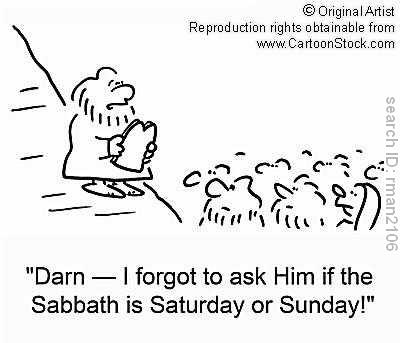
The Scriptures for Sunday Church Services
There are numerous passages in the Bible which show this development in the early church. Here are a few:
In the book of Acts, the early Christians met on the Lord’s Day, on the first day of the week to celebrate the Lord’s resurrection and eventual return (Acts 20:7).
In 1 Corinthians 16, Paul instructed the Christians to take an offering on the first day of the week when they met.
In Revelation 1:10, the apostle John, while in exile on the island of Patmos, held his own little church service on the Lord’s Day, and it was on that day which he received his Revelation about the end times.
Furthermore, in church history, we read that by 115 A.D., Christians had ceased to keep the Sabbath, and lived by the Lord’s Day, the first day of the week. They gathered to sing, study the Word of God, pray, and fellowship together.
If you want to read more about this, I recommend Sabbath in Crisis
This post is based off the Grace Commentary for Luke 6:6-11.

Meeting on the Lord’s Day is proper because I use the rule of Apostolic Precedent. Basically, if they (the N.T. church) does something and didn’t get in trouble for it (because the Apostles were still around), we should do it too.
So we should meet on the Lord’s day.
But the problem lies in the way the Sabbath has been combined by the church over the centuries. I say the the Lord’s Day is work day! God began to create on a Sunday, Jesus rose from the dead on a Sunday. It is the beginning of be productive, not an excuse to watch football.
So two points, there is some requirement if you follow apostolic precedent, second feel free to work second shift or do like the Christians in Egypt do and go to church at 5:00 am so they can work a full day on Sunday!
Johnny,
Interesting idea about apostolic precedent. But apostolic precedent can only take us so far as there are numerous things we can do as part of the church today which was impossible to do as part of the church in the NT era. Like make comments on blog, for example.
I think maybe the principle can work in reverse also. Just because the apostles did something in their time and culture does not mean that we should do it also, since we live in a different time and culture.
Acts 20:7 says they meet //after going out of the Sabbat (Motza-ei Shabbat)that would mean 6:00 pm our time Saturday nite called HAVDALAH fellowship meal, cause Rabbi Shaul (Paul) was to depart the next day (Sunday) morning get your Greek interlinear-same with 1 Corinthians 16:2
In the NT, There are more examples of the church meeting daily than examples of the church meeting on Sunday. Today the church primarily meets on Sunday because of tradition, not the NT.
Alan,
Absolutely true. I was only trying to explain why many “Institutional churches” do not meet on Saturday as their “primary” day.
Didn’t He rise on the first day of the week while it was still dark (ie. their first day of the week–our Saturday evening; “He HAS ALREADY RISEN”!). The first day of the week is tradition alone. a supposition based on a few verses and not enough to formally say or state this as church law. @Alan, I agree with you in that the preserved Word shows they met daily more than they met on Sunday–which is named after the Sun God.
Mark,
I don’t think it would be our Saturday evening, but would be our Sunday morning. Before Sunrise on Sunday.
Jews didn’t have a different first day of the week than the Romans. the Sabbath, or Saturday, was still the seventh day.
So by Jewish calculation, I suppose it was still the seventh day, but by Roman calculation, it was early in the morning on the first day.
My understanding is that the Sabbath went from sundown on Friday to sundown on Saturday. After sundown on Saturday would therefore be the end of the seventh day.
I have read the post and all the comments here on the subject of the Sabbath.
Several times it is mentioned that God instituted the Sabbath as a memorial to the creation. Most people I have heard on this , say the same. And it is found in Exodus Ch 20.
However nobody seems to notice that in Ch 5 of Deuteronomy, it says that God instituted the Sabbath as a memorial for the deliverance of Israel from Egypt ( no mention of 7 days of creation).
So the bible seems to give two different reasons for the Sabbath. Which one is effective.
It just goes to show that the clear teaching of scripture for legalistic interpretations isn’t so clear after all.
Further, in the letter to the Hebrews the NT, the writer appears to relate the Sabbath to entering the “promised land ” presumably an analogy for The Kingdom of God.
I can’t see how the sorting out of days of the week or sundowns or sunsets or ritual rest days has any relevance for the Christian walk. Neither me nor my ancestors were refugees from the Pharoah.
“One man esteemeth one day above another: another esteemeth every day alike. Let every man be fully persuaded in his own mind.” (Romans 14:5)
There is no one day that is more special or holy than any other day for the Christian. Every day is alike for the Christian.
Why is Friday included…..and not Saturday12am to Sunday 12 pm?
Oops meant Saturday12am to Saturday12pm?
As in Jewish a day begin at sunset and ends after sunrise. The bible very clear Matthew 28 the bible says now as the Sabbath day was beginning the women the rested according the commandment
I understand that God, in His Ten Commandments, commanded the Hebrews to work six days and then not to work on the seventh day, in remembrance of God’s creative work. The Hebrews obviously started to count their six plus one day week from the day they were given this divine injunction. By continuity, Christians took over that kind of counting the days of the week but, with the time, wanted to separate themselves somehow from that custom of the Jews. They created their own tradition in this regard and put the day of Jesus’ resurrection as a basis. The Lord’s day in Rev 1:10 seems to relate to Judgment Day rather than to a certain day of the week. There are other references made to the first day of the week, where the word ”first” can also be rendered as ”one”, thus meaning ”on one [day] of the week”. However, in the case of Acts 20:6, 7 it seems that, in Troas, Paul and the disciples came together on the first day of the week, since most scholars agree that Paul was in Troas between 49 and 55 CE. If we add to the last day (Nisan 21) of the 7-day Feast of Unleavened Bread 5 plus 7 days, we come to two different years (52 and 55 CE), of which the year 52 CE seems to be more appropriate, and we get the first day of the week (today we call that Sunday) being the 13th day after Paul left Philippi. Mentioning the Feast of Unleavened Bread seems only to be a time marker, as Jesus didn’t instruct His disciples to continue keeping the Jewish feasts. Breaking the bread on the first day of the week doesn’t relate to keeping any special feast but a common meal. The Jewish religion has nothing to do with Jesus, since they don’t accept Him as the Son of God and the Messiah. In fact, they regard Him as a liar and impostor. Thus, we, Christians, shouldn’t deal too much with their belief. Many Christians tie keeping Sunday to the day of Jesus’ resurrection. As Jesus was resurrected on a Friday (March 28 /Nisan 18/, 31 CE /3791 as per the Hebrew calendar/), this belief seems to be groundless. The truth rules out any debate on Jesus’ resurrection on Saturday or Sunday.:-)
Sandor,
I need to touch up on my one/first translations to know how to respond. Interesting food for thought, though!
The feasts (7) are a shadow of things to come like the earthly tabernacles. Not all the feast shadows have been fulfilled except the Passover and Pentecost. The feast of trumpets and great last day are yet to be fulfilled so we still pay full attention to them.
It may not seem too fair but, reading the posts sent in response to Jeremy’s blog, I still would recommend my article entitled “How Could Jesus Spend Three Days and Three Nights in the Tomb?” available at http://www.faithreaders.com/article-details.php?article=16869 that reveals the exact dates of the major events of Jesus’ earthly life. The article is rather long but addresses as many aspects of the subject as possible. Depsite this obvious endeavor, a theological review where I submitted this article of mine rejected to publish it because “it doesn’t provide a scholarly treatment of the subject”. Please check it out for yourself. BTW if my article revealing and proving facts that have not been known till the very date is not scholarly enough, how scholarly are those articles on this topic, WHICH HAVE NEVER EVER BEEN WRITTEN?!:-)
I’ll add some from Wikipedia http://en.wikipedia.org/wiki/Sabbath_in_Christianity
It seems those in Rome or close to Rome celebrated more on Sundays, where in other parts of the world Christians continued to celebrate on the Sabbath.
“In the 4th century, Socrates Scholasticus Church History book 5 states:[6]
For although almost all churches throughout the world celebrate the sacred mysteries on the sabbath of every week, yet the Christians of Alexandria and at Rome, on account of some ancient tradition, have ceased to do this. The Egyptians in the neighborhood of Alexandria, and the inhabitants of Thebaïs, hold their religious assemblies on the sabbath, but do not participate of the mysteries in the manner usual among Christians in general: for after having eaten and satisfied themselves with food of all kinds, in the evening making their offerings they partake of the mysteries.
”
In the 5th century, Sozomen Church History book 7, referencing Socrates Scholasticus, states:[7]
Assemblies are not held in all churches on the same time or manner. The people of Constantinople, and almost everywhere, assemble together on the Sabbath, as well as on the first day of the week, which custom is never observed at Rome or at Alexandria. There are several cities and villages in Egypt where, contrary to the usage established elsewhere, the people meet together on Sabbath evenings, and, although they have dined previously, partake of the mysteries.
Constantine’s infatuation with the Sun may have something to do with why Sunday won out.
However I suspect we are on the same page that we can and should worship every day.
Jon,
Thanks for the extra information. I love wikipedia! I really wish we could write a Bible Commentary like wikipedia. But it would get full of crazy ideas and would probably be too long to be of any use to anyone.
But I have always dreamed of a “crowdsourced” Bible commentary.
Be careful when reading anything on wikipedia. 🙏
If you will look at Genesis 2:1-3, you will find God created the seventh day as a memorial of His creation of life on the earth. It was given to mankind as a day of rest and meeting with God as was practiced by God as an example to the human race. Exodus 20:8-11 starts the word “Remember the Sabbath day to keep it holy.” Then it states that God rested on that day, blessed it and hallowed it (made it holy). Jesus stated that the Sabbath was “made for man.” He also stated that He was Lord even of the Sabbath day see Mark 2:24 – 28.. That clearly makes the Sabbath Day the Lord’s Day. In Revelation 1:10, the apostle John said he was in the Spirit on the Lord’s day. That day was the same as the Sabbath of creation. Had it not been, there would have been countless examples of believers including apostles who would have proclaimed that the day had changed. Note the absence of any reference to the change in the New Testament. The real fact is the tradition of the Catholic Church who claims to have transferred the Sabbath from Saturday to Sunday. They claim this is their “mark of authority in all religious matters.” Protestants have no reason to observe Sunday which is the first day of the week. The day started as a ritual- worship day by the sun worshippers. It has profound pagan origins. Constantine who had been a sun worshipper made the first Sunday law pertaining to worship on March 7, 321 A. D. Note that Constantine had been a worshipper of the sun. Constantine called the day the “venerable day of the sun god.” You are not honoring God by observing Sunday. To do so is to violate Gods Holy Law. Which other of the Ten Commandments would a Christian rebel against? We cannot use the resurrection of Jesus as an excuse to sin (break his commandments) see I John 3:r4, because the Bible does not command it. Tradition should neither play a part in ones decision to do anything contrary to the Bible. Jesus should be our model and the Bible should be our authority.
I honor all days as belonging to the Lord. “One person esteems one day above another; another esteems every day alike. Let each be fully convinced in his own mind. He who observes the day, observes it to the Lord; and he who does not observe the day, to the Lord he does not observe it….” (Rom 14:4-5).
I do not believe, nor have I ever taught, that Sunday is the Sabbath.
I used to believe the exact same way…then I started to ask the question, “If God is unchangeable, then why would he change?” Paul talks about being grafted in to the commonwealth of Israel if we believe in Jesus. Is Our Father not one with Himself? Jesus came to “pleroo” the law. Greek meaning: fill up, fill to the brim. He says whoever teaches Gods law will be great in the kingdom of Heaven. Will Christ contradict himself? Pray for understanding! The Sabbath is His wedding ring for his betrothed! It’s a sign to the nations
There are numerous other reasons as well that we need not observe the Sabbath. For example, we’re not Jewish. The Sabbath was one of the signs of the covenant God made with the Hebrew people. I am not a Hebrew, therefore, the Sabbath is a not a sign of the covenant God made with me.
There are numerous other reasons as well…
But which did the Father create first? The Hebrew people? Or the Sabbath? The day that he set aside and called holy.
Thank you for Sharing this with me, you are so correct.. I’m battling this issue with friends. I was trying to forward this to a friend. Unable to do so..
What is the reasoning of 7th day adventists
The reason for going to church on Saturday? Because Saturday is the Sabbath (as it has always been).
I’d be interested to hear your take on some within the Church chastising those who are not meeting on Sunday, Christmas Day, December 25, 2022; and are opting to meet on a Saturday Evening Christmas Eve services.
In light of what Romans 14:5-6 says that we must be convinced in our mind what day we come to worship. I don’t believe I am taking this out of context. To miss the Sunday gathering is viewed by some as allowing practicality to be the motivation. What do believe God’s word is on this. I see it was trying to place a believer under the law rather than Grace.
The 7th day of the week is known as “يوم السبت (Yom As-Sabbath)” in Arabic, “Շաբբաթ (Shabbath)” in Armenian, “Sübbôtha” in Bosnian, “Съббота (Sübbôthа)” in Bulgarian, “Dissabte” in Catalan, “Sübbôthа” in Croatian, “Sobotta” in Czech, “Sabbath” in English, “Sàbado” in Filipino, “Samedi” in classic French, “Sábado” in Galician, “შაბათი (Shabati)” in Georgian, “σάββατον (Sàbbáthōn)” in Greek, “Samedi” in Haiti Creole, “יוֹם שַׁבָּת (Yom Shabbat)” in Hebrew, “Szombath” in Hungaria, “Sàbatu” in Indonesian, “Sabato” in Italian, “Ишемби (Shembe)” in Kyrgyz, “Sabbatum” in Latin, “Сабота (Sabоta)” in Macedon, “Sàbatu” in Malay, “Sibt” in Maltese, “Sobota” in Polish, “Sábado” in Portuguese, “Sambătă” in Romanian, “Суббота (Sübbôtha)” in Russian, “Суббота (Sübbôtha)” in Serbian (Cyrillic), “Sobota” in Slovakian, “Sobota” in Slovenian, “Sabetti” in Somalia, “Sábado” in Spanish, “Şenbe” in Turkmens, “Sobotta” in Upper Sorbian (US), “Shanba” in Uzbek, “Cуббота (Sübbôtha)” in Ukrainian and “Sábado” in Yucatec Maya.
Meaning: Saturday is the Sabbath because it is the seventh day (and the “fourteenth day”). The Fourth commandment says that,
“Recall the day of the Sabbath to set him apart. You shall serve and you shall do all your business in six days. Then, the seventh day is a Sabbath for Yahweh your power. Within that day, you shall not do ALL business on that day. Neither you, nor your sons, nor your daughters, nor your slaves, nor your maids, nor your cattle and nor your strangers who is within your gates {will not work on that day}. As Yahweh made the skies, the earth, the waters and everything which are within them in six days and he ceased on the seventh day. So, Yahweh has blessed the Sabbath and he set him apart…..”
You do nit know your Bible Acts 20:7 only said they met on Sunday to break bread . Nothing wrong with this but all they did was eat together not go to a worship. They may have studied the Bible but they din,t have the Lords Supper or communion as you are implying. The Catholic Church changed the divinity of the Sabbath to Sunday. It started in the 321 AD under the Emperor of Rome Constatine. You are misleading many people Mark 2:27 explained the Fact that God made the Sabbath for mankind not just the Jews. Jesus Christ worshiped on Saturday never on Sunday. What is good for him is good for me.
“One of the things this book fails to recognize is that the Sabbath is actually a sign of the Mosaic covenant. Any time God makes a covenant, He provides a sign, or a symbol to go along with it so that we can remember what He has promised.”
Is wrong… The Sabbath was established at creation and is part of Gods moral law, The Ten Commandments, which are not part of the old mosaic law / Moses Law. The Sabbath will be with us in the new heaven and Earth.