
The verse that is most widely used to defend the modern practice of preaching where a person gets up on stage on Sunday morning to teach for 30-40 minutes from Scripture is 2 Timothy 4:2. In this verse, Paul instructs Timothy to “Preach the Word.”

So far, in my series on preaching, we have seen that there is a huge difference between preaching and teaching. In Scripture, preaching was often an open-air, spontaneous proclamation in a (usually) secular setting to announce something about Jesus, the Gospel, and the Kingdom of God.
Teaching, on the other hand, was an interactive discussion among followers of Jesus about Scripture.
Preach the Word
If this is the case, what then do we do with the instruction of Paul to Timothy to “Preach the Word”?
Well, if the distinctions between “preaching” and “teaching” continue to hold true even here, then Paul is instructing Timothy to proclaim, or announce, in a public setting what the Bible says about the arrival of the Kingdom of God in and through Jesus Christ. In other words, the instruction in 2 Timothy 4:2 is not a command to teach believers, but is a command to proclaim the Gospel and evangelize unbelievers. And not surprisingly, the context supports this view, since in 2 Timothy 4:5, Paul instructs Timothy to “do the work of an evangelist.” This work is not something different than preaching the Word, but is identical to it.
Doing the work of the evangelist is equated with preaching the Word. In the New Testament, preaching and doing the work of an evangelist are synonymous, but preaching and teaching the Scriptures are not.
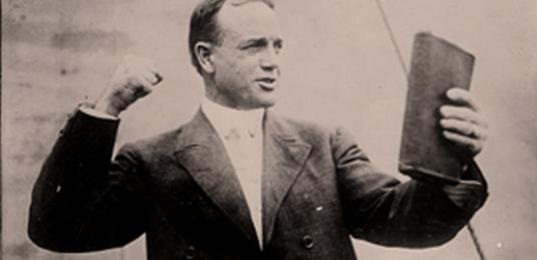
So when Paul commanded Timothy to “preach the Word,” he did not have in mind the same thing that takes place today on Sunday from most church pulpits. Generally, there are two kinds of sermons someone might hear in churches on Sunday mornings. Some churches follow the “preaching” examples in Scripture, and believe that the Sunday morning sermon should be evangelistic. Pastors who preach this way often preach evangelistic sermons, explaining the Gospel, and inviting the people to believe in it. While such a message is similar to biblical preaching, the venue is wrong. A typical church gathering is not a public setting in which there are more unbelievers than believers. Billy Graham’s preaching or a street preacher might be closest to the Biblical model of preaching.
The other kind of sermon one might hear on a Sunday morning is a focused on explaining and applying the Scriptures, which is closer to the “teaching” examples we see Jesus and the apostles engaged in during meetings of believers. However, usually this teaching was an interactive dialogue, rather than one person standing up front presenting a lecture or monologue.
So either way, the modern practice does not fit with the New Testament examples of preaching and teaching.
Why then do we do it? Paul tells us why in 2 Timothy 4:3-4.
Sound Doctrine and Healthy Teaching
Some churches prefer evangelistic sermons every week, and other churches prefer one person to deliver an expositional monologue for one reason: People no longer put up with “sound doctrine” but instead gather around themselves a host of teachers who tell them what their itching ears want to hear (2 Tim 4:3-4).
 In most churches and seminaries today, we are told that this verse means that people will no longer want to attend church to hear the pastor preach a sermon. But is this really what Paul meant? Not even close.
The words which are often translated “sound doctrine” might better be translated as “sound teaching” or better yet, “healthy teaching” (Gk., hugianousa didaskalia), in contrast to unhealthy teaching. What is the difference between the two? It is not that one form proclaims the gospel every week and invites people to “come forward” while another form of preaching does not. Nor is it that one form digs deep into the Hebrew and Greek words of the text, quotes Augustine and Calvin, and uses big theological words, while another form does not. It is not that one church hands out bulletin inserts for note-taking, and another church does not.
No, in the immediate and wider context of Scripture, healthy teaching is that which encourages a person to enter into the world, and live like Jesus among the people of the world. This form of teaching is how one lives out the message of the Gospel and the Kingdom of God that has been believed. Unhealthy teaching is the kind of teaching that causes people to withdraw from the world, while seeking greater, deeper, and more speculative teaching.
Healthy teaching sees love, service, and action in the world as the goal. Unhealthy teaching sees knowledge and more learning as the goal.
Those who follow teachers who give them what their itching ears want to hear are those who are content to gather more and more teachers, listen to more and more sermons, gaining more and more knowledge, and being so busy with Bible study, theological learning, and the accumulation of knowledge, that one never has a chance to put any of it into practice in the world.
Healthy teaching is that which results in action. Unhealthy teaching is that which results in more teaching.
This is the point of Paul in 2 Timothy 4. Paul wants Timothy to lead his church away from simply wanting to get more and more teaching, and instead, take them out into the world, where they can proclaim the Gospel, and put it into practice by loving and serving others, just as Jesus has done for us.
We will look more at this concept in future posts. For now, what do you think and what questions do you have?

Jeremy, I pray that your messages on this subject gains a wide audience. Christian mystic William Law’s “Address to the Clergy” points out how the apostles were not the “learned” but rather fishermen empowered by the Holy Spirit. We would do well to remember that.
Secondly, we should recognize the process that disciples are to go through. The verbiage of Scripture is that of patterns, models, molds, imprinting and conforming. Our Lord Jesus is our model. The Holy Spirit presses us into the mold made from Him. We in turn become models as disciples follow after us. The whole point of the teaching is to make our crookedness straight, our arrow dead center on the bull’s eye image of God, our rebellion squashed at the feet of His rule.
May God empower us by the Holy Spirit to proclaim salvation in the name of our Lord Jesus, the Christ and to thereby become disciples molded in His likeness as the Gospel spreads throughout the world. Amen.
For those whom He foreknew [of whom He was aware and loved beforehand], He also destined from the beginning [foreordaining them] to be molded into the image of His Son [and share inwardly His likeness], that He might become the firstborn among many brethren. ~ Romans 8:29 (Amplified Bible)
I have read that address by William Law. It is good.
Yes, Jesus is our model. I think, however, that He doesn’t want us to copy him, as much as He wants us, through the empowerment of the Holy Spirit, to become who He made us to be.
Then, all together, the church is the Body of Christ.
While I agree with you, I am very doubtful that most churches have any intention to change their current understandings of preaching and teaching. Many churches consider the monologue didactic sermon one of the centerpieces, if not THE centerpiece, of all they are about.
Of course, those churches think they really need to stay the course if they are to attract people and money to the church. Bills for properties, salaries and programs must be paid. People “expect” to sit mesmerized (hypnotized?;lulled to sleep?) by words that tickle their ears each week, do they not?
Loving people is telling them what my preacher says the Bible says, namely that they are immoral sinners who are going to hell. Service is when ten percent of the congregation spends one Saturday morning each year raking leaves for old people. Action is passing out political flyers and putting up yard signs supporting or opposing certain candidates and issues. (All real examples that we have seen many, many times. This stuff would almost be funny if it weren’t so true.)
Sam,
You are right. Few churches, if any, can move away from the monologue sermon, even if the pastor wanted to. Currently, it is too ingrained, too much of a centerpiece of the Sunday service, as you point out.
Also, most people love to be spectators, and get involved as little as possible, and a monologue sermons helps them do that. Sitting and listening to a performance on stage is little different than sitting at home on the couch and watching TV. It requires about as much brain power.
But actually requiring a dialogue, question and answer, interactive discussion about a text of Scripture, which then leads to brainstorming about how everybody can go out and put it into practice in tangible ways, and then actually going out and doing it, requires too much for most people.
So you are right. Few churches will change, which is why new communities and new groups need to rise up and take the lead in living like Jesus in our communities. I believe you are doing this in your community. Thank you for taking the lead!