
 As some of you may recall, I had an ongoing battle with Squirrels in Texas. They were boring holes in my house. Here in New York, my battle has been with mice. They’re nesting in the ventilation system of my Toyota Sienna and Toyota Camry (Yes, we’re a Toyota family).
For the first couple months we were here, I couldn’t figure out why the inside of our cars smelled like grass. Then, in the Sienna, the blower started making a real bad noise, and wouldn’t blow air. I took it in to the Toyota place and they told me it was mice building a nest in the blower motor, and they could remove the nest for me, but it would cost about $200. Yikes! I asked what could be done to keep the mice from doing this later on, and they said, “Nothing.” So I decided not to pay the $200 and just live with it. The grass small wasn’t bad, and the thumping in the blower fan, while annoying, wasn’t going to kill me.
But then last November (2009) a mouse died somewhere inside the ventilation system of my Camry. It stunk so bad, I had to drive everywhere with my windows rolled down — in the middle of winter. The last straw was when I got the opportunity to take my wife on a date, and we gagged all the way to dinner and all the way home. The smell of rotting mice corpses is not recommended for romance. So I took the Camry to Toyota, and again, they said they could clean it out for me, but it would cost an arm, a leg, and my next of kin. And probably, the mice would just come back.
So finally, I took matters into my own hands. I did a little research online and found out that the Camry blower motor has a filter which can be accessed from behind the glove box. I opened it up and pulled out about a quart of nesting material and…six dead, rotting baby mice. So at least this showed me I could clean out the mouse house every time they built a new one in the Camry. Over the past year, I’ve had to clean it out every month or so, and have had to buy a new filter each time also, as they keep chewing it apart for nesting material.
With the Sienna, I had no such luck. I took out the glove compartment (much more difficult), and there was no filter visible, and no way to access the blower motor. So I just to live with it. Thankfully, it never developed the rancid, rotting flesh smell.
Last week, however, the blower completely stopped working in the Sienna. It didn’t burn out; it was just so clogged, no air blew through the ventilation system, and when we turned it on, the vibration literally shook the front half of the car. I happened to need an oil change and state inspection this week, and had a $14.99 coupon at the Toyota dealer, so took it there. I again asked about the blower motor and the nesting mice, and they once again wanted to charge me a couple hundred dollars to clean it out. Since I didn’t want my wife and three girls to drive around in a freezing cold car all winter, and we would need to defrost the windows, so I almost paid them the money.
Wow, am I glad I didn’t! I’m pretty good with tools and machines, and so decided that whatever they were going to do to clean it out, I could do on my own at home. So I got home, took out a few tools, and got to work. It took me all of ten minutes to get access, ten minutes to clean, ten minutes to put wire mesh over the place the mice were getting in so they couldn’t get in again, and then ten minutes to close it all back up. It was so easy, I did the same thing to the Camry today. No more mice, no more mess, no more stinking corpses.
Why am I posting this? I googled “mice building nests in Toyota Sienna or Camry blower motor” and it seems this is a big problem with Toyota cars. Nobody wants to pay a shop a couple hundred bucks to clean out a nest when the mice will just be back a few days later.
So below are a few pictures with a minor explanations of what to do. All you really need is a regular screw driver, a pair of needle-nosed pliers, a socket wrench, and some wire mesh.
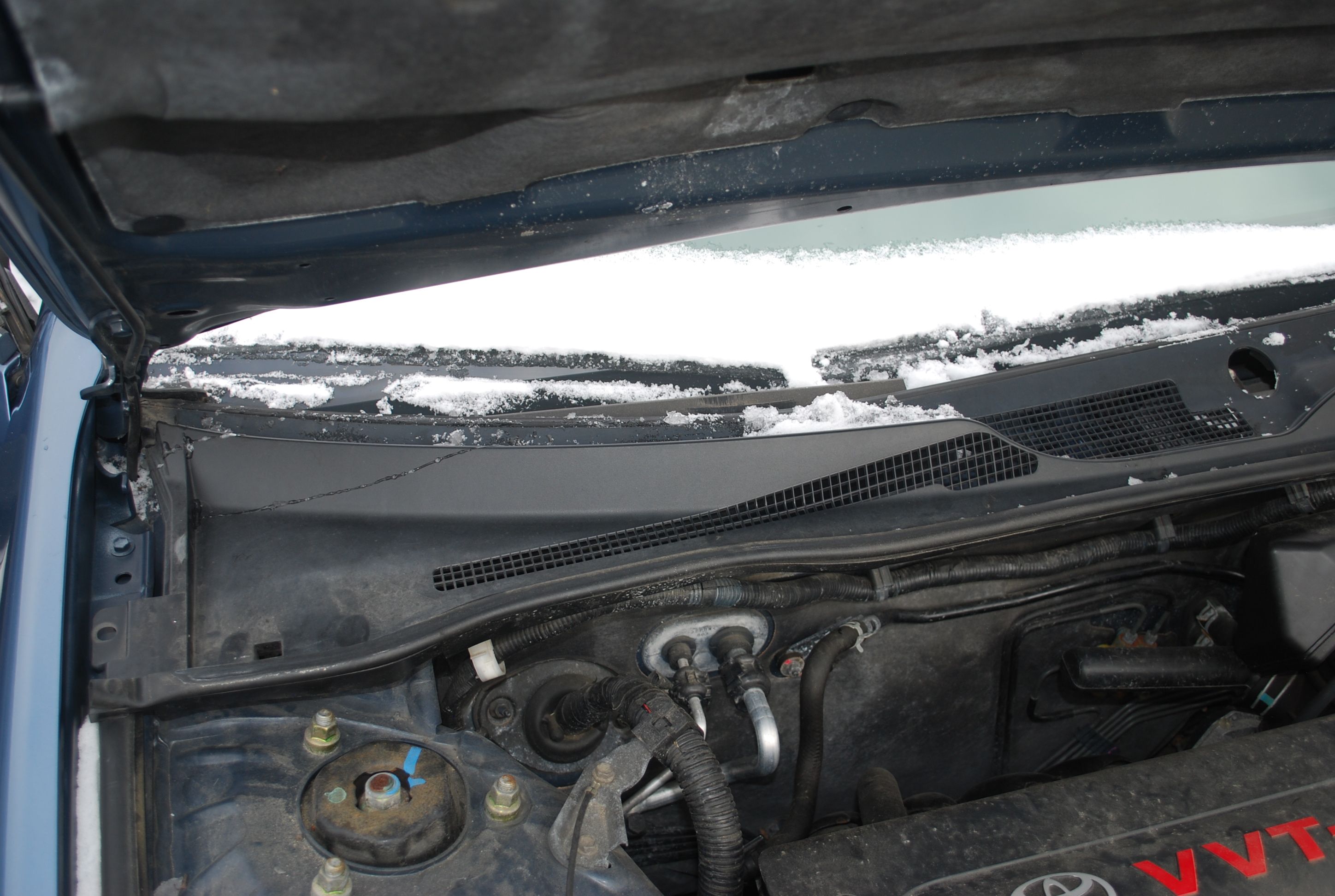
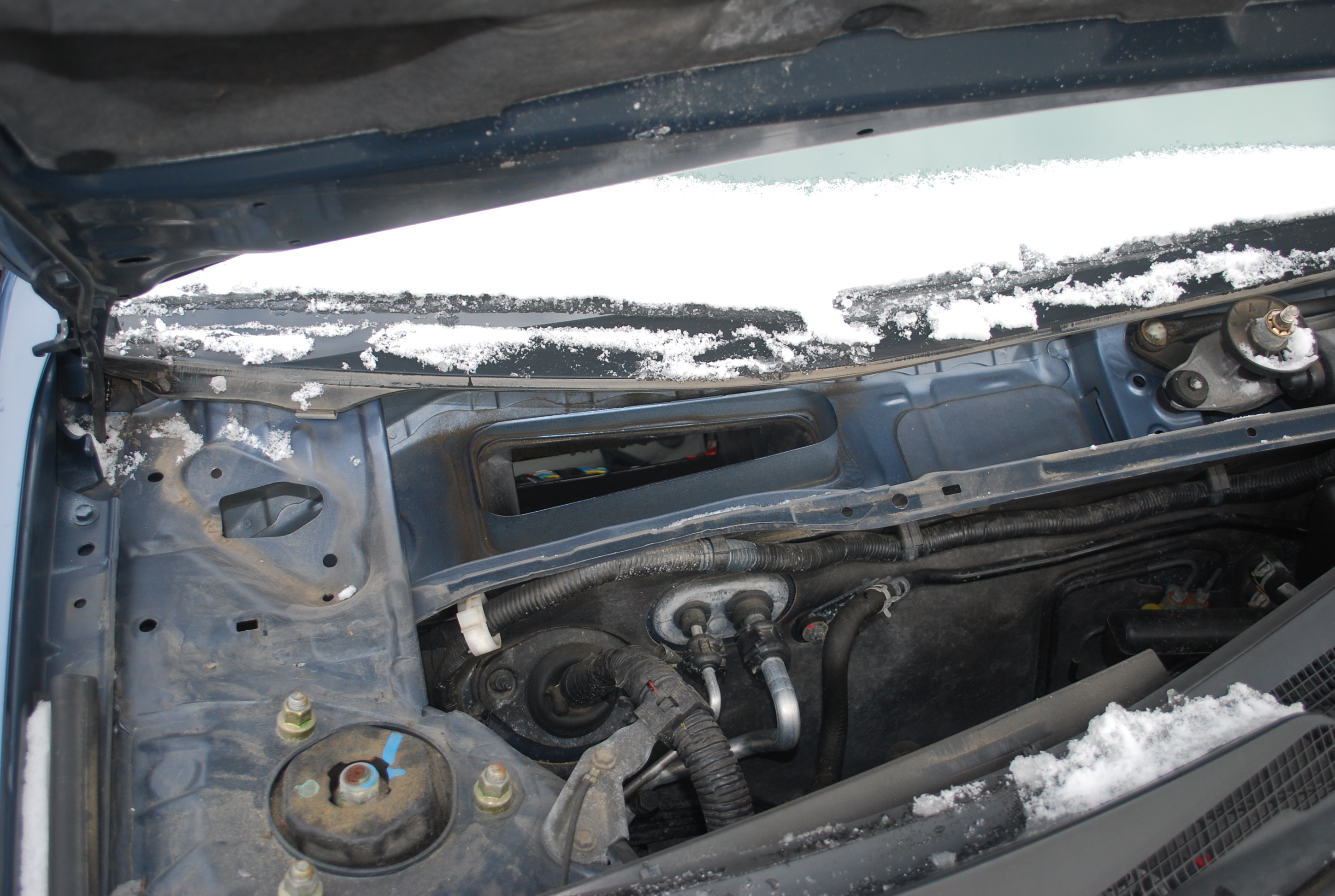

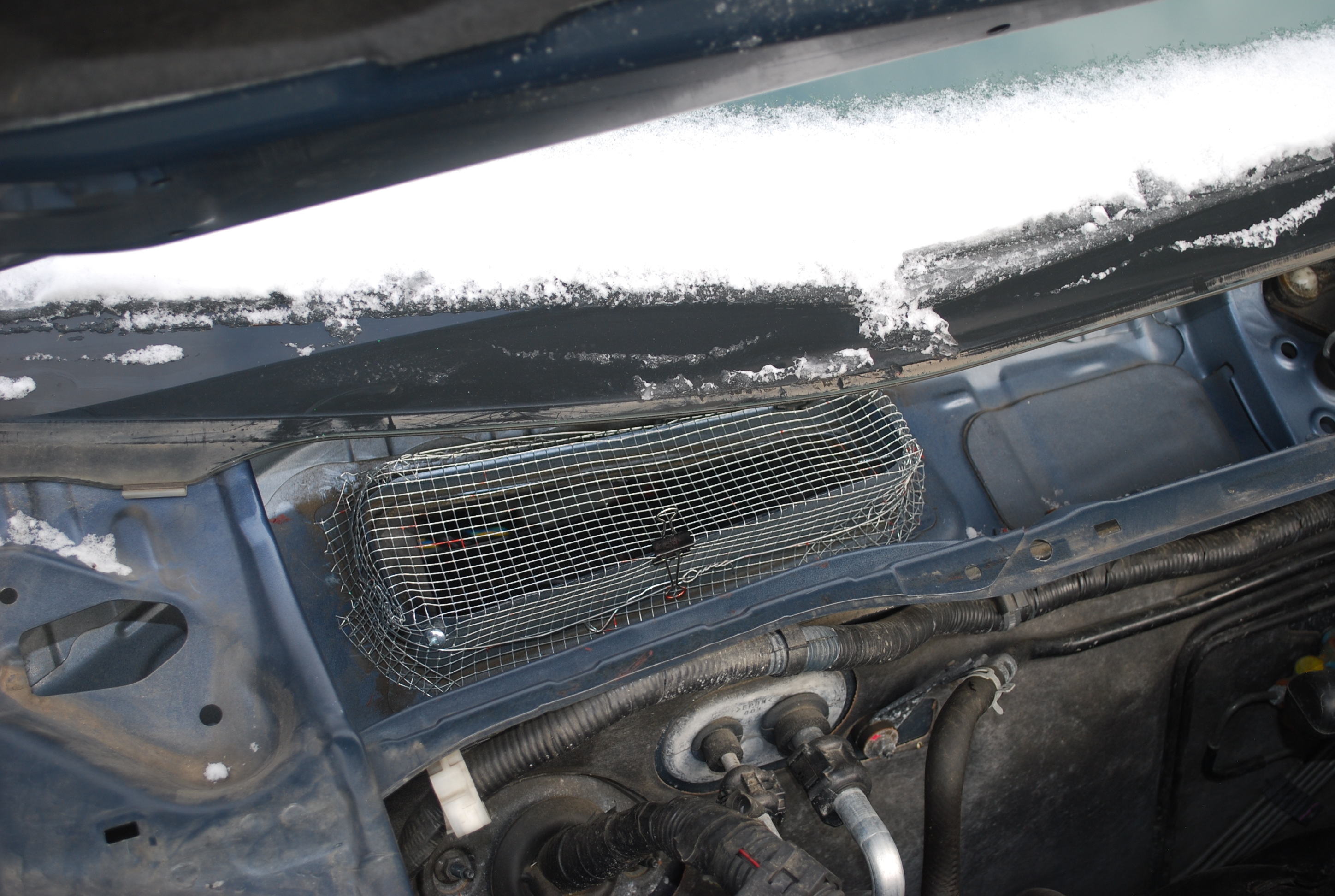
Then, put it all back together, and you’re done! I just saved myself about $400, plus any other damage the mice might have done to my blower fan and ventilation system, and hopefully, the mesh will keep them from coming back. If not, I’ll let you know.

Wow! What a helpful blog! Cool way to fix a mouse problem!
Thank you for this interesting information about Toyota Camry. I will use it!
My Sienna is a different model year from yours, and I had to take off the wiper arms. The intakes were also different, about five smaller ones stretched across the left half of the top of the engine compartment. I used screen material, hoping it won’t restrict airflow too much. I used gaff tape, which is much tougher and stickier and more tenacious than duct tape. It seems to be holding even though the temperature is in the mid-thirties. When it gets warmer I will try to screw down the screen as done in the original post.
Regular mouse traps dispatched the critters that were still in the car. We have mouse doodles all over the car. I suggest wearing a mask when vacuuming the car, in that mouse droppings can carry the hantavirus. Deer mice in the western US carry a particularly nasty version which can cause Hantavirus Pulmonary Syndrome. According to reports, about one out of three who have been diagnosed with HPS have died.
I want to thank the author of this post for his helpful hints. I think we have the problem solved.
It is interesting to note that upon examination, my Corolla already has screens over the intakes.
Tom,
Thanks for the update on your particular model, and the warning about HPS. It is good information.
THanks for the blog. Has it been effective? What model year was your Sienna?
Mark,
Yes, it still works. It is a 2002. I did the same thing on my Camry.
Thanks for the info.
I just got this 2002 Camry with smell. Mouse droppings on top of the filter and have been spraying Febreeze in the intake. But in the morning I will be pulling the cover and making sure they don’t come back.
Thanks and God bless you!
Glad I could help!
Thanks for the info.
Is the water drain horse the only entrance for them to get in? Maybe it is easier to just put a mesh on the water drain outlet?
I suppose you could try that. It might be the only way they are getting in, but I just wasn’t sure, so blocked it the way I shown above.
Very good article. I had a complete wiring harness replaced in my 2005 Camry at my cost of $500 (insurance deductible) as the overall repair bill was over $2500.00. My insurance paid the rest. More recently when I went to change out my cabin filter, it was filled with scraps of paper and rat droppings etc. Now my motor is vibrating bad so I will try to take it out and clean it and do your screen thing on the intake. Thanks for your unselfish distribution of good info.
Hope the guide is helpful for you and you can get rid of those rats!
Thanks for the info! I had the same problem with a 2004 Toyota Sienna. I’d start smelling something odd when running the air circulator, pull the cabin air filter, and find a mouse nest on top.The solution was a bit different for this model year. I have some photos of what I had to do, if you are interested.
We just bought an 04 am to replace the one we totaled by hitting a deer….never had this problem in 6 years with our old one.
Is there a way at to get a live mouse out?
Anyway you could pass along how to do this on an 04?
My 1998 Camry heater blower killed a few mice that got in there. I forgot about one of them once and yes they do smell nasty when rotting ! I never took the time to figure out where they were getting in so thanks.
What I used to do on the camry was take the blower motor out – not too hard but a bit awkward to get at under the glove compartment. Three screws hold it up – two are easy to get out and one not as easy – I eventually left that third screw out – the other two held it up just fine.
I was looking forward to get a car that the mice couldn’t get in – but ended up getting another 1998 Camry ! So far they have only gotten in the trunk but not the heater system But I will go look at the spot you put the wire over because there are mice running around all over where I park the car !
Thanks for the valuable article. I think mice mistakenly tried to live in my Camry 2006 se :). I found some droppings at the cabin filter. Plastic engine cover has quiet a bit mouse poop everywhere. I heard that moth balls are good mouse repellent. I will be storing those in engine area.
Wow you’re awesome. Mice kp getting into my car (01 ford expedition). Finally one day, we use the ac and then a bunch of vibrating. Now theres an awful smell. I attempted to access the blower (which i really dont know its location or how to access), but i dont have the right tools. Now discouraged, hudband says to just take it in. The mice is a continuing problem and from what I’ve seen it is $$$. Oder seems stronger on passenger side but i also smell it from undet yhe hood a little nearing the cowl. I think i will try to look under the cowl before i take it in…if i can figure it out!