
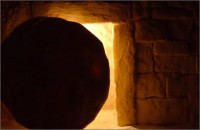
 Many people believe that the resurrection of Jesus proves that Jesus was God. There is one main problem with this view and it is this: the resurrection of Jesus does not prove He was God.
At least, not directly.
Eventually you can get to the divinity of Jesus from the resurrection of Jesus, but it is a little less straightforward than most suppose.
No one would conclude—not then or now—that someone was God simply because they had been raised from the dead. If I came to you and said, “I died in a car accident yesterday, but now I have come back to life,” you might think I was crazy, but even if you believed me, you would not conclude that I was God. One does not logically lead to the other.
So does the Resurrection of Jesus prove He is God?
Well, it is not so much the resurrection of Jesus that proved He was God, but what Jesus said and did before the resurrection which was then verified by the resurrection of Jesus.
I’m not talking about His claims to be God. Critics say He never made such claims. While I believe Jesus did explicitly claim to be God, for the sake of argument, let us just concede the point and move on.
The means by which Jesus implicitly made His claims to be God incarnate was through His actions of replacing the Temple and fulfilling the Torah. In Judaism, the Temple was the closest thing to incarnation that they had. It was where heaven and earth came together as one, where God could meet with man, where sins could be forgiven.
Jesus Replaced the Temple and the Torah
Jesus, through many words and actions indicated that the Temple ministry—including the priesthood and sacrifices—was being relocated in Himself. In forgiving sins, pronouncing lepers clean, and announcing judgment upon the Temple, Jesus was showing that He was the replacement for the Temple.
The same thing happened with the Torah. While many Jewish teachers used tradition and consensus to determine what the Torah meant and how to live it, Jesus simply declared on His own authority what it meant and how to apply it. Furthermore, in many of His teachings, He went beyond the Torah, and offered new commandments and further instructions. In such a way, He not only made the claim of being an infallible interpreter of the Law, but the actual Lawgiver Himself.
Again, some critics will want to deny that Jesus ever said or did such things. But with their constant denials of anything and everything that Jesus did, they very soon leave themselves in a an impossible situation: they are left with a Jesus who does and teaches some nice things, but which would barely get noticed by the populace, much less crucified. Eventually, these critics must give up their denials, or come up with a believable scenario for why Jesus was crucified.
In other words, Jesus had to have said and done something to get people angry enough at Him to crucify Him. If He never claimed to be God, either implicitly or explicitly, and never challenged traditional Jewish thinking or theology, then what possible scenario is there which would have led to His crucifixion?
The Crucifixion of Jesus
I agree with what NT Wright has written. The primary reason for the crucifixion was that “Judaism had two great incarnational symbols: Temple and Torah, [and] Jesus seems to have believed it was His vocation to upstage the one and outflank the other” (NT Wright, Challenge of Jesus, p. 120).
For the early believers, the resurrection of Jesus vindicated these claims of Jesus. For Jesus to make such outlandish claims about God’s Temple and God’s Torah and then to die is not surprising (if He was wrong). That is the just judgment of God.
But for Jesus to make such outlandish claims, and then not only to die, but also to rise from the dead, proves once and for all that God was in what Jesus said and did, and therefore, Jesus was the embodiment, the manifestation, the incarnation of the one God of Israel.
So the resurrection of Jesus by itself does not mean that Jesus was God, but the resurrection of Jesus is one link in the chain that gets us there.
For more on this, read The Challenge of Jesus by NT Wright – Chapter 5. See a fuller treatment in Jesus and the Victory of God.
The cross of Jesus is CENTRAL to everything!
Transform your life and theology by focusing on the crucifixion and resurrection of Jesus:
Fill out the form below to receive several emails from me about the death and resurrection of Jesus.
(Note: If you are a member of RedeemingGod.com, login and then revisit this page to update your membership.)

Does the Resurrection of Jesus Prove He is God? See Romans 1:4. If Jesus is the Son of God, He is God. You give a long answer and a wrong answer for a simple question.
Are you saying that the resurrection proves Jesus is God?
Then is Lazarus God? God raised him from the dead too. Or what about Talitha?
Remember that the title “Son of God” does not always equal “God.” https://redeeminggod.com/what-does-son-of-god-mean/
One thing i learned about Theology, that it is not for the common people to interpret a verse or build theories about GOD, there are qualified people who dedicated there lives to study Theology and learning from the wisdom of those which teach them.
And i must admit that i am not qualified to speak about Theology.
But for a common person i see that the logic of saying that resurrection of Jesus does not prove that Jesus was God is totally flawed.
Starting with one fact :
Jesus is GOD.
Jesus came for all humans salvation, but only those who believed in him and lived by his teachings shall be worthy for entering the kingdom of heaven.
Back to the Resurrection, he simply resurrected himself by himself only a GOD can do this, did this happened to any dead person, did the dead Lazarus woke alone from the death, it was Jesus who resurrected him.
Where in the the bible that it mention that his followers prayed for his resurrection, or didn’t the bible said that his disciple remembered what his said about his OWN resurrection.
John 2:22 ” When therefore he was risen from the dead, his disciples remembered that he had said this unto them; and they believed the scripture, and the word which Jesus had said ”
So, Jesus spoke about his own Resurrection ” also prove that he knew about his death in the first place “, did the bible mentioned any dead person telling about his death and resurrection.
At crucifixion, there was signs that he was a GOD, darkness of three hour periods in the middle of the day.
Matthew 27:45 ” Now from the sixth hour there was darkness over all the land unto the ninth hour. ”
After Jesus death didn’t the bible said that the the curtain of the temple was torn apart, an earthquake shook the earth.
Matthew 27:51 ” And, behold, the veil of the temple was rent in twain from the top to the bottom; and the earth did quake, and the rocks rent; ”
Didn’t the dead saints resurrected and appeared to many people after Jesus death and resurrection.
Matthew 27:52 ” And the graves were opened; and many bodies of the saints which slept arose ”
Matthew 27:53 ” And came out of the graves after his resurrection, and went into the holy city, and appeared unto many “.
The roman centurion themselves said that Jesus was the Son of God.
Matthew 27:54 ” Now when the centurion, and they that were with him, watching Jesus, saw the earthquake, and those things that were done, they feared greatly, saying, Truly this was the Son of God ”
So, after all this his resurrection does not prove that he is GOD ?!!!
Finally, why dear Mr Jeremy Myers, there are no reference to any verse in your article ?
Waheed,
I do believe Jesus is God. Do not misunderstand the point of the post. I am fully convinced that Jesus is 100% divine.
As to scripture references, I leave them out intentionally. I should probably write a post explaining why, since I get this accusation a lot.
But look, here is the issue: many people in the Bible were raised from the dead. Why do you not believe that they were God incarnate?
Also, if you want to prove that Jesus is God, you cannot begin by stating the fact that Jesus is God.
Dear Mr Jeremy Myers.
My reply was to prove that your statement about that “the resurrection of Jesus does not prove He was GOD”, is not correct, and i gave a few verses to make my reply with evidence from the bible.
Now to the “issue” of many people in the Bible were raised from the dead. Why do you not believe that they were God incarnate?
I guess for 2 reasons, they didn’t wake themselves from the death by themselves, and they died again finally.
I guess again and correct me if i am wrong that these 2 reasons do not apply on Jesus resurrection.
Happy Easter.
Jesus didn’t “raise himself.” The Bible pretty clearly states that “God raised Him from the dead” (Acts 2:24; 13:30, etc). God also raised the others people from the dead.
As to not dying after the resurrection, that may be true of the others who have already died, but when we are raised from the dead in the future resurrection, we will not die afterwards. Does that mean we will then be God incarnate?
Many people have ‘come back from the dead’ but Jesus is the only one I know of who did so after being dead for 3 days. Jesus and others have used God’s power to raise others from the dead but only Jesus raised Himself. I would agree, however, that His crucifixion and resurection were confirmations of prophecy.
Yes, they confirmed prophecy, and that is a good point about being dead for 3 days. It probably helps explain a different (but related) question of mine about why Jesus was in the grave for 3 days.
The pharisees knew of the 3 day prophecy and set up guards at the tomb to prevent anyone from stealing the body and making a claim of resurection. Boy, were those guards in for a surprise. 😉
The only author in the Bible who mentions anything about guards being at the tomb, Matthew, says that the guards were not posted until the next day after Jesus body had been placed in the tomb, and, even though Joseph of Arimethea had rolled a great stone in front of the tomb, he had not sealed it. So, the tomb of Jesus was left unguarded and unsealed the entire first night, in the darkness, and probably part of the next day. That would provide ample time and ample opportunity for someone to have moved or stolen the body.
So even if the biblical account of the “guards at the tomb” story is correct, the fact that there is a time period when the tomb was left unguarded, blows a hole in the Christian claim that a resurrection is the best explanation for the empty tomb and the disciples’ belief that Jesus had been resurrected. For instance, if grave robbers had taken the body, the Jews would say that the disciples took the body and the disciples would say that Jesus had fulfilled his prophecy and had risen from the dead.
Christian apologists use the alleged “fact” of an empty tomb as their trump card for evidence for the Resurrection.
Let’s assume that the entire account in Matthew regarding Aramathea burying Jesus in his private tomb, the great stone in front of the door, and the Roman guards are all fact. Let’s assume that on Sunday morning the women really did find an empty tomb. How strong of evidence is this “fact”? I assert that the empty tomb is only strong evidence IF Christians can prove that the body was guarded 24/7 from the very moment that Aramathea placed Jesus’ body in the tomb to the moment the women found the tomb empty.
If there is even a ten minute window when the tomb was unguarded, that is enough time for a group of men to roll back the stone, grab the body, and make off with it. Christians will assert that NO ONE would do this for a long list of reasons, including breaking the Sabbath. I assert that Jews breaking the Sabbath is much more probable than that an invisible middle-eastern deity reanimated the dead body of a Jewish prophet and sent angels to move back the stone. Yes, in a world where anything is possible, the latter is possible, but it just is not probable. It is much more probable that devout Jews would break the Sabbath. We have evidence of the disciples breaking the Sabbath in the Gospels, so why not do it again? Also, maybe it wasn’t the disciples. Maybe it was some of Jesus’ family who wanted the body buried in Galilee. Or maybe it was just grave robbers who thought they could make a profit selling the remains of a messiah pretender. Maybe a small group of the Sanhedrin didn’t like the idea of a blasphemer being buried in a respectable tomb, so they stole the body and tossed it into a hole, and did not tell the high priest and the other members. Or, maybe Aramethea only put the body in his tomb until Sabbath was over. After sunset Saturday night, with Pilate’s permission, he removed the body and threw it into an unmarked grave.
Again, all of these scenarios are much more probable than the Christian supernatural explanation. Bottom line: We do NOT have evidence that the tomb was guarded 24/7 from the moment that Aramethea placed the body in the tomb and rolled the stone in front until the women found the tomb empty on Sunday morning. Below is the passage from Matthew:
Now when evening had come, there came a rich man from Arimathea, named Joseph, who himself had also become a disciple of Jesus. 58 This man went to Pilate and asked for the body of Jesus. Then Pilate commanded the body to be given to him. 59 When Joseph had taken the body, he wrapped it in a clean linen cloth, 60 and laid it in his new tomb which he had hewn out of the rock; and he rolled a large stone against the door of the tomb, and departed. 61 And Mary Magdalene was there, and the other Mary, sitting opposite the tomb.
Pilate Sets a Guard
62 On the next day, which followed the Day of Preparation, the chief priests and Pharisees gathered together to Pilate, 63 saying, “Sir, we remember, while He was still alive, how that deceiver said, ‘After three days I will rise.’ 64 Therefore command that the tomb be made secure until the third day, lest His disciples come by night[m] and steal Him away, and say to the people, ‘He has risen from the dead.’ So the last deception will be worse than the first.”
65 Pilate said to them, “You have a guard; go your way, make it as secure as you know how.” 66 So they went and made the tomb secure, sealing the stone and setting the guard.
Perhaps the disciples, the Romans or unknown people did steal the body of Jesus and hide it, throw it in a pit or unmarked grave or whatever. On the other hand, would not Jesus’ followers dissipate once they knew that Jesus’ teachings, his promises had come to naught? Why would they continue following a dead Jesus? Why would most of them continue to the point of being executed themselves? That does not make sense to me. I don’t see much evidence that they did it for fame and fortune. Some have profited from the Christian religion in the two thousand years that have come and gone since Jesus was executed, but I don’t see where his disciples did.
I understand that for many Christianity is merely another religion, a way some of the human race copes with the short time accorded us in this plane. Some people really “need” a coping mechanism. Then there are others, myself included, who have encountered a living Jesus. We “see” him. You may think we imagine. Then again, perhaps we really do see what you do not. Otherwise why do we follow? For some of us, it is not for fame, fortune or anything like that. It is very real for us, a very real relationship. That relationship also makes others valuable in our eyes, not for what you can do for us, but because of what Jesus did for all of us. God showed up in person to show us who he really is, knowing that the human race would murder him. And yet he loved so much, valued us so much, that he came, knowing what we would do to him. That proves to me that you are worth being loved, and are loved by the guy I don’t think lies somewhere in an ancient grave. If you are worthy of his love, you are worthy of mine.
Why would the disciples believe that the teachings of Jesus were false if grave robbers, Romans, Jews, or others, stole the body, unbeknownst to them? All they know is that the tomb is empty on Sunday morning.
I do not believe that the early Christians were liars. I believe that they were sincere, devout people who were simply mistaken.
I frequently hear Christians appeal to their inner feelings and personal experiences as evidence for the existence of a resurrected first century Jewish prophet living inside of them. I’m not being flippant, but I ask you to consider this:
Young children sometimes develop an “imaginary friend”. This imaginary friend provides them with significant emotional and psychological comfort, but yet you and I know that this invisible friend is a figment of the child’s imagination. The comfort and security that the imaginary friend gives the child is very real, but the friend is not.
Is it possible that this is what you feel and experience in your relationship with your invisible “friend”?
It wasn’t just an empty grave that convinced the disciples. It was their claim that the risen Jesus appeared to Mary at the tomb, to two of the disciples on the road to Emmaus, to at least eleven disciples in a locked room in Jerusalem, later to Thomas, then again to the disciples by the Sea of Tiberius, and apparently on other occasions over a forty day period, then finally at “the ascension” (however one understands his last appearance to them).
Perhaps you have had imaginary and invisible friends. I have not, neither as a child nor as an adult. I do, however, remember reading a book written by a researcher about the imaginary friends of very small children. His research, which included interviews, found numerous accounts of small children who had imaginary friends, some of which were long-deceased ancestors, and sometimes other deceased people, people about whom the family knew nothing. Many of the imaginary friends told the small children their names, as well as additional information about themselves. Some of the families, and sometimes the researcher looked up the imaginary friend and discovered that such a person had once lived, and then discovered that the info the two or three year old child told them was accurate to a detail. Maybe some imaginary friends are imaginary only to others. I don’t attempt to explain that book. (I do not remember the name of the book. I have read thousands of books, and own a couple of thousand, many packed in boxes.)
Do you believe only what you can see? Maybe it is only imaginary and the “real” is invisible to you. Even if you think you see it, touch it, taste it, hear it, smell it, maybe you are only imagining those things. Maybe the world and everything and everyone in it exist only in your imagination. Perhaps your mind created it all. How can you know it did not? You must decide what you choose to believe is real, as do I. I cannot convince you of the correctness of my choices, nor can you convince me of the correctness of yours.
Have you read C.S. Lewis’ “Till We Have Faces”? What was the “real” and the “imaginary” in that story? Even when we think we have it all figured out, might we too change our minds, as did Queen Orual (at the end of her life), Queen of Glome “who was the most wise, just, valiant, fortunate and merciful of all the princes known in our parts of the world”, as attested by Arnom, priest of Aphrodite. You may find the story a good read. Many of Lewis’ fans say this is their favorite Lewis story.
What proof do you have that your invisible friend is any more real than a child’s imaginary friend?
As I said, I do not have and never have had invisible or imaginary friends.
If you believe that a dead first century prophet lives inside of your body and gives you signals regarding life decisions, by every definition, you have an imaginary friend, my friend.
Good thing I don’t believe that then.
Great. Then you are one step closer to reality.